Diamond Lemon Cheesecake Domes with Crystal Mirror
“`html
Table of Contents
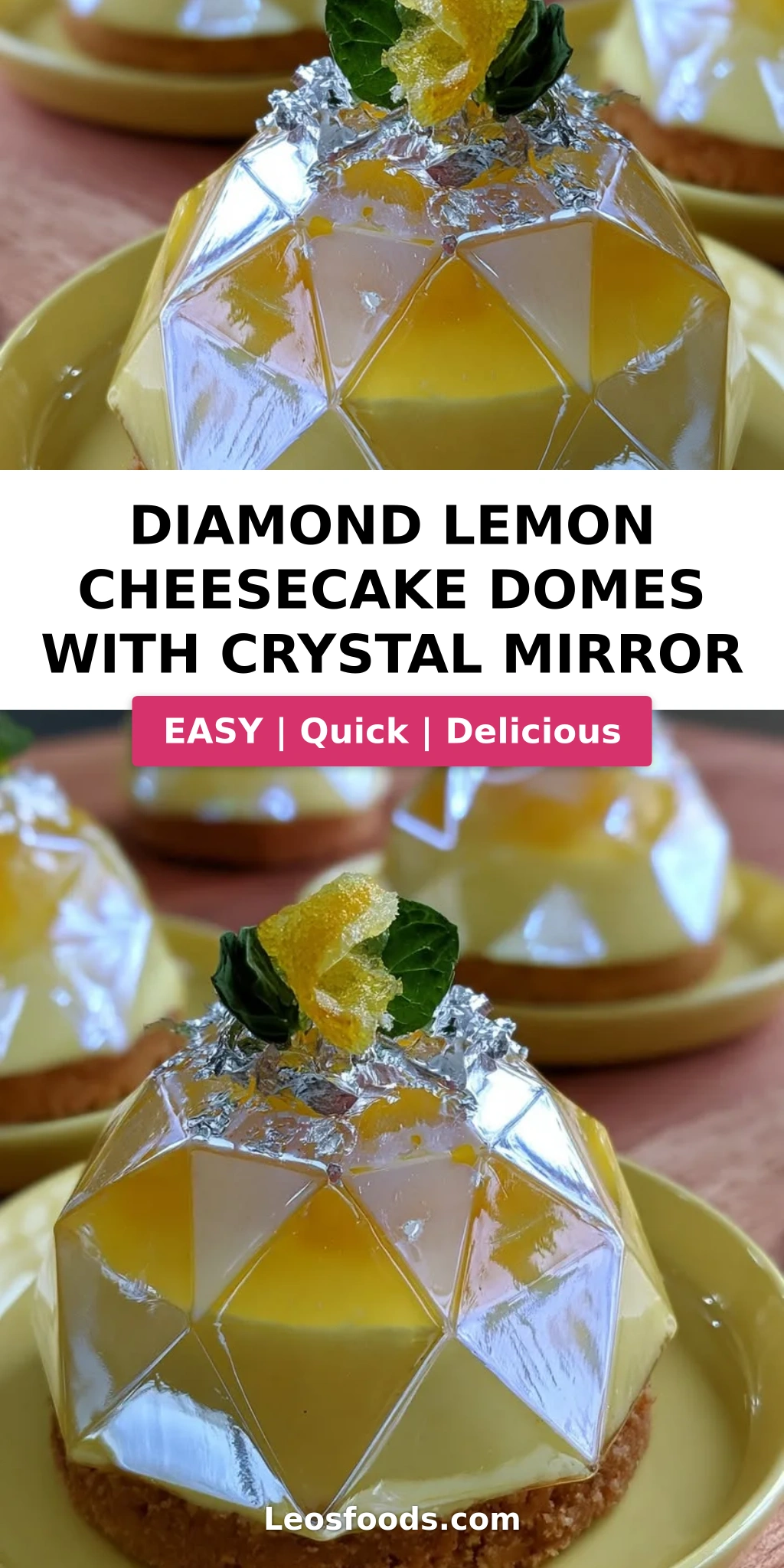
Diamond Lemon Cheesecake Domes with Crystal Mirror – A Jewel-Like Dessert That Steals the Show
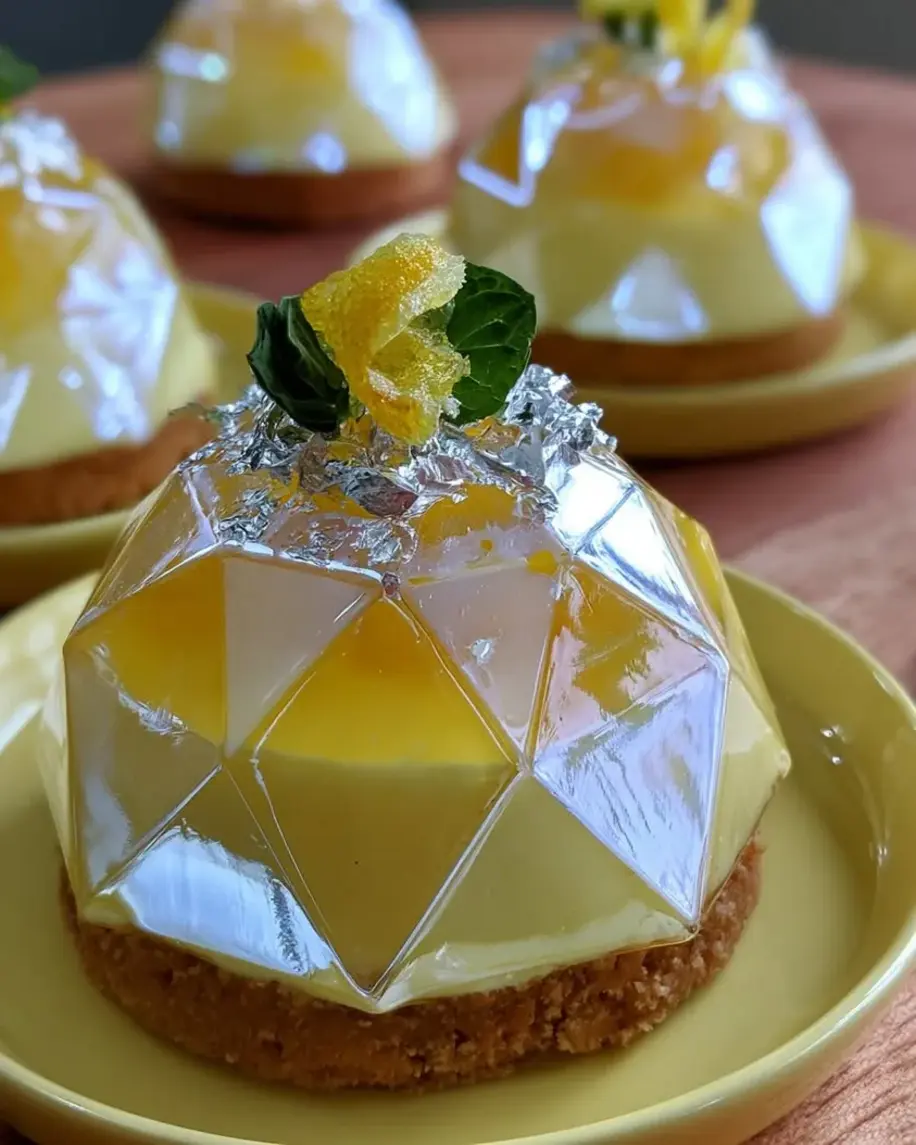
I still remember the first time I saw a mirror-glazed dessert in a Parisian pâtisserie window — a perfect dome of passion fruit mousse, gleaming like a polished gem under the soft lights of the 6th arrondissement. I stood there for a full minute, my nose pressed against the glass, wondering how on earth anyone could make a dessert look so much like jewelry. That memory came rushing back years later, here in my NYC kitchen, as I perfected these Diamond Lemon Cheesecake Domes with Crystal Mirror. This diamond lemon cheesecake domes recipe is my love letter to that Parisian moment — except I’ve added my own Moroccan warmth with bright, sun-kissed lemon and a hidden curd core that surprises you with every spoonful. The crystal mirror glaze isn’t just for show; it seals in a silky, tangy cheesecake that’s pure elegance on a plate.
When you crack through that glossy mirror surface, you’ll find a cloud-light lemon cheesecake filling that’s both rich and refreshing. The lemon curd core — hidden like a little treasure in the center — bursts with brightness, balanced by the buttery biscuit base that gives each dome a satisfying crunch. I’ve tested this recipe at least a dozen times, tweaking the gelatin ratios and chilling times until the texture was exactly right: firm enough to hold its shape when glazed, yet creamy enough to melt on your tongue. The crystal mirror glaze is a thing of beauty — smooth as glass, with a faint vanilla sweetness that doesn’t overpower the lemon. These domes are the kind of dessert that makes people gasp when you bring them to the table, and I mean that literally.
What sets this diamond lemon cheesecake domes recipe apart from other lemon cheesecake domes recipes is the technique I developed for the mirror glaze — cooling it to exactly 90°F ensures that perfect, streak-free shine every time. I learned that precision during my pastry training in Paris, where our chef would refuse to serve a glaze that wasn’t absolutely flawless. But don’t let the fancy name intimidate you: I’ve broken everything down into clear, manageable steps, and I’ll share my best tips so you can achieve that same crystal-clear finish at home. The secret is in the gelatin bloom and the patience to let the domes freeze fully — trust me, the payoff is worth every minute. Let me show you how to make these beauties yourself.
Why This Diamond Lemon Cheesecake Domes Recipe Is the Best
The Flavor Secret: Most lemon cheesecake domes recipes rely on lemon extract or bottled juice, but I insist on fresh lemon zest and juice — the same way my mother taught me back in Morocco, where we’d use lemons from the garden in everything from tagines to desserts. The zest brings essential oils that give the cheesecake a true lemon aroma, while the juice provides just enough acidity to cut through the cream cheese richness. The hidden lemon curd core adds an extra layer of intensity that makes every bite feel like a discovery. This isn’t just a lemon dessert; it’s a lemon experience.
Perfected Texture: The magic of this crystal mirror cheesecake domes lies in the gelatin technique. I bloom the gelatin in cold water for exactly five minutes before dissolving it into warm cream — this ensures a silky-smooth cheesecake filling without any rubbery spots. The mirror glaze, too, requires the same attention: blooming the gelatin properly and cooling the mixture to just the right temperature before pouring. My Parisian chef used to say that gelatin is the unsung hero of elegant desserts, and he was right. When done correctly, the result is a dome that’s firm enough to unmold cleanly but melts luxuriously in your mouth.
Foolproof & Fast: Despite its showstopping appearance, this edible mirror glaze dessert is surprisingly approachable for home cooks. I’ve streamlined the steps so that the active work is only about 50 minutes — the rest is freezer time, which does the heavy lifting for you. The biscuit base requires no baking, the cheesecake filling comes together in one bowl, and the mirror glaze is simply a matter of heating, stirring, and cooling. I’ve tested this recipe with beginner home bakers in my NYC cooking classes, and every single one of them has walked away with a gorgeous dome. If you can stir and pour, you can make these.
Diamond Lemon Cheesecake Domes Recipe Ingredients
I picked up the lemons for this recipe from the Union Square Greenmarket last weekend — they were so fragrant that I could smell them from three stalls away. It reminded me of the souk in Marrakech, where pyramids of citrus sit under striped awnings and the air is thick with the scent of sunshine. For the white chocolate, I head to my favorite baking supply shop in Chelsea; they carry a Belgian brand that melts like silk. The rest of the ingredients are everyday staples you’ll find at any US grocery store. Let me walk you through everything you need for this crystal mirror cheesecake domes recipe.
Ingredients List
- For the Lemon Cheesecake Filling:
- 8 oz cream cheese, softened
- 1/2 cup granulated sugar
- 1 cup heavy cream
- 2 tbsp fresh lemon juice
- 1 tsp lemon zest
- 1 tsp vanilla extract
- 2 tsp powdered gelatin
- 3 tbsp cold water (for blooming gelatin)
- For the Lemon Curd Core:
- 3/4 cup lemon curd (store-bought or homemade)
- 1 tsp lemon zest
- For the Biscuit Base:
- 1 cup digestive biscuits, finely crushed (about 8–9 biscuits)
- 3 tbsp unsalted butter, melted
- For the Crystal Mirror Glaze:
- 1 cup granulated sugar
- 1/2 cup water
- 1/2 cup sweetened condensed milk
- 1 cup white chocolate, finely chopped
- 1 tbsp powdered gelatin
- 3 tbsp cold water (for blooming gelatin)
- 1 tsp clear vanilla extract
- For Garnish (optional but stunning):
- Candied lemon peel
- Edible silver flakes
- Micro mint leaves
Ingredient Spotlight
Cream Cheese: This is the backbone of your cheesecake filling. Use full-fat block cream cheese (not the spreadable kind in a tub) for the richest texture and best structure. Philadelphia is my go-to brand because it has the right balance of fat and stabilizers. Let it soften at room temperature for about 30 minutes before mixing — cold cream cheese creates lumps that no amount of beating will fix. If you’re dairy-free, you can use a plant-based cream cheese block, but the texture will be slightly less firm, so add an extra 1/2 tsp of gelatin.
White Chocolate: The mirror glaze relies on white chocolate for its glossy finish and creamy sweetness. Choose a high-quality white chocolate with cocoa butter (not palm oil) — I like Valrhona or Callebaut. Chop it finely so it melts evenly into the hot glaze mixture. White chocolate chips often contain stabilizers that can make the glaze grainy, so stick with a bar and chop it yourself. For a vegan version, use a high-quality dairy-free white chocolate; the glaze will be slightly less shiny but still beautiful.
Gelatin: This is the secret to both the cheesecake structure and the mirror glaze. Use powdered gelatin (like Knox) for consistent results. Blooming it in cold water for exactly 5 minutes is crucial — this step hydrates the gelatin so it dissolves smoothly without lumps. Never add gelatin directly to hot liquid without blooming first, or you’ll end up with a stringy, uneven texture. For a vegetarian alternative, agar-agar can work, but the setting properties are different; I’ll cover that in the FAQ.
Lemons: Fresh lemons are non-negotiable here. You need both the zest and the juice, so buy organic if you can — you’ll be using the zest directly in the cheesecake and the curd. One large lemon yields about 2–3 tablespoons of juice and 1–2 teaspoons of zest. Roll the lemon on the counter before juicing to release more juice. Never use bottled lemon juice; it has a flat, metallic flavor that ruins the freshness of this dessert. Meyer lemons, when in season, add a lovely floral sweetness.
| Original Ingredient | Best Substitution | Flavor / Texture Impact |
|---|---|---|
| Cream cheese (full-fat block) | Neufchâtel or dairy-free cream cheese block | Slightly less rich; dairy-free version needs extra gelatin for structure |
| Digestive biscuits | Graham crackers or shortbread cookies | Graham crackers are sweeter and slightly more honey-flavored; shortbread is buttery and less sweet |
| White chocolate (cocoa butter based) | High-quality dairy-free white chocolate | Glaze may be slightly less glossy; flavor is similar but less creamy |
| Powdered gelatin | Agar-agar (vegetarian) | Firmer, more brittle set; requires different blooming and heating method |
How to Make Diamond Lemon Cheesecake Domes — Step-by-Step
Now let’s get to the fun part. I’ve organized these steps so you can work efficiently — the biscuit base comes together in minutes, the cheesecake filling is a breeze, and the mirror glaze is where the real magic happens. Take your time with the freezing steps; they’re essential for that perfect dome shape. Here’s how to make this lemon cheesecake domes recipe like a pro.
Step 1: Make the Biscuit Base
Crush the digestive biscuits into fine crumbs — I use a food processor for speed, but a zip-top bag and rolling pin work beautifully too. You want a uniform crumb with no large chunks. Mix the crumbs with melted butter until every particle is moistened. Press about 1 tablespoon of the mixture into the bottom of each dome mold, using the back of a spoon or a small glass to compact it firmly. Pop the molds into the freezer for 15 minutes to set the base while you prepare the filling.
💡 Stella’s Pro Tip: For a cleaner edge on your domes, chill the biscuit base in the freezer for a full 20 minutes before adding the cheesecake filling. This prevents the crumbs from mixing into the cream cheese layer and keeps that distinct base line.
Step 2: Bloom the Gelatin for the Cheesecake
In a small bowl, sprinkle the 2 teaspoons of powdered gelatin over 3 tablespoons of cold water. Stir gently with a fork to ensure all the gelatin is wet. Let it sit for 5 minutes — it will thicken and become a firm, jiggly mass. This blooming process is essential for smooth, lump-free gelatin. While it blooms, gather your cheesecake ingredients so everything is at hand.
⚠️ Common Mistake to Avoid: Don’t rush the bloom time. If you add gelatin to the cream before it’s fully hydrated, you’ll get white specks or a grainy texture in your cheesecake filling. Set a timer for exactly 5 minutes.
Step 3: Make the Cheesecake Filling
In a large mixing bowl, beat the softened cream cheese with an electric mixer until smooth and creamy — about 2 minutes on medium speed. Add the sugar, lemon juice, lemon zest, and vanilla extract, and beat until fully combined and fluffy, about 1 minute more. In a separate small saucepan, warm about 1/4 cup of the heavy cream over low heat until it’s just steaming (not boiling). Remove from heat and whisk in the bloomed gelatin until fully dissolved. Stir this gelatin-cream mixture into the cream cheese base until evenly incorporated. In a separate chilled bowl, whip the remaining 3/4 cup heavy cream to soft peaks — when you lift the whisk, the cream should droop slightly but hold its shape. Gently fold the whipped cream into the cream cheese mixture in three additions, using a rubber spatula and a light hand. The filling should be silky and airy.
💡 Stella’s Pro Tip: When folding the whipped cream into the cream cheese base, use a figure-eight motion and scrape the bottom of the bowl with each pass. This ensures the mixture stays aerated without deflating the cream. Stop folding as soon as no white streaks remain — over-folding will make the filling dense.
Step 4: Assemble the Domes with Lemon Curd Core
Remove the dome molds from the freezer. Spoon or pipe the cheesecake filling into each mold until it’s about halfway full. Place a small spoonful (about 1 tablespoon) of lemon curd mixed with a pinch of lemon zest into the center of each dome — this will be the hidden surprise. Then cover the curd completely with more cheesecake filling, filling each mold to the top. Use a small offset spatula or the back of a spoon to smooth the tops flat. Tap the molds gently on the counter to release any air bubbles. Freeze the filled domes for at least 6 hours or overnight — they must be completely solid before glazing.
⚠️ Common Mistake to Avoid: The lemon curd core must be fully enclosed by cheesecake filling — if any curd touches the edge of the mold, it will leak out during unmolding and ruin the dome shape. Make sure there’s a layer of filling under and over the curd.
Step 5: Make the Crystal Mirror Glaze
Bloom 1 tablespoon of powdered gelatin in 3 tablespoons of cold water for 5 minutes. In a medium saucepan, combine 1 cup sugar, 1/2 cup water, and 1/2 cup sweetened condensed milk. Heat over medium heat, stirring occasionally, until the mixture is steaming and the sugar has dissolved — about 3–4 minutes. Do not let it boil vigorously. Remove from heat and add the bloomed gelatin, stirring until completely dissolved. Add the finely chopped white chocolate and stir until the mixture is smooth and the chocolate has fully melted. Add the clear vanilla extract and stir. Use an immersion blender to blend the glaze until it’s completely smooth and glossy — this step is key for that mirror shine. Pour the glaze through a fine-mesh strainer into a clean bowl to remove any undissolved bits. Let it cool to 90°F (32°C), stirring occasionally. You can speed this up by setting the bowl over an ice bath, but watch it carefully — you don’t want it to set.
💡 Stella’s Pro Tip: The temperature of the glaze is everything. At 90°F, it’s fluid enough to coat the frozen dome evenly but thick enough to cling without running off. Use a digital thermometer for accuracy — I keep one clipped to my saucepan at all times during this step.
Step 6: Glaze the Frozen Domes
Remove the frozen domes from the molds by gently pressing on the bottom of each mold. If they’re stubborn, dip the mold in warm water for 3–4 seconds — no longer, or the dome will start to melt. Place the frozen domes on a wire rack set over a baking sheet lined with parchment paper. Working quickly, pour the cooled mirror glaze over each dome, starting from the top and letting it flow evenly down the sides. Make sure the entire dome is covered; the excess glaze will drip onto the parchment below. Once all domes are glazed, carefully transfer them to a clean baking sheet or serving platter and refrigerate for at least 30 minutes to set the glaze. The shine will develop fully as they chill.
⚠️ Common Mistake to Avoid: The domes must be frozen solid when you glaze them. If they’re even slightly thawed, the glaze will slide off or create a messy, uneven coating. Keep them in the freezer until the very last minute, and work with one dome at a time if needed.
Step 7: Garnish and Serve
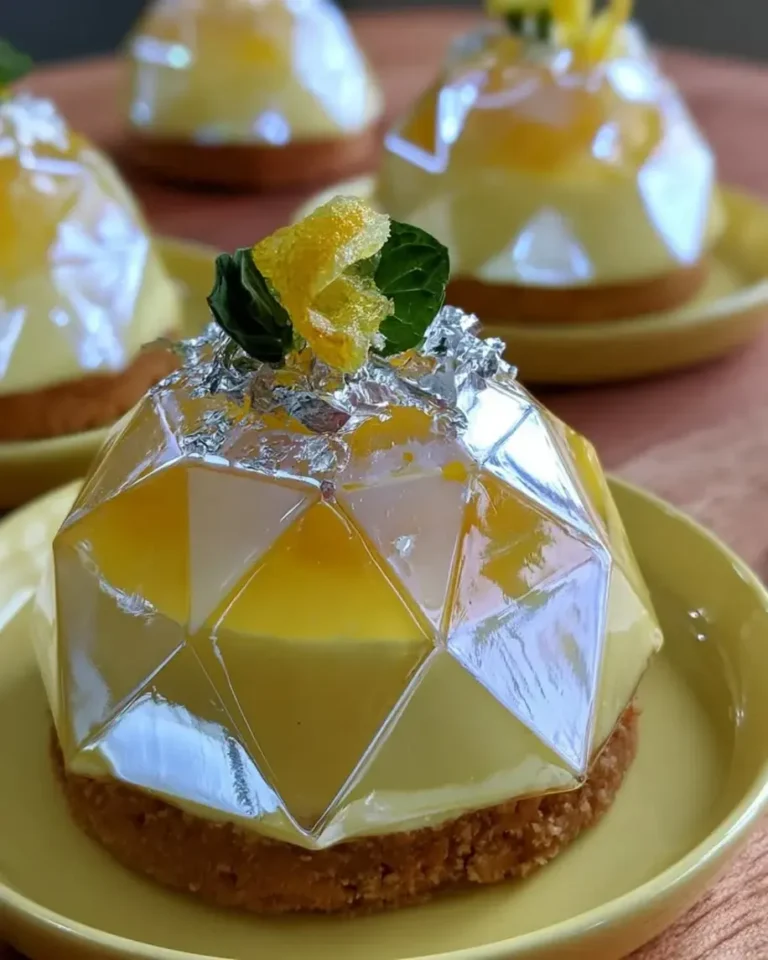
Once the mirror glaze has set (after about 30 minutes in the fridge), the domes are ready to garnish. Arrange candied lemon peel on top in a small cluster, sprinkle a few edible silver flakes for that diamond sparkle, and tuck a tiny sprig of micro mint behind the lemon peel for a fresh green contrast. Serve the domes chilled — they should be cold but not frozen. The cheesecake filling will be firm yet creamy, and the mirror glaze will crackle slightly as you cut into it. These domes are best enjoyed within 24 hours of glazing for the most dramatic shine.
💡 Stella’s Pro Tip: For the most stunning presentation, serve each dome on a small white plate with a drizzle of leftover mirror glaze and a few extra silver flakes scattered around. The contrast of the white plate against the glossy dome is absolutely gorgeous — it’s like serving a piece of art.
| Step | Action | Duration | Key Visual Cue |
|---|---|---|---|
| 1 | Make biscuit base and press into molds | 15 min chill | Firm, compacted crumb layer |
| 2 | Bloom gelatin for cheesecake | 5 min | Firm, jiggly gelatin mass |
| 3 | Beat cream cheese and fold in whipped cream | 5 min | Smooth, airy, no lumps |
| 4 | Fill molds with cheesecake and lemon curd core | 10 min | Curd fully enclosed, tops smooth |
| 5 | Freeze domes solid | 6+ hours | Rock hard, no give when pressed |
| 6 | Prepare crystal mirror glaze | 15 min + cooling | Glaze at 90°F, smooth and glossy |
| 7 | Pour glaze over frozen domes | 5 min | Even coating, no bare spots |
| 8 | Refrigerate to set glaze | 30 min | Glaze is firm, shiny, and set |
Serving & Presentation
These diamond lemon cheesecake domes are meant to be the centerpiece of a celebration — birthdays, anniversaries, dinner parties, or even a fancy weekend dinner at home. I love serving them on simple white porcelain plates that let the mirror glaze take center stage. For an extra touch, I sometimes drizzle a thin ribbon of leftover mirror glaze across the plate and place the dome right on top, like a jewel in a velvet box. The candied lemon peel adds a pop of bright yellow that echoes the lemon flavor inside, while the silver flakes catch the light and make the whole dessert sparkle.
When it comes to pairings, I keep things elegant but approachable. A dollop of lightly sweetened crème fraîche on the side cuts through the sweetness beautifully — a trick I picked up in Paris. For drinks, a glass of chilled Moscato d’Asti or a floral jasmine tea complements the lemon without overwhelming it. If you’re serving these after a heavy meal, the bright citrus notes are wonderfully refreshing. And if you’re like me and love a touch of contrast, a few fresh raspberries scattered around the plate add a ruby-red counterpoint to the golden dome.
| Pairing Type | Suggestions | Why It Works |
|---|---|---|
| Side Accompaniment | Crème fraîche, whipped cream, fresh berries | Adds creaminess or tart contrast to balance sweetness |
| Sauce / Drizzle | Raspberry coulis, passion fruit sauce, caramel | Bright fruit sauce cuts richness; caramel adds depth |
| Beverage | Moscato d’Asti, jasmine tea, sparkling lemonade | Light bubbles or floral notes complement lemon without overpowering |
| Garnish | Candied lemon peel, edible silver flakes, micro mint, edible flowers | Adds visual sparkle, freshness, and a hint of extra flavor |
Make-Ahead, Storage & Reheating
As a busy NYC food blogger with a never-ending to-do list, I’m a huge fan of recipes that let me get ahead. These lemon cheesecake domes are perfect for party planning because the heavy lifting happens in the freezer. I usually make the domes (without the glaze) up to a week in advance and keep them frozen, then glaze them the morning of my event. The mirror glaze is best applied the day you plan to serve, but the unglazed domes are happy in the freezer for much longer. Here’s everything you need to know about storing and prepping ahead.
| Method | Container | Duration | Reheating / Serving Tip |
|---|---|---|---|
| Refrigerator (glazed) | Covered container, single layer | Up to 2 days | Serve straight from fridge; glaze may soften slightly |
| Freezer (unglazed) | Airtight container, separated by parchment | Up to 1 month | Glaze directly from frozen; no need to thaw first |
| Make-Ahead | Freeze domes, glaze on day of serving | Up to 1 week in advance | Glaze domes while frozen; refrigerate after glazing |
If you’re planning a dinner party, here’s my suggested timeline: make the lemon curd (or buy a good quality one) up to a week ahead. Prepare the biscuit base and cheesecake filling, assemble the domes, and freeze them solid — this can be done up to a week in advance. On the day of your party, prepare the mirror glaze, let it cool to 90°F, glaze the frozen domes, and refrigerate. They’ll be ready to serve in about 30 minutes after glazing. The glaze stays beautifully shiny for about 24 hours, so don’t glaze more than a day ahead. One more tip: if you have leftover glaze, you can store it in the fridge for up to a week and gently reheat it to 90°F to use again — just whisk it smooth and strain it before using.
Variations & Easy Swaps
One of the things I love most about this crystal mirror cheesecake domes recipe is how versatile it is. Over the years, I’ve played with different flavors and dietary adaptations, and I’m excited to share my favorite variations with you. Whether you’re gluten-free, dairy-free, or just looking to try something new, there’s a version here for you. These variations have all been tested in my NYC kitchen — some inspired by Moroccan flavors, others by French pastry traditions, and a few born from a late-night craving and whatever I had in the pantry.
| Variation | Key Change | Best For | Difficulty Impact |
|---|---|---|---|
| Moroccan Orange Blossom | Add 1 tsp orange blossom water to cheesecake; use orange curd instead of lemon | Floral, aromatic twist; special occasions | Same difficulty |
| Gluten-Free Version | Use gluten-free graham crackers or almond flour + butter base | Celiac or gluten-sensitive guests | Same difficulty |
| Berry Swirl | Swirl 1/2 cup raspberry purée into cheesecake filling before freezing | Fruity, colorful variation; summer entertaining | Same difficulty |
Moroccan Orange Blossom Variation
This variation is close to my heart — it’s inspired by the orange blossom water my mother would drizzle over semolina cakes in our kitchen in Morocco. Replace the lemon zest in the cheesecake filling with 1 teaspoon of orange zest, and add 1 teaspoon of orange blossom water along with the vanilla. Swap the lemon curd core for a high-quality orange curd (or even a dollop of orange marmalade). The floral aroma pairs beautifully with the sweet mirror glaze, and the orange flavor is more mellow and exotic than lemon. Garnish with candied orange peel and a tiny edible orchid for a truly stunning presentation. This version is always a hit at my NYC dinner parties — it feels both luxurious and familiar.
Gluten-Free Version
For a gluten-free adaptation, simply replace the digestive biscuits with gluten-free graham crackers or shortbread cookies. I’ve also made the base using 1 cup of almond flour mixed with 3 tablespoons of melted butter and 1 tablespoon of sugar — press it into the molds and freeze as usual. The almond flour base has a slightly nuttier flavor and a more delicate crumb, which works beautifully with the lemon filling. Make sure your gluten-free graham crackers are certified gluten-free if you’re serving someone with celiac disease. The rest of the recipe — the cheesecake filling, lemon curd, and mirror glaze — is naturally gluten-free, so this is an easy swap with no compromise on taste or texture.
Berry Swirl Variation
During summer, when berries are at their peak at the Union Square Greenmarket, I love making a berry swirl version of these domes. Purée 1/2 cup of fresh raspberries or strawberries with 1 tablespoon of sugar and strain to remove seeds. After you’ve folded the whipped cream into the cheesecake filling, gently swirl in the berry purée with a few strokes of a spatula — don’t overmix, you want distinct ribbons of berry. The lemon curd core still works beautifully, but you could also use a berry compote or even a spoonful of good-quality jam. The pink and yellow swirls inside the dome are absolutely gorgeous when you cut into it, and the berries add a fresh tartness that complements the lemon.
What is the best way to achieve a mirror-like shine on lemon cheesecake domes?
The key to a perfect mirror-like shine is temperature control and proper straining. First, make sure your mirror glaze is cooled to exactly 90°F (32°C) before pouring — any warmer and it will run off the frozen dome; any cooler and it will set too thick and lose its shine. Use an immersion blender to emulsify the glaze until it’s completely smooth and glossy, then strain it through a fine-mesh sieve to remove any undissolved gelatin or chocolate bits. The domes must be frozen solid so the glaze sets instantly on contact, creating that smooth, glass-like finish. Finally, refrigerate the glazed domes for at least 30 minutes to allow the glaze to fully set — the shine will deepen as it chills.
Can I use a different gelatin alternative to make the crystal mirror glaze set properly?
Yes, you can use agar-agar as a vegetarian alternative to gelatin, but the technique is different. Use 1 tablespoon of agar-agar powder (instead of 1 tbsp gelatin) and bloom it in the same amount of cold water. However, agar-agar requires boiling to activate — you’ll need to bring the sugar-water-condensed milk mixture to a full boil for 2 minutes before adding the bloomed agar, then proceed with the recipe. The set will be firmer and more brittle than gelatin, and the glaze may be slightly less glossy. I also recommend using a clear vegetable gum like xanthan gum (1/4 tsp) to improve the shine. For the cheesecake filling, agar-agar works too, but the texture will be less creamy. If you’re new to agar, I suggest sticking with gelatin for your first attempt at this recipe.
How far in advance can I prepare Diamond Lemon Cheesecake Domes for a party?
You can prepare the unglazed domes up to 1 week in advance and keep them frozen in an airtight container. The lemon curd core and biscuit base hold up beautifully in the freezer. The mirror glaze is best applied the day you plan to serve — glaze the frozen domes in the morning and refrigerate them until your event, up to 24 hours ahead. I don’t recommend glazing more than 24 hours in advance, as the shine can dull slightly over time. If you’re really pressed for time, you can make everything (including glazing) up to 2 days ahead, but the domes will be at their most spectacular on day one. For the best flavor and texture, bring the glazed domes to room temperature for about 5–10 minutes before serving — they should be cold but not frozen solid in the center.
What type of mold is best for shaping the cheesecake into perfect domes?
For perfectly smooth, hemispherical domes, I recommend using silicone hemisphere molds — they’re flexible, non-stick, and available at most baking supply stores or online. Look for molds that are about 2.5 to 3 inches in diameter for individual servings, which yields 8 domes from this recipe. Silicone is ideal because the frozen domes pop out easily with a gentle press on the bottom. If you don’t have hemisphere molds, you can use large silicone muffin cups or even small oven-safe bowls lined with plastic wrap, but the shape won’t be as perfectly round. Avoid rigid metal or plastic molds — frozen cheesecake is too firm to release cleanly from non-flexible molds. For the best results, lightly grease your silicone molds with a neutral oil before adding the biscuit base.
Can I make the lemon curd from scratch instead of using store-bought?
Absolutely, and I actually recommend it if you have the time! Homemade lemon curd is brighter, fresher, and lets you control the sweetness. To make your own, whisk together 3 large eggs, 1/2 cup sugar, 1/3 cup fresh lemon juice, and 1 tablespoon lemon zest in a small saucepan. Cook over low heat, stirring constantly with a wooden spoon, until the mixture thickens and coats the back of the spoon — about 8–10 minutes. Remove from heat and stir in 3 tablespoons of cold butter until smooth. Strain through a fine-mesh sieve and chill completely before using. The homemade curd will be more vibrant in color and flavor than most store-bought versions, and it freezes beautifully for up to 3 months if you want to make it well ahead.
Why did my mirror glaze crack or develop bubbles after setting?
Cracks in the mirror glaze usually happen when the dome is too cold or the glaze is too hot when poured — the thermal shock causes the glaze to contract and crack. Make sure your domes are frozen solid but not straight from a deep freeze that’s below 0°F, and your glaze is cooled to exactly 90°F. Bubbles form when air gets incorporated into the glaze, usually from over-whisking or using a blender on too high a speed. Use an immersion blender on low speed and tap the bowl on the counter to release any trapped air before pouring. You can also pass a kitchen torch briefly over the glazed dome to pop any surface bubbles, but do this before the glaze fully sets. If your glaze is already cracked, you can try warming it slightly and pouring a thin second layer, but prevention is truly the best approach.
Can I use this recipe to make a full-sized cheesecake instead of individual domes?
Yes, you can adapt this recipe for a 9-inch springform pan, but the technique changes a bit. Press the biscuit base into the bottom of the pan and chill. Pour the cheesecake filling over the base, dollop the lemon curd in small spoonfuls over the surface (rather than a single core), and use a knife to gently swirl it into the filling. Bake at 325°F for about 35–40 minutes until the edges are set but the center still jiggles slightly. Cool completely, then chill for at least 4 hours. For the mirror glaze, you’ll need to increase the quantities by 50% to cover the full cake. Pour the glaze over the chilled (not frozen) cheesecake and let it flow over the edges. The result is a stunning mirror-glazed lemon cheesecake that serves 12–16 people — just as impressive as the domes, but with a different texture and presentation.
How do I store leftover mirror glaze and can I reuse it?
Leftover mirror glaze can be stored in an airtight container in the refrigerator for up to 1 week. To reuse it, gently warm the glaze in a heatproof bowl set over simmering water (double boiler method) or in the microwave in 10-second bursts at 50% power, stirring between each burst until it reaches 90°F. If the glaze has thickened or formed a skin, whisk it smooth and strain it through a fine-mesh sieve before using. You may need to add a teaspoon of warm water to thin it back to the right consistency. I often keep leftover glaze on hand to drizzle over ice cream, panna cotta, or even fresh fruit — it’s too good to waste. Just note that each time you reheat and cool the glaze, the shine diminishes slightly, so it’s best used within a day or two for the most glass-like finish.
What can I use instead of edible silver flakes for garnish?
If you don’t have edible silver flakes, there are plenty of beautiful substitutes that still give a jewel-like finish. Edible gold flakes or leaf create an even more luxurious look and are widely available at baking supply stores or online. For a more budget-friendly option, use white shimmer dust (luster dust) — just mix a pinch with a drop of clear alcohol or vanilla extract and paint a few delicate strokes on the set glaze. You can also skip the metallic look entirely and go for a natural garnish: candied lemon peel curls, a tiny sprig of fresh rosemary or mint, freeze-dried raspberry powder sprinkled around the plate, or a single edible pansy or viola flower. The domes are stunning even without any garnish, so don’t stress if you can’t find silver flakes — a simple candied lemon peel on top is classic and elegant.
Can I use this recipe for lemon cheesecake domes recipe with a different citrus flavor?
Absolutely — this recipe is a wonderful base for any citrus fruit. For lime domes, use fresh lime juice and zest in the cheesecake filling and swap the lemon curd for key lime curd. Orange domes work beautifully with orange juice and zest, plus a Grand Marnier-spiked orange curd for an adult twist. Grapefruit is more delicate and slightly bitter, so I suggest using half grapefruit juice and half lemon juice in the filling to maintain the right acidity. For a truly unique flavor, try yuzu — the Japanese citrus has a floral, aromatic quality that pairs perfectly with the mirror glaze. Whatever citrus you choose, keep the ratios the same and adjust sugar to taste. The mirror glaze itself stays neutral, so it will complement any citrus flavor beautifully. Each variation will have its own color and character, and they’re all showstoppers in their own right.
Share Your Version!
I absolutely love seeing how these Diamond Lemon Cheesecake Domes turn out in your kitchen. There’s something so special about the moment you pour that glossy mirror glaze over a perfectly frozen dome — it never gets old, and I want to celebrate that moment with you! If you make this recipe, please leave a star rating and a comment below letting me know how it went. Did the glaze turn out perfectly shiny? Did your guests gasp when you brought them to the table? Did you try one of the variations? I read every single comment, and your feedback helps me create even better recipes for you.
And don’t forget to snap a photo and share it on Instagram or Pinterest — tag me @leosfoods so I can see your beautiful creations. I love sharing my favorite reader photos on my stories, and you might just inspire someone else to try this recipe. If you have a question that wasn’t covered in the FAQ, drop it in the comments and I’ll answer as soon as I can. From my NYC kitchen to yours — I hope this recipe brings as much warmth to your table as it does to mine. — Stella 🧡
Love This Recipe? Save It to Pinterest!
If you enjoyed this Diamond Lemon Cheesecake Domes with Crystal Mirror recipe, don’t let it get lost in your browser tabs! 😄 Pin it now so you can find it again anytime — and explore hundreds more tried-and-tested recipes waiting for you on my Pinterest boards.
👉 Follow Stella on Pinterest @stellarecipeblog
📌 Pin this recipe · 🔁 Re-pin your favorites · 💬 Tag me when you make it — I love seeing your creations!
“`
Print
Diamond Lemon Cheesecake Domes with Crystal Mirror
Elegant lemon cheesecake domes with a glossy crystal mirror glaze, perfect for special occasions.
- Total Time: 7 hours (includes freezing and chilling)
- Yield: 8 1x
Ingredients
- For the Lemon Cheesecake Filling:
- 8 oz cream cheese, softened
- 1/2 cup granulated sugar
- 1 cup heavy cream
- 2 tbsp lemon juice
- 1 tsp lemon zest
- 1 tsp vanilla extract
- 2 tsp powdered gelatin
- 3 tbsp cold water
- For the Lemon Curd Core:
- 3/4 cup lemon curd
- 1 tsp lemon zest
- For the Biscuit Base:
- 1 cup digestive biscuits, finely crushed
- 3 tbsp melted butter
- For the Crystal Mirror:
- 1 cup granulated sugar
- 1/2 cup water
- 1/2 cup sweetened condensed milk
- 1 cup white chocolate, finely chopped
- 1 tbsp powdered gelatin
- 3 tbsp cold water
- 1 tsp clear vanilla extract
- For Garnish (optional):
- Candied lemon peel
- Edible silver flakes
- Micro mint leaves
Instructions
- 1. Mix crushed biscuits with melted butter and press into dome molds as a base layer. Chill for 15 minutes.
- 2. Bloom gelatin for cheesecake filling in cold water for 5 minutes.
- 3. Beat cream cheese, sugar, lemon juice, lemon zest, and vanilla until smooth.
- 4. Warm a small portion of cream and dissolve gelatin, then mix into cheesecake base.
- 5. Whip remaining cream to soft peaks and fold into mixture.
- 6. Fill dome molds halfway with cheesecake filling.
- 7. Place a frozen lemon curd core into the center of each dome.
- 8. Cover with remaining filling and smooth the tops.
- 9. Freeze for at least 6 hours or until fully firm.
- 10. Bloom gelatin for mirror glaze in cold water.
- 11. Heat sugar, water, and condensed milk until steaming.
- 12. Remove from heat and stir in gelatin and white chocolate until smooth.
- 13. Add vanilla extract and blend until glossy.
- 14. Cool glaze to about 90°F (32°C).
- 15. Unmold frozen domes and place on a wire rack.
- 16. Pour crystal mirror glaze evenly over domes until fully coated.
- 17. Refrigerate for 30 minutes before serving.
- 18. Garnish with candied lemon peel, silver flakes, and micro mint.
- Prep Time: 30 minutes
- Cook Time: 20 minutes
- Method: Dessert
- Cuisine: American
Nutrition
- Calories: 330
- Sugar: 31 g
- Fat: 18 g
- Carbohydrates: 36 g
- Protein: 4 g
Tried This Recipe? Leave a Comment!
Did you make this recipe? I’d love to hear how it turned out! Please leave a comment and a rating below. Your feedback helps other home cooks and supports cheerychop.com!
For more delicious inspiration, follow me on Pinterest!