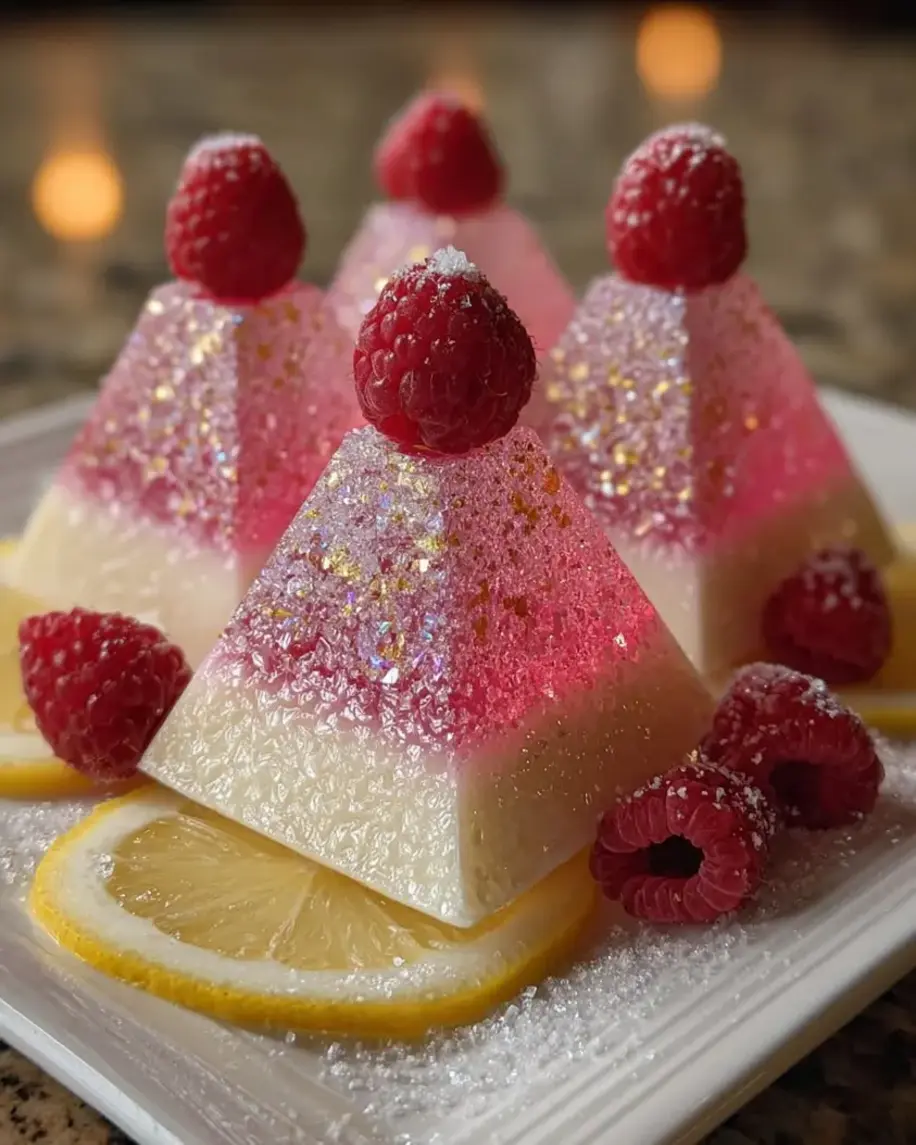
Raspberry Lemon Crystal Pyramids with Cheesecake Center
“`html
Table of Contents
Raspberry Lemon Crystal Pyramids with Cheesecake Center – A Stunning Crystal Mirror Glaze Dessert
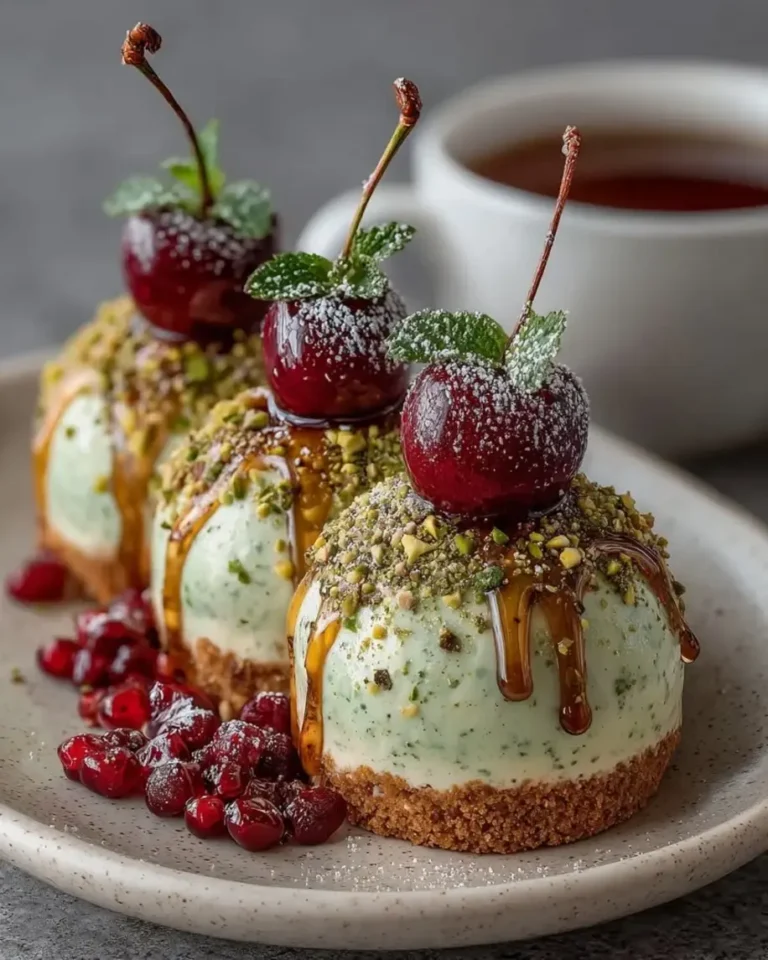
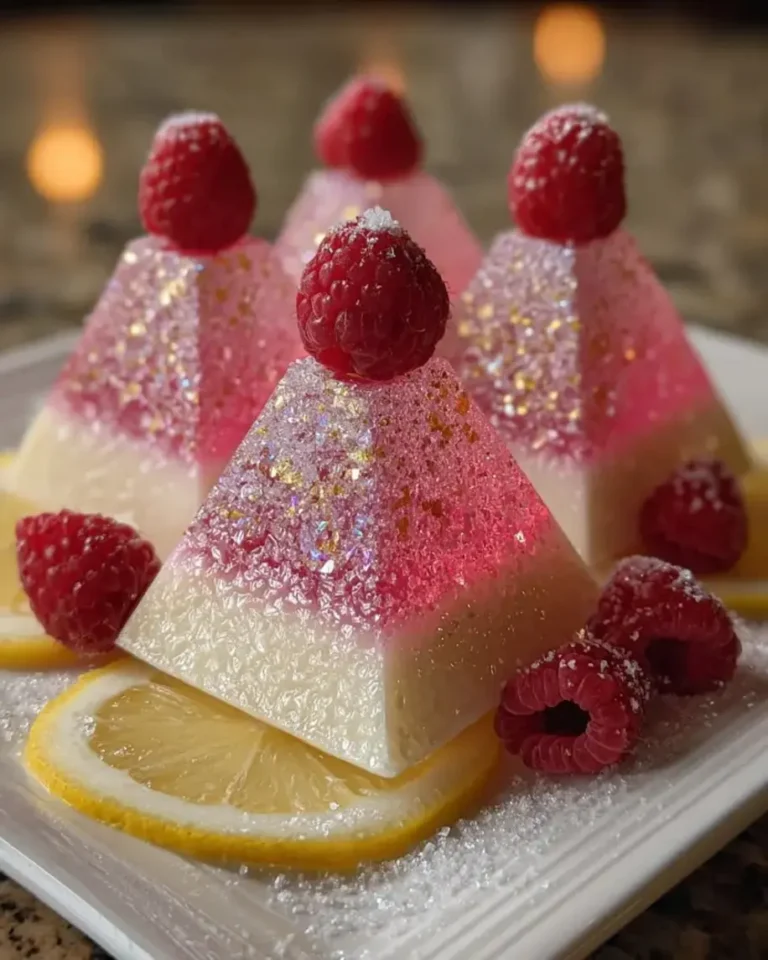
I still remember the first time I saw a crystal mirror glaze pyramid in a Parisian pâtisserie window. I was twenty-three, fresh out of culinary school, and utterly transfixed by the way light danced across that flawless, jewel-toned surface. That memory came rushing back last week when I walked past a display of raspberries at the Union Square Greenmarket — their deep crimson color and bright tang begged to be transformed into something extraordinary. These Raspberry Lemon Crystal Pyramids with Cheesecake Center are the result: a show-stopping crystal mirror glaze pyramid dessert that combines the tartness of fresh raspberries, the brightness of lemon, and a creamy cheesecake heart, all wrapped in a shimmering, edible jewel-like coating.
Picture this: you break through a glossy, mirror-like shell with your spoon — it shatters ever so slightly — and you sink into a layer of airy raspberry lemon mousse that tastes like summer in a cloud. Then comes the surprise: a dense, velvety cheesecake center that balances the fruit’s acidity with rich, creamy sweetness. The vanilla sponge base at the bottom adds just enough structure to hold everything together. Each bite is a journey through textures — from the delicate crackle of the glaze to the silky mousse and the firm, luscious cheesecake. A whisper of lemon zest throughout keeps it bright and lifts the whole experience.
This isn’t a simple weeknight dessert — it’s a weekend project that rewards you with something truly magical. I’ve spent years perfecting my crystal mirror glaze technique, from my days at Le Cordon Bleu in Paris to testing it obsessively in my tiny NYC apartment kitchen. What I’m sharing here is the version I’ve landed on after countless trials: a glaze that sets with a flawless, glass-like finish every time, a mousse that holds its shape without being rubbery, and a cheesecake center that stays perfectly frozen during assembly then thaws to the ideal creaminess. In this post, I’ll walk you through each component with the tips that matter most — including 💡 Stella’s Pro Tip for getting that absolutely clear, crack-free mirror finish, plus the common mistake that ruins most home bakers’ first attempt at a crystal mirror glaze.
Why This Raspberry Lemon Crystal Pyramids Recipe Is the Best
The Flavor Secret — My Moroccan grandmother taught me that the best fruit desserts balance sweet and tart so neither one dominates. I use raspberry puree (not juice, not syrup) as the backbone of the mousse, then amplify it with fresh lemon juice and zest. The lemon doesn’t just add brightness — it actually enhances the raspberry’s natural berry notes, making them taste more concentrated and vibrant. The cheesecake center, inspired by the creamy North African ‘jben’ cheese my mother used to make, cuts through the fruit with a clean, rich tang that keeps you coming back for another bite.
Perfected Texture — I learned the hard way that crystal mirror glaze is finicky. Too hot, it runs off and leaves bald patches. Too cold, it sets before you can pour it and clumps into an uneven mess. The ratio of white chocolate to condensed milk to gelatin in this recipe is the exact one I developed during my pastry section at Le Cordon Bleu — it gives a glaze that pours like thick cream, self-levels beautifully, and sets to a mirror-like surface with no streaks or bubbles. The mousse uses just enough gelatin to hold its pyramid shape without tasting bouncy, and the sponge base is intentionally lean so it doesn’t compete with the rich mousse and glaze.
Foolproof & Fast — While this dessert looks intimidating, I’ve broken it into four manageable components that each come together quickly. The sponge cake takes 20 minutes from start to finish. The cheesecake centers freeze in 30 minutes. The mousse comes together in 10 minutes of active work. Even the glaze — the part most home bakers fear — requires only 15 minutes of hands-on time. The key is planning ahead: make the components over two days, or set aside an afternoon when you can chill each layer properly. I promise you, the first time you unmold a perfectly formed pyramid with a glossy, crystal-clear finish, you’ll feel like a professional pastry chef.
Raspberry Lemon Crystal Pyramids Ingredients
Every time I make these pyramids, I think about how lucky we are in New York City to have access to incredible ingredients year-round. I buy my raspberries from the greenmarket when they’re in season and freeze my own puree — but high-quality frozen raspberry puree works beautifully, too. The white chocolate for the glaze is something I’m particular about: use a good brand like Valrhona or Guittard, because the flavor of the chocolate comes through in the glaze. Here’s exactly what you’ll need for each component.
Ingredients List
- For the Raspberry Lemon Mousse:
- 2 cups raspberry puree (fresh or high-quality frozen, thawed)
- 1/3 cup granulated sugar
- 2 tbsp fresh lemon juice (from about 1 lemon)
- 1 tsp lemon zest
- 1 cup heavy cream, cold
- 2 tsp powdered gelatin
- 2 tbsp cold water (for blooming gelatin)
- For the Cheesecake Center:
- 8 oz cream cheese, softened to room temperature
- 1/4 cup powdered sugar
- 1/2 tsp vanilla extract
- 2 tbsp heavy cream
- For the Vanilla Sponge Base:
- 1 cup all-purpose flour
- 1/2 tsp baking powder
- 1/4 tsp salt
- 1/4 cup unsalted butter, softened
- 1/3 cup granulated sugar
- 1 large egg, at room temperature
- 1/2 tsp vanilla extract
- 1/4 cup milk, at room temperature
- For the Crystal Mirror Glaze:
- 1 cup white chocolate, finely chopped
- 1/3 cup sweetened condensed milk
- 1/4 cup water
- 1/2 cup granulated sugar
- 2 tsp powdered gelatin
- 2 tbsp cold water (for blooming gelatin)
- Pink food coloring, as needed (gel or powder preferred)
- Edible crystal shimmer dust, as needed
- For Garnish (optional):
- Fresh raspberries
- Lemon zest curls
Ingredient Spotlight
Raspberry Puree — This is the soul of your mousse. I prefer to make my own by pressing fresh or frozen raspberries through a fine-mesh sieve to remove the seeds. A cup of whole berries yields about 1/2 cup of puree, so buy 4 cups of fresh berries for the 2 cups you’ll need. If using store-bought puree, look for one with no added sugar. The puree provides the acidity, fruit flavor, and natural color that make these pyramids so striking.
White Chocolate for Glaze — This is non-negotiable for a crystal-clear mirror finish. Use a high-quality white chocolate with at least 30% cocoa butter — cheap white chips contain palm oil and additives that make the glaze cloudy and streaky. I use Valrhona Ivoire or Guittard white wafers. The cocoa butter in good white chocolate emulsifies with the condensed milk and gelatin to create that glossy, transparent sheen that defines a crystal mirror glaze.
Powdered Gelatin — Sheet gelatin is traditional in French pastry, but powdered gelatin is more accessible in US grocery stores and works perfectly when bloomed correctly. The key is to let it sit in cold water for a full 5–10 minutes until it’s like firm jello, then heat it gently to dissolve. Never add gelatin directly to a hot liquid without blooming first — it will clump and you’ll end up with a lumpy, unusable mousse or glaze.
| Original Ingredient | Best Substitution | Flavor / Texture Impact |
|---|---|---|
| Raspberry puree | Strawberry or mixed berry puree | Sweeter, less tart; color shifts to pink/red |
| White chocolate (glaze) | High-quality white chocolate chips (not baking chips) | Slightly less glossy; still works if quality is good |
| Cream cheese (center) | Vegan cream cheese (e.g., Kite Hill or Miyoko’s) | Less tangy, slightly softer; freeze well |
| Heavy cream (mousse) | Full-fat coconut cream (chilled, whipped) | Coconut flavor comes through; dairy-free |
| Gelatin (powdered) | Agar-agar powder (use 1 tsp, different setting method) | Firmer, more brittle set; not recommended for glaze |
How to Make Raspberry Lemon Crystal Pyramids — Step-by-Step
Before you start, I want you to take a deep breath. This recipe has several components, but each one is straightforward, and I’ve broken them down so you can work through them without stress. Read through the entire recipe first, set up your ingredients (mise en place is your best friend here), and give yourself a full afternoon or split it over two days. You’ve got this. Let’s make some magic.
Step 1: Make the Vanilla Sponge Base
Preheat your oven to 350°F (175°C). Grease a small baking pan (8×8 inches works well) and line it with parchment paper. In a medium bowl, whisk together 1 cup all-purpose flour, 1/2 tsp baking powder, and 1/4 tsp salt. In a separate large bowl, beat 1/4 cup softened unsalted butter with 1/3 cup granulated sugar until light and fluffy — about 2 minutes with a hand mixer. Add 1 large egg and 1/2 tsp vanilla extract, beating until combined. Gradually add the dry ingredients in three additions, alternating with 1/4 cup milk, mixing just until smooth. Spread the batter evenly into the prepared pan and bake for 18–20 minutes, until a toothpick inserted in the center comes out clean. Cool completely in the pan, then cut into 8 pieces that are roughly the size of your pyramid mold bases — about 1.5 inches square each.
💡 Stella’s Pro Tip: For the fluffiest sponge, make sure your egg and milk are at room temperature before you start. Cold ingredients seize the butter and give you a dense, heavy cake. If you’re short on time, place the egg in a bowl of warm water for 5 minutes and microwave the milk for 10 seconds.
Step 2: Prepare the Cheesecake Centers
In a medium bowl, beat 8 oz softened cream cheese with 1/4 cup powdered sugar and 1/2 tsp vanilla extract until completely smooth — no lumps allowed. Add 2 tbsp heavy cream and beat for another 30 seconds until the mixture is light and spreadable. Line a small baking sheet or plate with parchment paper. Transfer the cheesecake mixture to a piping bag fitted with a round tip (or use a zip-top bag with a corner snipped off). Pipe 8 small mounds about 1 inch wide and 1/2 inch tall onto the lined sheet — these will be the hidden centers of your pyramids. Place the sheet in the freezer and freeze until completely firm, at least 30 minutes. You want them rock-solid so they stay centered when you add the mousse.
⚠️ Common Mistake to Avoid: Don’t skip freezing the cheesecake centers until they’re rock hard. If they’re even slightly soft, they’ll sink to the bottom of the mousse or displace the filling as you pipe. I learned this the hard way — my first batch of pyramids had cheesecake centers that drifted to one side, giving me lopsided slices.
Step 3: Make the Raspberry Lemon Mousse
In a small bowl, sprinkle 2 tsp powdered gelatin over 2 tbsp cold water. Let it sit for 5–10 minutes until it’s firm and jiggly — this is called blooming. Meanwhile, in a medium saucepan, combine 2 cups raspberry puree, 1/3 cup granulated sugar, 2 tbsp lemon juice, and 1 tsp lemon zest. Warm over medium heat, stirring occasionally, until the mixture is hot but not boiling — about 3–4 minutes. Remove from heat and add the bloomed gelatin, stirring until completely dissolved. Pour the mixture into a large bowl and let it cool to room temperature — you can speed this up by placing the bowl over an ice bath, stirring occasionally. While the raspberry mixture cools, whip 1 cup cold heavy cream to soft peaks — the cream should hold a gentle shape but still be soft and billowy. Once the raspberry mixture is at room temperature (not warm — warm cream will deflate it), gently fold the whipped cream into the raspberry mixture in three additions, using a rubber spatula and a light hand. Fold just until no white streaks remain. Set aside at room temperature while you prepare your molds.
💡 Stella’s Pro Tip: The mousse should be at a thick but still pourable consistency — similar to a thick milkshake. If it’s too runny, it hasn’t cooled enough; if it’s too firm, it’s starting to set. Work quickly once it reaches the right consistency. If the mousse gets too firm while you’re filling molds, briefly warm the bowl over a pan of simmering water for 10–15 seconds and stir gently to loosen it.
Step 4: Assemble the Pyramids
You’ll need 8 pyramid-shaped silicone molds — the kind used for chocolate or gelatin desserts work perfectly. Make sure they’re clean and dry. Fill each mold halfway with the raspberry lemon mousse. Take a frozen cheesecake center and gently press it into the mousse so it’s centered. Top with enough remaining mousse to fill the mold almost to the top — leave about 1/4 inch space. Press a piece of the vanilla sponge base into the top, gently pushing so it’s flush with the surface of the mousse. The sponge base will be the bottom of your pyramid when you unmold it. Place the filled molds on a small baking sheet and freeze for at least 4 hours, or overnight. The pyramids must be completely frozen solid before you glaze them.
⚠️ Common Mistake to Avoid: Don’t skip the freezing step — and don’t rush it. If the pyramids aren’t fully frozen (at least 4 hours, ideally 6–8), the mousse will be too soft to hold its shape when you unmold it, and the warm glaze will melt the surface instead of coating it cleanly. I always make mine the day before glazing and leave them in the freezer overnight.
Step 5: Make the Crystal Mirror Glaze
In a small bowl, bloom 2 tsp powdered gelatin in 2 tbsp cold water for 5–10 minutes. In a small saucepan, combine 1/4 cup water, 1/2 cup granulated sugar, and 1/3 cup sweetened condensed milk. Heat over medium, stirring constantly, until the sugar dissolves and the mixture is smooth — do not let it boil. Remove from heat and stir in the bloomed gelatin until fully dissolved. Place 1 cup finely chopped white chocolate in a heatproof bowl. Pour the hot cream mixture over the chocolate and let it sit for 1 minute, then stir gently until the chocolate is completely melted and the glaze is smooth and glossy. Add pink food coloring one drop at a time, stirring until you reach your desired shade. Stir in edible crystal shimmer dust — start with 1/2 tsp and add more if you want extra sparkle. The glaze needs to cool to a pourable consistency — about 90°F (32°C). You can test it by dipping a spoon: the glaze should coat the back of the spoon in a smooth, even layer that runs off in a steady ribbon. If it’s too thick, warm it gently over a water bath; if too thin, let it cool a bit more.
💡 Stella’s Pro Tip: The temperature of the glaze is everything. Too warm, it runs off the frozen pyramid and pools at the bottom. Too cool, it thickens and won’t self-level. I use an instant-read thermometer to hit exactly 90°F. If you don’t have a thermometer, the glaze should feel warm to the touch — like a warm bath — but not hot. It should flow like thick maple syrup, not like water.
Step 6: Glaze and Garnish
Remove the frozen pyramids from the freezer and unmold them one at a time. Place each pyramid on a wire rack set over a baking sheet (to catch the drips). Working quickly, pour the cooled glaze evenly over each pyramid, starting from the top and letting it cascade down the sides. Make sure the entire surface is covered — tilt the pyramid gently if needed, but try not to touch the glaze with your fingers. Let the excess glaze drip off for 10–15 seconds, then use a small offset spatula or knife to gently lift the pyramid off the wire rack and transfer it to a serving plate or parchment-lined tray. Repeat with the remaining pyramids. The glaze will set within 10–15 minutes, forming a firm, mirror-like shell. If desired, garnish each pyramid with a fresh raspberry and a curl of lemon zest just before serving.
⚠️ Common Mistake to Avoid: Don’t touch or adjust the glaze once it’s poured — any fingerprints or smudges will set into the surface and ruin the mirror effect. If a spot is uncovered, let the first layer set for 2 minutes, then carefully pour a second thin layer over that spot. Also, make sure your wire rack is perfectly level — an uneven rack will cause the glaze to pool on one side.
| Step | Action | Duration | Key Visual Cue |
|---|---|---|---|
| 1 | Make sponge base | 18–20 min bake | Golden edges, toothpick clean |
| 2 | Prepare cheesecake centers | 30 min freeze | Firm to touch, holds shape |
| 3 | Make raspberry mousse | 15 min active | Thick, pourable, no streaks |
| 4 | Assemble pyramids | 10 min + 4 hr freeze | Rock-solid, no give when pressed |
| 5 | Make crystal mirror glaze | 15 min active | Glossy, smooth, coats spoon |
| 6 | Glaze and garnish | 15 min + 15 min set | Mirror finish, no streaks |
Serving & Presentation
These raspberry lemon crystal pyramids are truly a showpiece dessert, so let them shine. I like to serve each pyramid on a small white plate with a simple swipe of extra raspberry puree or a dusting of edible shimmer dust around the base. The contrast between the glossy, mirror-like pyramid and the matte plate is stunning. For a special occasion, add a few fresh raspberries, a tiny sprig of mint, and a delicate lemon zest curl on top. The bright colors — deep pink glaze, red raspberries, green mint, yellow zest — make for a gorgeous presentation that will have everyone reaching for their phones before they reach for their forks.
When you’re ready to serve, let the pyramids sit at room temperature for 5–7 minutes after taking them out of the freezer. This softens the mousse just enough that it becomes silky and spoonable, while the glaze stays firm and the cheesecake center remains creamy. Use a sharp, warm knife if you want to slice one open to reveal the layers — the contrast between the pink mousse, white cheesecake, and golden sponge is absolutely beautiful. In my NYC apartment, I serve these at dinner parties and watch people’s faces go from curiosity to pure joy with the first bite. The bright raspberry and lemon flavors make this an especially welcome dessert after a rich meal.
If you’re serving a crowd, you can plate all 8 pyramids on a large wooden board or mirrored platter (how fitting!) for a dramatic centerpiece. Let guests help themselves, or present each one on an individual plate with a small fork and a napkin. These pyramids are rich enough to stand alone, but they pair beautifully with a light, floral tea like jasmine or a crisp sparkling wine. For a non-alcoholic option, a lemon-and-raspberry spritzer with fresh mint echoes the flavors in the dessert and cleanses the palate between bites.
| Pairing Type | Suggestions | Why It Works |
|---|---|---|
| Side Accompaniment | Fresh raspberries, mint sprig, lemon curl, extra puree | Enhances fruit flavor and visual appeal |
| Sauce / Dip | Extra raspberry coulis, white chocolate sauce, whipped cream | Adds moisture and richness to each bite |
| Beverage | Sparkling rosé, jasmine tea, lemon-raspberry spritzer | Cuts richness, cleanses palate, echoes fruit notes |
| Garnish | Edible flowers (violas, rose petals), gold leaf, shimmer dust | Elevates elegance for special occasions |
Make-Ahead, Storage & Reheating
One of the best things about this raspberry lemon crystal pyramid dessert is how well it works for make-ahead entertaining. Living in NYC with a busy schedule, I rely on desserts I can prep in stages. Here’s my strategy: make the sponge base and cheesecake centers up to 2 days ahead and keep them in the freezer. The mousse can be made and assembled into the molds up to 1 day ahead — just keep the filled molds in the freezer. The glaze should be made fresh on the day you plan to serve, as it loses its mirror shine after about 24 hours in the fridge. Once glazed, the pyramids are best served within 4–6 hours, though they’ll hold in the refrigerator for up to 24 hours with a slightly softer glaze.
| Method | Container | Duration | Reheating / Serving Tip |
|---|---|---|---|
| Refrigerator (glazed) | Airtight container, single layer | Up to 24 hours | Serve directly from fridge; glaze softens slightly |
| Freezer (unglazed) | In molds, wrapped tightly in plastic | Up to 2 weeks | Unmold and glaze directly from frozen |
| Make-Ahead (unglazed) | In molds on baking sheet, covered | Up to 3 days before glazing | Glaze on day of serving for best shine |
If you’re storing glazed pyramids in the refrigerator, place them in a single layer in an airtight container and don’t stack anything on top of them — the glaze is firm but delicate. The mirror finish may develop tiny condensation droplets after a few hours; if that happens, you can gently dab them off with a paper towel, but the shine won’t be quite as perfect as fresh. This is why I always recommend glazing within a few hours of serving. For the best texture, take the pyramids out of the refrigerator 5–7 minutes before serving to let the mousse soften slightly. Leftover pyramids? They’ll still taste delicious the next day, even if the glaze isn’t as shiny — the raspberry lemon mousse and cheesecake center are just as wonderful.
Variations & Easy Swaps
One of the things I love about this raspberry lemon crystal pyramid recipe is how adaptable it is once you understand the basic structure. Over the years, I’ve played with different fruit combinations, dietary adaptations, and flavor twists — some inspired by my Moroccan roots, others by seasonal finds at the NYC greenmarket. Here are three of my favorite variations, each tested in my own kitchen so you can swap with confidence.
| Variation | Key Change | Best For | Difficulty Impact |
|---|---|---|---|
| Moroccan Orange Blossom & Raspberry | Add 1 tbsp orange flower water to mousse; swap lemon for orange | Aromatic, floral twist; special occasions | Same difficulty |
| Strawberry & Basil | Use strawberry puree instead of raspberry; add 2 tbsp finely chopped basil to mousse | Herbal, summery; greenmarket bounty | Same difficulty |
| Dairy-Free / Vegan | Vegan cream cheese, coconut cream, agar-agar, vegan white chocolate | Dairy-free entertaining | Moderate — different setting behavior |
Moroccan Orange Blossom & Raspberry Variation
This variation is a nod to my North African roots. Orange flower water is a staple in Moroccan desserts — it’s floral, fragrant, and slightly sweet, and it pairs beautifully with raspberries. Replace the lemon juice and zest in the mousse with the zest of 1 orange and 2 tablespoons of fresh orange juice. Add 1 tablespoon of orange flower water along with the orange juice. The resulting mousse has a lovely perfumed quality that’s truly elegant. For the glaze, replace the pink food coloring with a pale orange hue and add a drop of orange extract for extra fragrance. This version is especially wonderful for spring celebrations like Mother’s Day or Easter.
Strawberry & Basil Variation
During peak strawberry season at the Union Square Greenmarket, I can’t resist making this version. Swap the raspberry puree for 2 cups of fresh strawberry puree (about 1 lb strawberries, hulled and blended). Reduce the sugar to 1/4 cup since strawberries are sweeter than raspberries. After folding the whipped cream into the mousse, gently fold in 2 tablespoons of finely chopped fresh basil leaves. The basil adds a peppery, aromatic note that makes the strawberry flavor taste even more vibrant. For the glaze, use a red food coloring or a mix of red and pink to get a deep, rose-colored mirror finish. Garnish with a small basil leaf and a slice of fresh strawberry on top.
Dairy-Free / Vegan Variation
I’ve tested this variation for friends with dairy restrictions, and while the texture is slightly different, it’s still absolutely delicious. For the cheesecake center, use a high-quality vegan cream cheese like Kite Hill or Miyoko’s — these brands have the best tang and texture. Replace heavy cream in both the mousse and the cheesecake center with full-fat coconut cream (chill the can overnight and scoop the solid white part). For the mousse, use 1 teaspoon of agar-agar powder instead of gelatin — dissolve it in the raspberry puree and boil for 1 minute to activate it, then cool to room temperature before folding in the whipped coconut cream. For the glaze, use a vegan white chocolate (many brands like iChoc or Enjoy Life make them). The glaze won’t be quite as glossy as the original, but it will still be beautiful and delicious. Note that dairy-free versions set slightly softer, so freeze them for a full 6 hours before glazing.
What is the best way to get a clear, crystal-like texture for the raspberry lemon pyramid shells?
The key to a flawless crystal mirror glaze lies in three things: temperature, straining, and patience. First, make sure your white chocolate is finely chopped and melted smoothly — any lumps will create streaks in the glaze. Second, strain the glaze through a fine-mesh sieve before using it to catch any undissolved gelatin or chocolate bits. Third, and most importantly, the glaze must be at exactly 90°F (32°C) when you pour it. Too hot and it will melt the frozen mousse and become cloudy; too cold and it will thicken and leave a textured, uneven surface. I highly recommend using an instant-read thermometer for this step. Also, make sure your frozen pyramids are completely dry before glazing — any condensation on the surface will create spots in the mirror finish. Work quickly and pour the glaze in one smooth motion from the top of the pyramid, letting it cascade evenly down all sides.
Can I substitute the cheesecake center with a dairy-free or vegan alternative?
Absolutely, and I’ve done it many times for dairy-free friends. The best substitute is a high-quality vegan cream cheese like Kite Hill or Miyoko’s — these have the tanginess and richness that most closely mimic dairy cream cheese. Blend it with powdered sugar and a splash of full-fat coconut cream (the solid part from a chilled can) until smooth. The texture will be slightly softer than dairy cheesecake, so freeze the centers for at least 45 minutes instead of 30 to ensure they’re rock solid before adding the mousse. One thing to note: vegan cream cheese doesn’t set as firmly as dairy, so the centers will be creamier and slightly more spreadable when thawed — which is actually quite lovely. For a completely dairy-free version, also swap the heavy cream in the mousse for whipped coconut cream and use a vegan white chocolate for the glaze.
How long do these crystal pyramids need to set in the refrigerator before serving?
Once you’ve glazed the pyramids, they only need about 10–15 minutes at room temperature for the glaze to set firm. You can serve them immediately after the glaze sets, or refrigerate them for up to 24 hours. If you refrigerate them, the glaze will soften slightly and may develop tiny condensation droplets — simply dab them gently with a paper towel before serving. For the best texture experience, I recommend serving the pyramids within 4–6 hours of glazing. The mousse and cheesecake center are best when they’ve been frozen solid during assembly (minimum 4 hours), then glazed, and then allowed to sit at room temperature for 5–7 minutes before serving. This brief rest softens the mousse to a silky, spoonable consistency while keeping the glaze firm and the cheesecake center creamy.
What type of mold works best for shaping these raspberry lemon pyramids?
I recommend using flexible silicone pyramid molds specifically designed for chocolate or gelatin desserts. They’re available in various sizes — look for ones that hold about 1/2 cup to 3/4 cup of liquid for a single-serving pyramid. Silicone is essential because it flexes, allowing you to unmold the frozen mousse pyramids without damaging their shape. The smooth interior surface of quality silicone molds also helps achieve a clean, blemish-free surface for the glaze to adhere to. Avoid rigid plastic or metal molds, as you’ll almost certainly damage the mousse trying to get it out. You can find pyramid molds online at baking supply stores or on Amazon — search for “silicone pyramid mold” and look for ones with smooth, seamless interiors. Before filling, make sure the molds are completely clean and dry.
Can I make these raspberry lemon crystal pyramids without gelatin?
Yes, you can use agar-agar powder as a plant-based alternative to gelatin, but the texture and behavior will be different. For the mousse, use 1 teaspoon of agar-agar powder instead of 2 teaspoons of powdered gelatin. Dissolve the agar-agar in the raspberry puree and bring it to a full boil for 1 minute to activate it — this is critical because agar-agar needs boiling to set properly. Let it cool to room temperature before folding in the whipped cream. For the glaze, use 1 teaspoon of agar-agar instead of 2 teaspoons of gelatin, and again boil it for 1 minute with the liquid ingredients. The set will be firmer and more brittle than with gelatin, and the glaze may be slightly less glossy. One important note: agar-agar sets at room temperature, so you need to work faster when filling the molds and glazing. I’ve tested this and it works, but the original gelatin version gives a more forgiving, more professional result.
How do I store leftover glazed pyramids and keep the mirror finish intact?
To store leftover glazed pyramids, place them in a single layer in an airtight container. Do not stack anything on top of them, as the glaze is firm but can be scratched or dented. Keep them in the refrigerator for up to 24 hours. The mirror finish will soften slightly and may develop tiny condensation droplets — this is normal and doesn’t affect the taste. Before serving leftovers, let them sit at room temperature for 5–7 minutes and gently dab off any condensation with a paper towel. The glaze won’t be as brilliantly shiny as the day you made it, but the flavor will still be wonderful. If you want to store them for longer, keep the pyramids unglazed in the freezer for up to 2 weeks, then glaze them fresh on the day you plan to serve. This is actually my preferred method for entertaining — I keep the frozen unglazed pyramids on hand and whip up the glaze while the coffee is brewing.
Can I use frozen raspberries for the puree instead of fresh?
Yes, frozen raspberries work perfectly for the puree, and in many ways they’re more convenient. In fact, I often prefer frozen raspberries because they’re at their peak of ripeness when frozen, so the flavor is excellent. Thaw the berries completely, then press them through a fine-mesh sieve to remove the seeds and create a smooth puree. You’ll need about 3 cups of frozen berries to get 2 cups of puree. The only difference is that frozen berries can have slightly more liquid content, so your mousse might be a touch softer. To compensate, you can reduce the puree by simmering it for 5 minutes to concentrate the flavor and thicken it slightly, then let it cool before proceeding with the recipe. This extra step gives you a more intense raspberry flavor and a firmer mousse — a win-win in my book.
Why did my crystal mirror glaze turn cloudy instead of clear?
A cloudy mirror glaze is almost always caused by one of three issues. First, the white chocolate may not be high quality — cheap white chocolate contains vegetable oils and additives that won’t emulsify properly with the condensed milk and gelatin. Use a brand with at least 30% cocoa butter. Second, the glaze might have been too cool when you poured it, causing it to thicken and set before it could self-level. Always use a thermometer and aim for exactly 90°F. Third, air bubbles can create a cloudy appearance — this happens if you stir the glaze too vigorously or if you pour it too quickly from a height. Stir gently and slowly, and let the glaze rest for 2–3 minutes after mixing to let any bubbles rise to the surface. If you see bubbles, pop them with a toothpick before pouring. One more tip: if your frozen pyramids have condensation on them, the moisture will cause the glaze to turn cloudy on contact. Pat the pyramids dry before glazing.
How far in advance can I prepare each component of this dessert?
This dessert is designed for make-ahead entertaining, and I often prep components over several days. Here’s my timeline: up to 3 days before serving, make the vanilla sponge base and store it wrapped tightly at room temperature. Up to 2 days before, make the cheesecake centers and freeze them solid on a tray, then transfer to a freezer bag. Up to 1 day before, prepare the raspberry lemon mousse, fill the molds, add the cheesecake centers and sponge bases, and freeze the assembled pyramids — keep them in the molds overnight. On the day of serving, make the crystal mirror glaze fresh, unmold the frozen pyramids, and glaze them within 4–6 hours of serving for the best shine. I find this staggered approach makes the whole project feel manageable. You do all the active cooking on the first day, assembly on the second day, and glazing on the third day — never more than 30 minutes of work at any one time.
Can I use a different fruit for the mousse and still get the same crystal effect?
Absolutely! The crystal mirror glaze technique works beautifully with any fruit puree, as long as you adjust the sweetness and acidity accordingly. Strawberry, mango, passion fruit, blueberry, and even peach all make wonderful mousses. The key is to maintain the same total volume of puree (2 cups) and adjust the sugar based on the fruit’s natural sweetness. For very tart fruits like passion fruit or sour cherry, increase the sugar to 1/2 cup. For sweeter fruits like mango or peach, reduce the sugar to 1/4 cup. The lemon juice in the original recipe helps balance sweetness and adds brightness — if you’re using a sweeter fruit, keep the lemon juice; if you’re using a very tart fruit, reduce it to 1 tablespoon. The gelatin and whipped cream ratios remain the same regardless of the fruit, so you can experiment freely. For the glaze, adjust the food coloring to match your fruit — yellow for mango, blue-purple for blueberry, orange for passion fruit.
Share Your Version!
I absolutely love seeing how you all make these raspberry lemon crystal pyramids your own. Whether you stick with the original recipe, try one of my variations, or invent something entirely new — drop a comment below and let me know how it turned out! Did the crystal mirror glaze give you that perfect mirror finish? Did your guests gasp when you brought these to the table? Tag me in your photos on Instagram or Pinterest @leosfoods — I read every single comment and love sharing your creations with my community.
If you have a question about a step that wasn’t covered in the FAQ, ask away in the comments. I personally answer every question within 48 hours — usually much faster. And if you’re feeling extra generous, a quick star rating helps other home bakers find this recipe and gives my little NYC kitchen a huge boost of joy. From my NYC kitchen to yours — I hope this recipe brings as much warmth to your table as it does to mine. — Stella 🧡
Love This Recipe? Save It to Pinterest!
If you enjoyed this Raspberry Lemon Crystal Pyramids with Cheesecake Center recipe, don’t let it get lost in your browser tabs! 😄 Pin it now so you can find it again anytime — and explore hundreds more tried-and-tested recipes waiting for you on my Pinterest boards.
👉 Follow Stella on Pinterest @stellarecipeblog
📌 Pin this recipe · 🔁 Re-pin your favorites · 💬 Tag me when you make it — I love seeing your creations!
“`
Print
Raspberry Lemon Crystal Pyramids with Cheesecake Center
- Yield: 8 1x
Ingredients
- For the Raspberry Lemon Mousse:
- 2 cups raspberry puree
- 1/3 cup granulated sugar
- 2 tbsp lemon juice
- 1 tsp lemon zest
- 1 cup heavy cream
- 2 tsp powdered gelatin
- 2 tbsp cold water
- For the Cheesecake Center:
- 8 oz cream cheese, softened
- 1/4 cup powdered sugar
- 1/2 tsp vanilla extract
- 2 tbsp heavy cream
- For the Vanilla Sponge Base:
- 1 cup all-purpose flour
- 1/2 tsp baking powder
- 1/4 tsp salt
- 1/4 cup unsalted butter, softened
- 1/3 cup granulated sugar
- 1 large egg
- 1/2 tsp vanilla extract
- 1/4 cup milk
- For the Crystal Mirror Glaze:
- 1 cup white chocolate, finely chopped
- 1/3 cup sweetened condensed milk
- 1/4 cup water
- 1/2 cup granulated sugar
- 2 tsp powdered gelatin
- 2 tbsp cold water
- Pink food coloring, as needed
- Edible crystal shimmer dust, as needed
- For Garnish (optional):
- Fresh raspberries
- Lemon zest curls
Instructions
- 1. Preheat oven to 350°F (175°C). Grease and line a small baking pan.
- 2. Whisk together flour, baking powder, and salt.
- 3. Beat butter and sugar until fluffy. Add egg and vanilla extract.
- 4. Alternate adding dry ingredients and milk until smooth.
- 5. Bake for 18–20 minutes. Cool completely and cut into pyramid-sized base pieces.
- 6. Beat cream cheese, powdered sugar, vanilla, and heavy cream until smooth. Pipe small portions onto a tray and freeze until firm.
- 7. Bloom gelatin in cold water for the mousse.
- 8. Heat raspberry puree, sugar, lemon juice, and lemon zest until warm.
- 9. Stir in gelatin until dissolved and cool to room temperature.
- 10. Whip heavy cream to soft peaks and fold into the raspberry mixture.
- 11. Fill pyramid molds halfway with mousse, place a frozen cheesecake center inside, and cover with more mousse.
- 12. Add the sponge base and freeze until completely firm, about 4 hours.
- 13. Bloom gelatin in cold water for the glaze.
- 14. Heat water, sugar, and condensed milk until smooth. Remove from heat.
- 15. Stir in gelatin, then pour over white chocolate and mix until glossy.
- 16. Add pink food coloring and crystal shimmer dust. Cool to a pourable consistency.
- 17. Unmold frozen pyramids and place on a wire rack.
- 18. Pour glaze evenly over each pyramid until fully coated.
- 19. Allow glaze to set for 10–15 minutes.
- 20. Garnish with fresh raspberries and lemon zest curls before serving.
Nutrition
- Calories: 335
- Sugar: 31 g
- Fat: 18 g
- Carbohydrates: 41 g
- Protein: 5 g
Tried This Recipe? Leave a Comment!
Did you make this recipe? I’d love to hear how it turned out! Please leave a comment and a rating below. Your feedback helps other home cooks and supports cheerychop.com!
For more delicious inspiration, follow me on Pinterest!