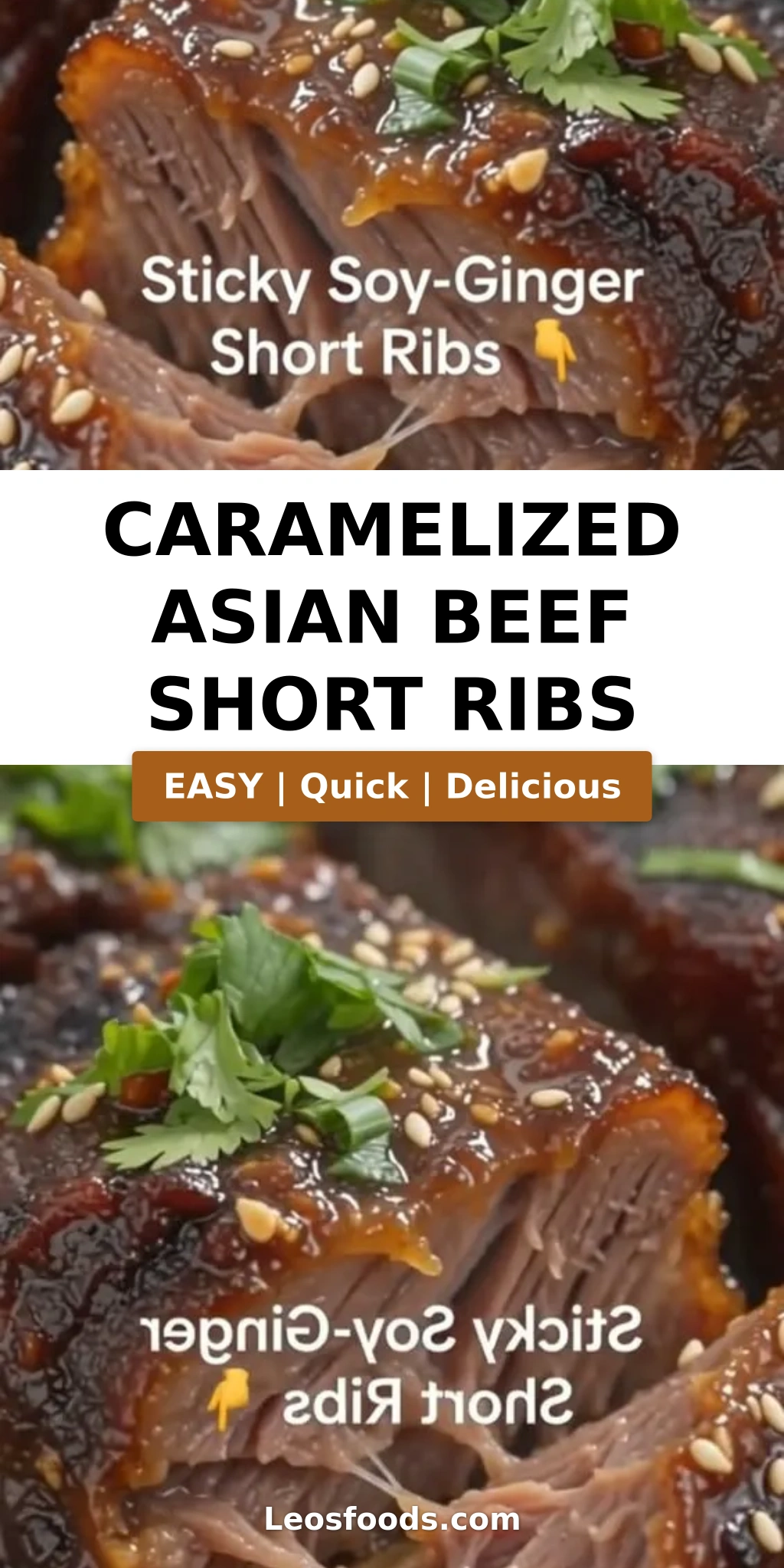
Sticky Caramelized Asian Beef Short Ribs
Table of Contents
Caramelized Asian Beef Short Ribs – Sticky, Tender & Soy-Ginger Perfection
I still remember the first time I made asian beef short ribs that actually tasted like the ones from my favorite Chinatown spot in New York City. I had just moved into my little apartment near Union Square, and the smell of soy, ginger, and caramelizing brown sugar filled every corner. These caramelized short ribs are the kind of dish that stops conversation the moment you set the pan on the table — glossy, lacquered, and impossibly tender. Growing up in Morocco, my mother taught me that patience in the kitchen always pays off, and this recipe is living proof. The sticky beef ribs you get after hours of slow roasting are nothing short of magical, with a deep umami richness that coats every bite.
Imagine biting into a piece of meat so tender it practically falls off the bone, cloaked in a thick, soy ginger beef ribs glaze that hits every note — savory, sweet, tangy, and just a whisper of heat. The aroma alone will have your family wandering into the kitchen asking what’s for dinner. These slow roasted short ribs develop a crust that is sticky and caramelized on the outside while staying buttery and succulent within. I love serving them over a bed of fluffy jasmine rice so every grain catches that luscious sauce. The contrast of textures — the crisp edge of the caramelized exterior against the melt-in-your-mouth meat — is pure weeknight luxury.
What sets my version apart is a trick I learned during my pastry training in Paris: I finish the ribs under the broiler for a final blast of heat that intensifies the caramelization without burning the sugar. It’s a small step that makes a huge difference. In this post, I’ll walk you through every stage — from searing to slow roasting to that glossy finish — so you can nail these asian beef short ribs on your very first try. I’ll also share the one mistake most home cooks make that leads to a bitter sauce (spoiler: it’s all about when you add the honey) and how to fix it. Grab your Dutch oven and let’s get cooking!
Why This Caramelized Asian Beef Short Ribs Recipe Is the Best
The flavor secret behind these asian beef short ribs lies in the balance of the glaze. I combine brown sugar and honey with soy sauce, hoisin, and fresh ginger to create a layered sweetness that never feels cloying. The French technique of deglazing and reducing the sauce after braising is what gives it that restaurant-quality sheen. Growing up in Morocco, I learned to layer spices slowly — here, the ginger and garlic are mellowed by the long cooking time, so they perfume the meat without overwhelming it.
Texture is everything with short ribs, and my method guarantees perfection. By searing the ribs first and then slow roasting them covered at 325°F, the collagen breaks down into gelatin, giving you that fork-tender bite. The final step — simmering the sauce on the stovetop until it thickens and coats the back of a spoon — transforms the liquid into a glossy, caramelized glaze that clings to every rib. I’ve tested this technique dozens of times in my NYC kitchen, and it works every single time.
This recipe is also foolproof for beginners. The ingredients are easy to find at any US grocery store, and the hands-on time is minimal — most of the work happens in the oven. You don’t need any special equipment beyond a good Dutch oven. I’ve made these caramelized short ribs for dinner parties, holiday gatherings, and quiet weeknight meals, and they always steal the show. If you can sear meat and whisk a sauce, you can make this dish.
Asian Beef Short Ribs Ingredients
I source my short ribs from the meat counter at the Union Square Greenmarket in NYC, where the grass-fed beef is always well-marbled. The rest of the ingredients come from my local Whole Foods and the little Asian market on Mott Street in Chinatown. Each component plays a specific role in building the deep, balanced flavor of these soy ginger beef ribs.
Ingredients List
- 4 pounds beef short ribs, bone-in
- 1/2 cup soy sauce
- 1/4 cup brown sugar, packed
- 1/4 cup honey
- 2 tablespoons hoisin sauce
- 4 cloves garlic, minced
- 2 tablespoons fresh ginger, grated
- 1 teaspoon sesame oil
- 1/2 cup beef broth
- 1 tablespoon rice vinegar
- 1/2 teaspoon red pepper flakes (optional)
- 2 green onions, sliced (for garnish)
- 1 tablespoon sesame seeds (for garnish)
Ingredient Spotlight
Let’s look at the four most important ingredients in these asian beef short ribs and how to choose them at your local market. I’ll also share the substitutions I’ve tested so you can adapt the recipe to what you have on hand.
| Original Ingredient | Best Substitution | Flavor / Texture Impact |
|---|---|---|
| Soy Sauce | Tamari or coconut aminos | Tamari is very similar; coconut aminos are sweeter and less salty |
| Brown Sugar | Coconut sugar or dark brown sugar | Coconut sugar is less sweet; dark brown adds deeper molasses notes |
| Hoisin Sauce | Oyster sauce or extra soy + a touch of sugar | Oyster sauce is more savory; DIY version is thinner but works |
| Fresh Ginger | 1 tsp ground ginger (not ideal) | Ground ginger is milder and lacks the fresh heat — use fresh if possible |
How to Make Caramelized Asian Beef Short Ribs — Step-by-Step
Making these caramelized short ribs is a labor of love, but I promise every minute is worth it. Follow these steps closely and you’ll be rewarded with the most succulent, sticky beef ribs of your life.
Step 1: Preheat and Season
Preheat your oven to 325°F. While it heats, pat the short ribs dry with paper towels and season them generously on all sides with salt and pepper. Let them sit at room temperature for about 15 minutes — this helps the seasoning adhere and promotes a better sear.
💡 Stella’s Pro Tip: For the best crust, use a cast-iron Dutch oven. It holds heat evenly and gives you that deep brown sear that builds flavor.
Step 2: Sear the Ribs
Heat a tablespoon of oil in your Dutch oven over medium-high heat. Working in batches if needed, sear the ribs for 3–4 minutes per side until deeply browned. Don’t crowd the pot — too many ribs at once will steam instead of sear. Transfer the seared ribs to a plate and set aside.
⚠️ Common Mistake to Avoid: Skipping the sear or rushing it. A pale surface means less flavor. You want a dark, almost mahogany crust on each side.
Step 3: Whisk the Sauce
In a medium bowl, whisk together soy sauce, brown sugar, honey, hoisin sauce, minced garlic, grated ginger, sesame oil, beef broth, rice vinegar, and red pepper flakes if using. Make sure the brown sugar is fully dissolved — this prevents graininess in the finished glaze.
💡 Stella’s Pro Tip: Grate the ginger on a microplane rather than chopping it. It melts into the sauce and distributes the flavor evenly without stringy bits.
Step 4: Combine and Simmer
Return the seared ribs to the Dutch oven, nestling them in a single layer if possible. Pour the sauce over the ribs and bring the liquid to a gentle simmer on the stovetop — about 3–4 minutes over medium heat. Once simmering, cover the pot with a tight-fitting lid and transfer it to the oven.
⚠️ Common Mistake to Avoid: Boiling the sauce too hard before covering. A gentle simmer is all you need. Boiling can cause the sugar to scorch on the bottom of the pot before the meat is tender.
Step 5: Slow Roast
Bake the ribs for 2.5 to 3 hours, checking once at the 2-hour mark. The meat is ready when it is very tender and practically falling off the bone. A fork inserted into the thickest part should meet no resistance. If the sauce looks too thin at this point, don’t worry — we will thicken it next.
💡 Stella’s Pro Tip: Every oven runs slightly different. At the 2-hour mark, start checking for doneness every 15 minutes. The ribs should jiggle like a slow-cooked pot roast.
Step 6: Thicken the Sauce
Carefully remove the ribs from the pot and transfer them to a plate. Skim the excess fat from the surface of the sauce using a large spoon or a fat separator. Place the pot on the stovetop over medium-high heat and simmer the sauce until it thickens and becomes syrupy, about 10 minutes. You will see it darken and reduce by about half.
⚠️ Common Mistake to Avoid: Not skimming the fat. If you skip this step, the sauce will be greasy and won’t caramelize properly. Take the extra minute to remove it.
Step 7: Glaze and Garnish
Return the ribs to the pot and spoon the thickened sauce over each piece until they are fully coated. For extra caramelization, place the pot under the broiler for 2–3 minutes — watch closely so the sugar doesn’t burn. Garnish with sliced green onions and sesame seeds, and serve immediately.
💡 Stella’s Pro Tip: If you broil, use an oven-safe pot and keep the handle facing away from the flame. The broiler step is optional but it gives the ribs that candied, sticky finish that makes them unforgettable.
| Step | Action | Duration | Key Visual Cue |
|---|---|---|---|
| 1 | Season ribs | 15 min | Salt and pepper evenly coating all sides |
| 2 | Sear ribs | 3–4 min per side | Deep mahogany crust forms |
| 3 | Make sauce | 5 min | Sugar fully dissolved, sauce smooth |
| 4 | Simmer & cover | 3–4 min | Gently bubbling, not boiling |
| 5 | Slow roast | 2.5–3 hr | Meat pulls apart with fork |
| 6 | Thicken sauce | ~10 min | Syrupy, coats spoon |
| 7 | Glaze & garnish | 2–3 min (broil) | Glossy, lacquered surface |
Serving & Presentation
I love serving these caramelized short ribs over a bed of steamed jasmine rice, which soaks up every drop of that sticky sauce. A simple side of garlicky bok choy or roasted broccoli balances the richness beautifully. When I’m feeling nostalgic for my Paris days, I’ll add a sprinkle of flaky sea salt right before serving — it cuts through the sweetness and adds a lovely crunch.
Garnish is non-negotiable here. The green onions and sesame seeds add color and a fresh, nutty contrast to the deep, dark glaze. For a finishing touch, I sometimes drizzle a little extra sesame oil over the top just before bringing the pot to the table. It reminds me of the vibrant street food stalls in Marrakech, where every dish is a feast for the eyes as much as the palate.
| Pairing Type | Suggestions | Why It Works |
|---|---|---|
| Side Dish | Steamed jasmine rice, garlic bok choy, roasted broccoli | Rice absorbs the sauce; greens cut richness with freshness |
| Sauce / Dip | Extra reduced glaze, chili crisp, hoisin-lime dip | Glaze reinforces the caramelized notes; chili crisp adds heat |
| Beverage | Cold sake, light lager, iced green tea | Sake and beer cut sweetness; green tea cleanses the palate |
| Garnish | Green onions, sesame seeds, flaky salt, fresh cilantro | Adds color, crunch, and a burst of freshness to finish |
Make-Ahead, Storage & Reheating
These sticky beef ribs are a dream for meal prep. I often make a double batch on Sunday and enjoy them throughout the week — the flavor actually deepens after a day or two in the fridge. Here is how I store and reheat them in my busy NYC kitchen.
| Method | Container | Duration | Reheating Tip |
|---|---|---|---|
| Refrigerator | Airtight glass container | Up to 4 days | Reheat in a covered pot on low with a splash of water or broth |
| Freezer | Freezer-safe zip bag or container | Up to 3 months | Thaw in fridge overnight, then reheat covered at 300°F for 20 min |
| Make-Ahead | Pot with lid | Up to 2 days in advance | Cook fully, cool, refrigerate. Reheat gently and add fresh garnish before serving |
When reheating, avoid the microwave — it can toughen the meat and make the sauce grainy. Instead, warm the ribs in a covered pot on the stovetop over low heat, adding a tablespoon of beef broth or water to loosen the sauce. Stir occasionally until heated through, then finish with a fresh sprinkle of green onions and sesame seeds. The ribs will taste just as good as the day you made them.
If you are planning to freeze these asian beef short ribs, I recommend freezing them in the sauce. The glaze acts as a protective layer that keeps the meat moist during thawing. When you are ready to serve, reheat them slowly and add a final drizzle of honey or soy sauce to refresh the flavor.
Variations & Easy Swaps
| Variation | Key Change | Best For | Difficulty Impact |
|---|---|---|---|
| Spicy Korean Gochujang | Add 2 tbsp gochujang to the sauce | Heat lovers, Korean flavor fans | Easy — same method |
| Gluten-Free / Tamari | Replace soy sauce with tamari | Gluten-free diets, celiac | Easy — no change needed |
| Orange-Ginger Twist | Add 2 tbsp orange juice + zest | Bright, citrus-forward preference | Easy — adds a bright note |
Spicy Korean Gochujang Version
For a fiery kick, stir 2 tablespoons of gochujang (Korean chili paste) into the sauce before pouring it over the ribs. The gochujang adds a complex, fermented heat that pairs beautifully with the brown sugar and honey. This version reminds me of the Korean-Moroccan fusion dishes I used to experiment with at a pop-up in Brooklyn. The heat level is medium — if you want it milder, start with 1 tablespoon and taste as you go.
Gluten-Free / Tamari Version
To make these caramelized short ribs gluten-free, simply swap the soy sauce for tamari. Tamari has a similar color and saltiness, so no other adjustments are needed. Coconut aminos also work but will make the sauce a touch sweeter — reduce the honey by 1 tablespoon if you go that route. This variation is a staple in my gluten-free dinner rotation, and the flavor is just as bold and satisfying as the original.
Orange-Ginger Twist
During the winter months, I love adding 2 tablespoons of fresh orange juice and the zest of one orange to the sauce. The citrus brightens the deep umami notes and complements the ginger beautifully. I discovered this combination at the Union Square farmers market when I found a batch of incredible blood oranges. The orange caramelizes slightly during the broiling step, creating a beautiful glossy finish with a subtle fruity note.
What is the best way to caramelize beef short ribs without burning the sugar?
The key to caramelizing asian beef short ribs without burning the sugar is to control the heat at every stage. First, sear the ribs at medium-high heat to build flavor, but do not let the sugar in the sauce hit high heat directly until the final reduction. When you simmer the sauce on the stovetop after roasting, keep it at a gentle bubble — not a rolling boil — and stir occasionally. The broiler step at the end should be brief, 2–3 minutes max, and you should watch it the entire time. If your sauce starts to smell bitter or turns very dark brown, the sugar has scorched. A good rule is to finish the glaze on the stovetop rather than relying solely on the oven or broiler for caramelization.
Can I substitute soy sauce with tamari or coconut aminos in Asian beef short ribs?
Yes, absolutely. Tamari is a gluten-free alternative made from soybeans with little or no wheat, and it has a very similar flavor profile to soy sauce, making it a nearly seamless swap in these soy ginger beef ribs. Coconut aminos, made from fermented coconut sap, are sweeter and less salty, so you may want to reduce the honey or brown sugar by about a tablespoon and add a pinch of salt to balance the flavor. Both substitutes will work beautifully in this recipe. I tested all three versions in my NYC kitchen, and the texture and caramelization were consistent across the board.
How long should I cook Asian beef short ribs for them to become tender?
For bone-in slow roasted short ribs, the sweet spot is 2.5 to 3 hours at 325°F. The collagen in the meat needs time to break down into gelatin, which is what gives you that fork-tender, melt-in-your-mouth texture. I recommend checking at the 2-hour 15-minute mark: insert a fork into the thickest part of a rib — if it twists easily and the meat starts to separate from the bone, they are ready. Every cut of meat is slightly different, so rely on tenderness rather than the clock. Cooking them longer than 3 hours can cause the meat to dry out and the sauce to reduce too much and burn.
What side dishes pair well with caramelized Asian beef short ribs?
These sticky beef ribs pair beautifully with light, fresh sides that balance the richness of the glaze. Steamed jasmine rice or coconut rice is classic and soaks up the sauce perfectly. For vegetables, I recommend garlicky bok choy, sautéed snow peas, or a crisp cucumber salad with rice vinegar and sesame seeds. A simple slaw with shredded carrots and a lime-ginger dressing also works wonders. If you want something heartier, try serving the ribs over garlic noodles or alongside crispy smashed potatoes. The goal is to let the ribs be the star while the sides add freshness and texture.
Can I make caramelized Asian beef short ribs in a slow cooker or Instant Pot?
Yes, you can adapt this recipe for a slow cooker. Sear the ribs first, then transfer them to the slow cooker with the sauce and cook on low for 7–8 hours or on high for 4–5 hours. For the Instant Pot, sear using the sauté function, then pressure cook on high for 45 minutes with a natural release of 15 minutes. In both cases, you will still need to remove the ribs and simmer the sauce on the stovetop to thicken and caramelize it properly. The slow cooker method yields ultra-tender meat, but the stovetop reduction is essential for achieving that sticky glaze.
How do I prevent the sauce from becoming too salty?
The best way to control saltiness in these asian beef short ribs is to use low-sodium soy sauce and to adjust the salt you add when seasoning the meat. I always use low-sodium soy sauce and I do not add extra salt to the sauce itself — the soy sauce, hoisin, and beef broth provide enough sodium. If you accidentally make the sauce too salty, add a splash of water or unsalted beef broth and a teaspoon of honey or brown sugar to balance it out. Taste the sauce before you add the ribs to the pot and adjust early.
Can I use boneless short ribs for this recipe?
Yes, boneless short ribs work well, though bone-in ribs have more flavor and stay moister during the long cooking time. If you use boneless ribs, reduce the cooking time by about 30 minutes and check for tenderness starting at the 2-hour mark. Boneless ribs can dry out more easily, so I recommend keeping them submerged in the sauce and covering the pot tightly. The caramelization step at the end works the same way. Either way, you will end up with delicious caramelized short ribs that are sure to impress.
What is the difference between hoisin sauce and oyster sauce in this recipe?
Hoisin sauce is thick, sweet, and made from soybeans, sugar, and spices, while oyster sauce is more savory and made from oyster extracts. In these sticky beef ribs, hoisin adds sweetness and a subtle five-spice warmth that complements the brown sugar and honey. If you substitute oyster sauce, the ribs will be less sweet and more savory — you may want to add an extra tablespoon of brown sugar to compensate. I prefer hoisin for this recipe, but oyster sauce is a fine substitute if that is what you have in your fridge.
Can I prepare these Asian beef short ribs a day ahead for a party?
Absolutely. In fact, these slow roasted short ribs taste even better the next day because the flavors have more time to meld. Cook the ribs fully, cool them in the sauce, and refrigerate them in an airtight container. When you are ready to serve, reheat them gently on the stovetop or in a 300°F oven until warmed through, then finish with the broiler step for that fresh caramelized glaze. Add the green onions and sesame seeds just before serving. This make-ahead strategy is my go-to for dinner parties — it saves time and the results are consistently stunning.
What type of beef short ribs are best for caramelizing — English cut or flanken style?
For these caramelized short ribs, I recommend English-cut short ribs, which are cut between the bones into individual pieces. They are thicker and more uniform, making them ideal for slow roasting and searing. Flanken-style ribs, which are cut across the bone into thin strips, cook much faster and are better suited for grilling or Korean barbecue. English-cut ribs hold up to the long braising time and give you that dramatic, falling-off-the-bone presentation. Look for ribs with good marbling — the fat keeps the meat moist and adds flavor during the slow roast.
Share Your Version!
I absolutely love hearing how these asian beef short ribs turn out in your kitchen. Did you try the broiler trick? Did you go for the spicy gochujang variation? Drop a star rating and a comment below — your feedback helps other home cooks know exactly what to expect. Every time I see a photo of someone’s glossy, caramelized ribs, it makes my day.
Snap a photo of your sticky beef ribs and tag me on Instagram or Pinterest @leosfoods. I share my favorite reader recreations in my stories every week. If you have a question about a substitution or a step, ask away — I personally read every comment and I will get back to you. Cooking is about connection, and nothing makes me happier than knowing this recipe is bringing warmth to your table.
From my NYC kitchen to yours — I hope this recipe brings as much warmth to your table as it does to mine. — Stella 🧡
Love This Recipe? Save It to Pinterest!
If you enjoyed this Caramelized Asian Beef Short Ribs recipe, don’t let it get lost in your browser tabs! 😄 Pin it now so you can find it again anytime — and explore hundreds more tried-and-tested recipes waiting for you on my Pinterest boards.
👉 Follow Stella on Pinterest @stellarecipeblog
📌 Pin this recipe · 🔁 Re-pin your favorites · 💬 Tag me when you make it — I love seeing your creations!
🍳 Made this recipe? I want to hear about it!
Tag @leosfoods on Instagram or leave a ⭐⭐⭐⭐⭐ review below. Your feedback helps this little food blog grow — and it makes my day every single time. Thank you for being here! 💛
— Stella 🧡
Caramelized Asian Beef Short Ribs
Slow-roasted, sticky, and unbelievably tender 🤤🥩 These Caramelized Asian Beef Short Ribs are packed with bold soy-ginger flavor and melt right off the bone. The perfect comfort-food dinner for cozy nights! 🍚✨
- Total Time: 3 hours 20 minutes
- Yield: 4 servings 1x
Ingredients
- 4 pounds beef short ribs, bone-in
- 1/2 cup soy sauce
- 1/4 cup brown sugar, packed
- 1/4 cup honey
- 2 tablespoons hoisin sauce
- 4 cloves garlic, minced
- 2 tablespoons fresh ginger, grated
- 1 teaspoon sesame oil
- 1/2 cup beef broth
- 1 tablespoon rice vinegar
- 1/2 teaspoon red pepper flakes (optional)
- 2 green onions, sliced (for garnish)
- 1 tablespoon sesame seeds (for garnish)
Instructions
- Preheat oven to 325°F.
- Season short ribs with salt and pepper. In a large ovenproof pot or Dutch oven, heat oil over medium-high heat and sear ribs on all sides, about 3-4 minutes per side. Remove ribs.
- In a bowl, whisk together soy sauce, brown sugar, honey, hoisin sauce, garlic, ginger, sesame oil, beef broth, rice vinegar, and red pepper flakes.
- Return ribs to pot, pour sauce over them, and bring to a simmer. Cover and transfer to oven.
- Bake for 2.5 to 3 hours, until meat is very tender and falling off the bone.
- Remove ribs from pot. Skim fat from sauce. Simmer sauce on stovetop until thickened and caramelized, about 10 minutes.
- Return ribs to pot, coat with sauce, and garnish with green onions and sesame seeds.
Notes
For extra caramelization, broil the coated ribs for 2-3 minutes before serving. Serve over steamed rice or noodles.
- Prep Time: 20 minutes
- Cook Time: 3 hours
- Method: Main Course
- Cuisine: Asian
Nutrition
- Calories: 685 kcal
- Sugar: 28 g
- Fat: 42 g
- Carbohydrates: 32 g
- Protein: 38 g
Tried This Recipe? Leave a Comment!
Did you make this recipe? I’d love to hear how it turned out! Please leave a comment and a rating below. Your feedback helps other home cooks and supports cheerychop.com!
For more delicious inspiration, follow me on Pinterest!