Lavender Lemon Pavlova with Mascarpone Cream & Ruby Berries
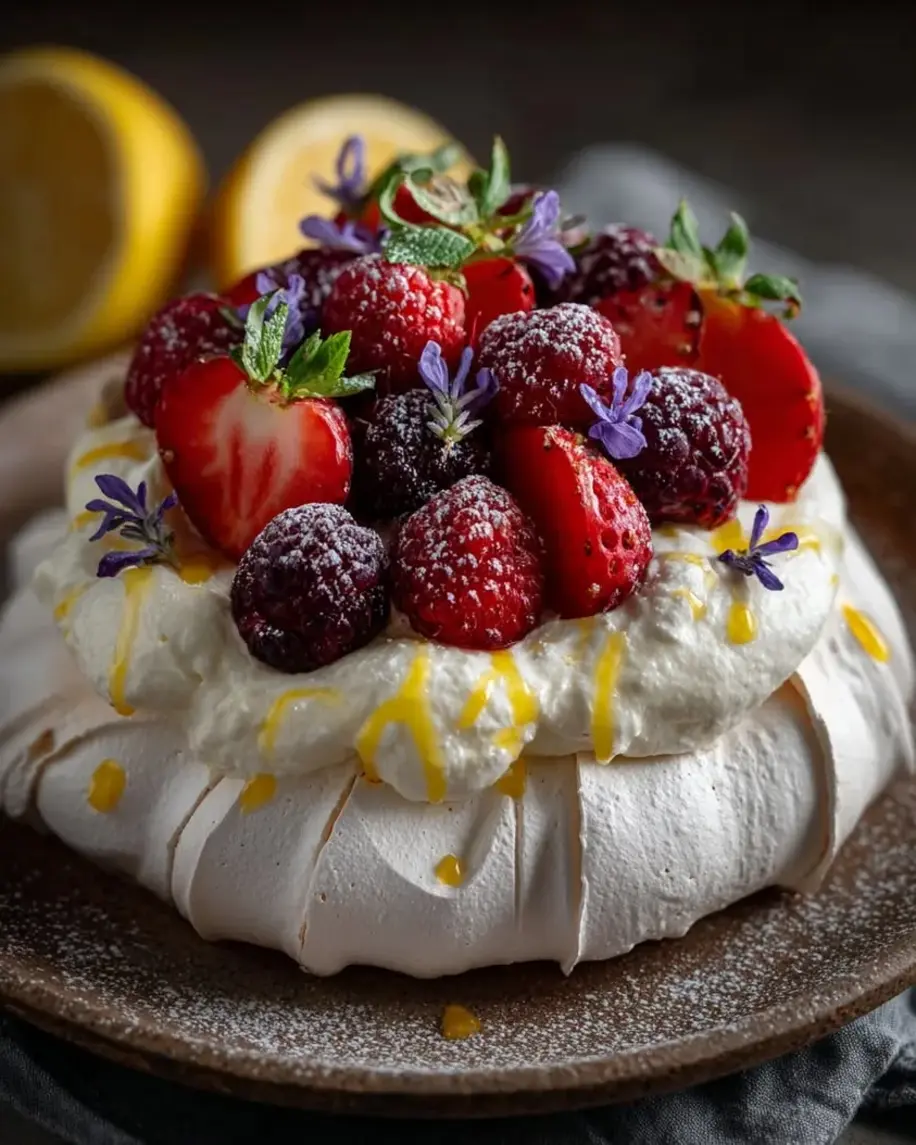
Table of Contents
Lavender Lemon Pavlova with Mascarpone Cream & Ruby Berries – The Perfect Elegant Dessert
I still remember the first time I made a lavender lemon pavlova – it was a sunny Saturday at my Paris culinary school, and the head pastry chef insisted we infuse the meringue with dried lavender from Provence. That floral, honeyed aroma mixed with bright lemon took me straight back to my mother’s kitchen in Morocco, where she would steep lavender in warm milk for her famous flan. This lavender lemon pavlova recipe is my love letter to those two worlds: the delicate French technique and the warm North African embrace of floral flavors. The magic lies in the meringue – crisp on the outside, marshmallowy within – and the cloud of mascarpone cream that melts into the ruby berries.
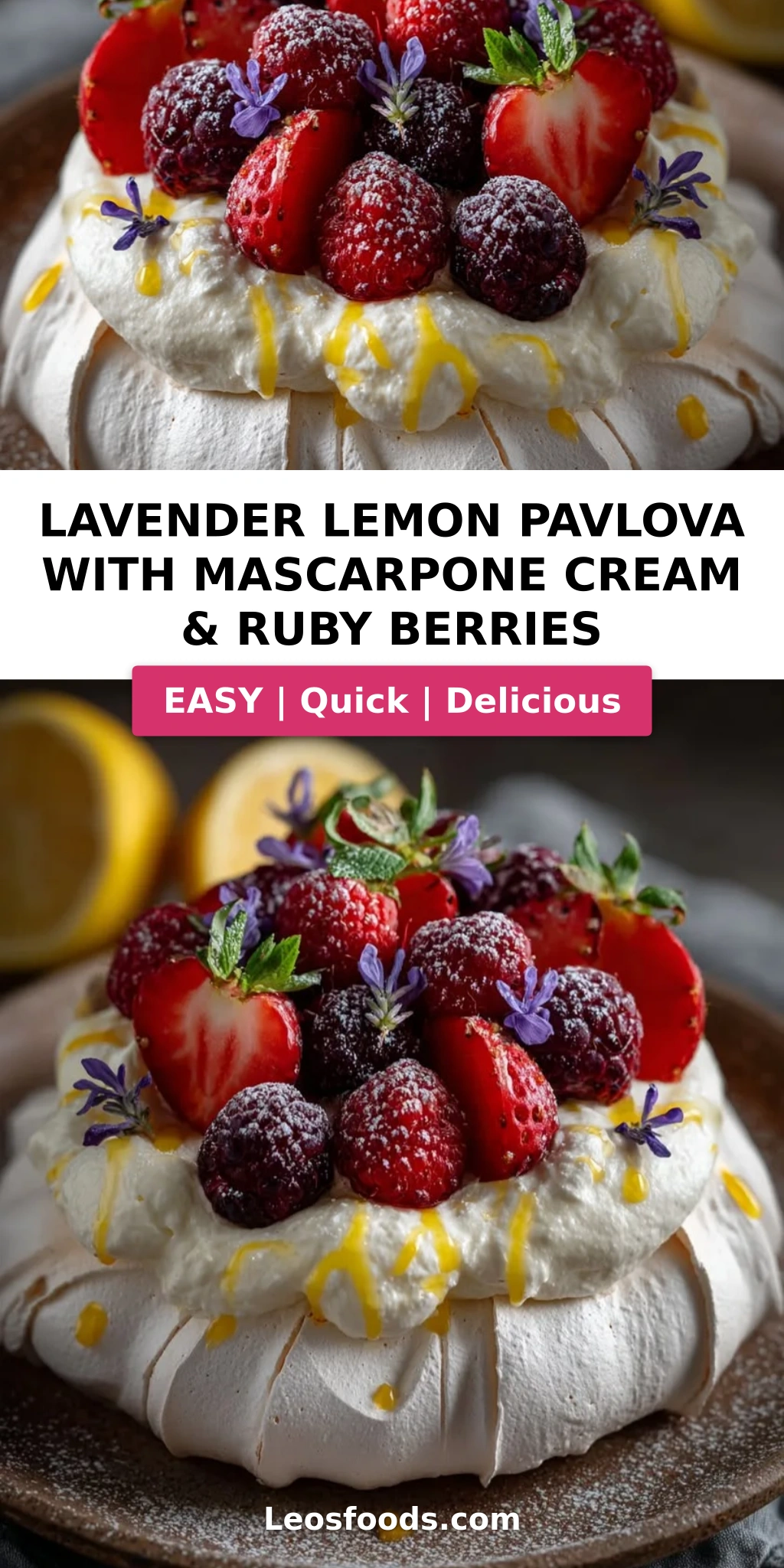
Imagine a snowy white pavlova base, its surface kissed with specks of ground lavender and lemon zest. The first bite shatters with a whisper, then gives way to a soft, airy interior. The mascarpone cream is luscious, not too sweet, with a tangy kick from fresh lemon juice. And the berries – strawberries, raspberries, cherries – macerated in honey and lemon, burst like jewels on your plate. The whole dessert is a symphony of textures and flavors: floral, citrusy, creamy, tart. It’s exactly the kind of elegant dessert that makes you slow down and savor each spoonful.
What sets this lavender pavlova recipe apart? I’ve spent years perfecting the meringue’s stability so you don’t end up with a cracked or weeping base. The secret is a tiny bit of cornstarch and vinegar, and grinding the dried lavender to a fine powder so it distributes evenly without bitter clumps. Plus, the mascarpone cream here is a game-changer – lighter than traditional whipped cream, richer than buttercream, and it holds its shape beautifully. I’ll share my tricks for a foolproof pavlova and a common mistake to avoid at every step. Let’s get started!
Why This Lavender Lemon Pavlova Recipe Is the Best
The flavor secret is the dual floral-citrus punch. By grinding dried culinary lavender and mixing it directly into the meringue, you get a subtle, even perfume without any bitterness. The lemon zest brightens the whole dessert. Growing up in Morocco, I learned that rose and orange blossom water can overwhelm, but lavender is more delicate – it whispers rather than shouts. My French training taught me to balance acidity and fat, so the mascarpone cream includes a splash of lemon juice to cut through the richness.
Perfected texture comes from two critical steps: the vinegar and cornstarch. Vinegar (or cream of tartar) stabilizes the egg whites, while cornstarch absorbs excess moisture and helps create that marshmallowy center. I also insist on cooling the pavlova inside the turned-off oven for at least an hour – this gentle drying prevents the dreaded crack and the sunken middle. It’s the same technique I learned from a pastry chef in the 6th arrondissement.
Foolproof & fast? Well, pavlova does require patience for baking and cooling, but the active time is only about 30 minutes. The components can be made ahead (see the Make-Ahead section), and the assembly takes five minutes. This recipe is fail-safe if you follow the visual cues – stiff, glossy peaks for the meringue; a thick, spreadable cream; berries that release just a little juice. Even if you’ve never made a pavlova before, I promise you’ll wow your guests.
Lavender Lemon Pavlova Ingredients
I love sourcing ingredients for this recipe at my local Union Square Greenmarket in NYC. The lavender comes from the dried herb stand, the berries are at their peak in summer, and the eggs are from pasture-raised hens. But everything is easy to find at any well-stocked grocery store. Here’s what you’ll need:
Ingredients List
- For the Pavlova: 4 large egg whites
- 1 cup granulated sugar
- 1 tsp white vinegar
- 1 tsp cornstarch
- 1 tsp vanilla extract
- 1/2 tsp dried culinary lavender, finely ground
- 1 tsp lemon zest
- For the Mascarpone Cream: 8 oz mascarpone cheese
- 1 cup heavy cream
- 1/3 cup powdered sugar
- 1 tsp vanilla extract
- 1 tsp lemon juice
- For the Ruby Berries: 1 cup strawberries, halved
- 1/2 cup raspberries
- 1/2 cup cherries, pitted and halved
- 1 tbsp honey
- 1 tsp lemon juice
- For Garnish (optional): Fresh lavender sprigs, lemon zest, powdered sugar dusting
Ingredient Spotlight
Dried culinary lavender is the star. Look for food-grade lavender in the spice aisle or online. Avoid any labeled for potpourri – those may contain chemicals. Grind it to a powder using a mortar and pestle or a spice grinder so you don’t get crunchy bits in your delicate meringue. If you can’t find lavender, you can substitute 1 teaspoon of rose water (add with the vanilla) but the flavor will be different – more Moroccan-style.
Mascarpone cheese is an Italian cream cheese with a velvety texture. It’s what makes the topping luxuriously thick without being heavy. For a dairy-free version, try full-fat coconut cream whipped with a little powdered sugar – but note that coconut cream won’t hold its shape as long. Regular cream cheese blended with heavy cream can work, but the tang will be stronger.
Egg whites are the backbone of the pavlova. Use eggs that are a few days old – they whip up more voluminously than super-fresh ones. Separate the eggs carefully; even a speck of yolk will prevent the whites from stiffening. Room-temperature whites also whip faster and higher. If you’re short on time, place the eggs in a bowl of warm water for 10 minutes.
Ruby berries – strawberries, raspberries, cherries – provide acidity and color. You can use frozen berries in a pinch; thaw and drain them first, and reduce the honey because they’ll be sweeter. In winter, swap in pomegranate arils and blood orange segments for a festive twist.
| Original Ingredient | Best Substitution | Flavor / Texture Impact |
|---|---|---|
| Dried culinary lavender | 1 tsp rose water (added with vanilla) | Floral, more Moroccan; omit lavender powder |
| Mascarpone cheese | Full-fat cream cheese + 2 tbsp heavy cream | Tangier, slightly less smooth; whip longer |
| Heavy cream (for topping) | Canned coconut cream (chilled, whipped) | Coconut flavor, lighter, less stable |
| Granulated sugar | Superfine sugar (dissolves faster) | Same sweetness, easier meringue |
| Fresh berries | Frozen mixed berries (thawed, drained) | Softer texture, sweeter juice |
How to Make Lavender Lemon Pavlova — Step-by-Step
I’ve broken down every step so even a first-time pavlova maker will feel confident. Pay attention to the visual cues – the meringue should be glossy and stiff, the cream thick but not buttery.
Step 1: Prepare Oven and Tray
Preheat your oven to 250°F (120°C). Line a large baking sheet with parchment paper. Trace a 9-inch circle on the parchment as a guide – just flip it over so the pencil marks don’t touch the food.
💡 Stella’s Pro Tip: Use a dab of butter in the four corners under the parchment to keep it flat.
Step 2: Whip Egg Whites
In a very clean, dry bowl (preferably stainless steel or glass), beat the 4 egg whites on medium speed until soft peaks form – the whites should hold a gentle curl when you lift the whisk.
⚠️ Common Mistake to Avoid: Using a plastic bowl with a trace of grease. Wipe your bowl and whisk with lemon juice or vinegar before starting.
Step 3: Gradually Add Sugar
With the mixer running on medium-high, add the granulated sugar one tablespoon at a time. Wait until each addition is mostly dissolved before adding the next. Continue beating until the meringue is stiff, glossy, and holds a peak that doesn’t droop. Rub a little between your fingers – it should feel smooth, not grainy.
💡 Stella’s Pro Tip: To test if the sugar is fully dissolved, take a dab of meringue and rub it between your thumb and forefinger. If it feels gritty, keep beating.
Step 4: Fold in Flavors
In a small bowl, mix the vinegar, cornstarch, vanilla, ground lavender, and lemon zest together. Gently fold this mixture into the meringue using a spatula. Use a light hand – you want to keep as much air as possible.
⚠️ Common Mistake to Avoid: Over-folding will deflate the meringue. Stop as soon as you no longer see streaks.
Step 5: Shape the Pavlova
Spoon the meringue onto the parchment circle. Spread it out to the circle’s edge, then create a slight well in the center – like a bird’s nest – by building up the sides with a spatula. The edges can have soft peaks for a beautiful rustic look.
💡 Stella’s Pro Tip: For an elegant swirl, use the back of a spoon to make decorative ridges on the sides. Those ridges will catch the cream and berries.
Step 6: Bake and Cool
Place the tray in the oven and bake for 1 hour 15 minutes. Do not open the door! After the time is up, turn off the oven but leave the pavlova inside for at least 1 hour (or overnight) to cool completely. The meringue will continue drying and become crisp.
⚠️ Common Mistake to Avoid: Opening the oven door during baking or cooling can cause the pavlova to crack from sudden temperature change. Be patient!
Step 7: Make Mascarpone Cream
In a large bowl, combine mascarpone, heavy cream, powdered sugar, vanilla, and lemon juice. Beat with a hand mixer on low until smooth, then increase to medium-high and whip until thick and fluffy – about 2–3 minutes. Do not overbeat or it will become grainy.
💡 Stella’s Pro Tip: For a lighter cream, fold in 1/4 cup of whipped cream separately after beating the mascarpone mixture. This gives a silky, airy texture.
Step 8: Prepare Ruby Berries
In a medium bowl, toss the strawberries, raspberries, and cherries with 1 tablespoon honey and 1 teaspoon lemon juice. Let them sit for at least 10 minutes to release their natural juices – this creates a beautiful ruby syrup.
⚠️ Common Mistake to Avoid: Tossing too early – the berries will become mushy. Prepare them while the pavlova cools so they are fresh.
Step 9: Assemble and Serve
Just before serving, place the cooled pavlova on a serving plate. Spread the mascarpone cream over the top, leaving the edges visible. Spoon the ruby berries and their syrup over the cream. Garnish with fresh lavender sprigs, additional lemon zest, and a light dusting of powdered sugar.
💡 Stella’s Pro Tip: For clean slices, use a serrated knife dipped in hot water. Wipe dry between cuts. Serve immediately after assembly to keep the meringue crisp.
| Step | Action | Duration | Key Visual Cue |
|---|---|---|---|
| 1 | Preheat oven, line tray | 5 min | Oven at 250°F, parchment ready |
| 2 | Whip egg whites to soft peaks | 3–4 min | Whisk leaves a soft curl |
| 3 | Gradually add sugar, beat to stiff peaks | 8–10 min | Glossy, stiff peak, smooth between fingers |
| 4 | Fold in lavender-lemon mixture | 1 min | No streaks, meringue holds air |
| 5 | Shape into nest on tray | 5 min | 9-inch circle, indented center |
| 6 | Bake then cool in oven | 1h15 + 1h cooling | Golden hue, firm exterior |
| 7 | Whip mascarpone cream | 3–4 min | Thick, fluffy, holds peaks |
| 8 | Toss berries with honey & lemon | 2 min + 10 min rest | Juices released, berries glossy |
| 9 | Assemble and garnish | 5 min | Cream spread, berries piled, lavender on top |
Serving & Presentation
This elegant dessert recipe deserves a showstopping presentation. Place the assembled pavlova on a cake stand or a large wooden board. The white meringue against the ruby berries and creamy top is stunning. For individual servings, you can make mini pavlovas (about 4-inch rounds) – just reduce baking time to 45 minutes and let them cool as directed.
When I serve this at dinner parties in my NYC apartment, I like to pair it with a chilled dessert wine like a late-harvest Riesling or a sparkling Moscato. The floral notes in the wine echo the lavender. For a non-alcoholic option, a hibiscus iced tea with a splash of lemon is perfect. The berries can be swapped for any seasonal fruit – in fall, roasted figs and pears work beautifully; in spring, try sliced strawberries and edible flowers.
| Pairing Type | Suggestions | Why It Works |
|---|---|---|
| Side Dish | Fresh mint leaves, candied violets | Adds freshness and a touch of whimsy |
| Sauce / Dip | Extra berry sauce (simmer berries with sugar), lemon curd drizzle | Enhances tartness and fruitiness |
| Beverage | Late-harvest Riesling, Moscato d’Asti, hibiscus iced tea | Sweet floral notes complement lavender and berries |
| Garnish | Fresh lavender sprigs, lemon zest curls, edible glitter | Visual appeal, aromatic, and festive |
Make-Ahead, Storage & Reheating
As a busy mom and food blogger in New York, I plan ahead. The pavlova base can be baked, cooled, and stored in an airtight container at room temperature for up to 3 days. The mascarpone cream can be whipped and refrigerated for up to 2 days – just re-whip it briefly before spreading. The berries are best macerated just before serving, but you can prep them (wash, halve, pit) and keep them dry in the fridge for a day.
| Method | Container | Duration | Reheating Tip |
|---|---|---|---|
| Refrigerator (assembled) | Loose cover (not airtight – condensation ruins crunch) | Up to 4 hours | Not recommended – the meringue softens quickly; best to assemble just before serving. |
| Freezer (pavlova base only) | Wrap tightly in plastic then foil | Up to 3 months | Thaw at room temp for 30 min, then re-crisp in 200°F oven for 10 min |
| Make-Ahead (components) | Separate airtight containers | Pavlova base: 3 days room temp; Cream: 2 days fridge; Berries: 1 day dry | Assemble only when ready to serve |
If you have leftovers (rare in my house!), you can enjoy them the next day – the meringue will soften into a chewy, meringue-like crisp. I actually love that texture! Just keep the assembled pavlova loosely covered in the fridge and eat within 24 hours.
Variations & Easy Swaps
| Variation | Key Change | Best For | Difficulty Impact |
|---|---|---|---|
| Rose Water & Pistachio | Replace lavender with 1 tsp rose water; top with chopped pistachios | Moroccan-inspired, nutty crunch | Easy |
| Dairy-Free / Vegan | Use aquafaba for meringue, coconut cream for topping | Plant-based diet, allergy-friendly | Medium – aquafaba requires extra care |
| Winter Citrus & Pomegranate | Swap berries for blood orange segments and pomegranate arils | Seasonal holiday table | Easy |
Rose Water & Pistachio Pavlova
This variation takes me straight back to my mother’s kitchen in Morocco, where rose water and pistachios were used in every celebration. Simply replace the ground lavender with 1 teaspoon of rose water (add it with the vanilla). Omit the lemon zest from the meringue for a more floral profile. Top the mascarpone cream with chopped toasted pistachios and a few dried rose petals. The nutty crunch and floral aroma make this version equally stunning.
Dairy-Free / Vegan Pavlova
For a plant-based version, use aquafaba (the liquid from a can of chickpeas) instead of egg whites. Whip 3/4 cup aquafaba with 1/4 tsp cream of tartar until stiff peaks, then gradually add 3/4 cup sugar. Proceed with the same folding and baking – the baking time may need to be extended by 15–20 minutes. For the cream, chill a can of full-fat coconut cream overnight, scoop out the solid top, and whip with 2 tablespoons powdered sugar and 1/2 teaspoon vanilla. The texture is luscious but less stable than mascarpone – serve immediately.
Winter Citrus & Pomegranate Pavlova
When ruby berries are out of season, I turn to the bright colors of winter. Swap the mixed berries for blood orange segments, pomegranate arils, and a few kumquat slices. Macerate them with honey and a splash of orange liqueur (like Grand Marnier) instead of lemon juice. The effect is jewel-like and perfect for holiday gatherings. I first made this for a Christmas party in Paris, and it was a hit.
Can I use dried lavender instead of fresh in a Lavender Lemon Pavlova?
Absolutely, and in fact I recommend dried culinary lavender over fresh for this recipe. Fresh lavender flowers contain more moisture, which could make your meringue weep or become sticky. Dried lavender has a concentrated, aromatic floral flavor that bakes beautifully without adding extra liquid. Just be sure to buy food-grade dried lavender (look in the spice aisle of your grocery store or online). Grind it to a fine powder using a mortar and pestle or a clean coffee grinder – this prevents bitter pieces from ruining the delicate texture. If you only have fresh, you can try drying it yourself: hang bunches upside down in a dark, dry place for a week, then strip the flowers. But honestly, dried is more reliable for pavlova.
How do I prevent my pavlova from cracking or sinking in the middle?
This is the number one question I get from readers! Two secrets: first, add 1 teaspoon of white vinegar and 1 teaspoon of cornstarch to your meringue – they stabilize the egg whites and absorb excess moisture. Second, never open the oven door during baking or during the cooling process. After the bake time ends, turn off the oven and leave the pvlova inside for at least one hour to cool gradually. The sudden change in temperature is what causes cracks. Also, shaping your pavlova with a slight well in the center gives the meringue room to settle without sinking. If you follow these steps, you’ll get a perfect crisp shell with a soft marshmallow center every time.
What is the best substitute for mascarpone in the cream for this pavlova?
The best substitute for mascarpone is a mixture of full-fat cream cheese and heavy cream. For every 8 ounces of mascarpone, use 6 ounces of cream cheese (softened) and 2 tablespoons of heavy cream. Beat them together until smooth, then proceed with the rest of the recipe – still add the powdered sugar, vanilla, and lemon juice. The flavor will be slightly tangier and the texture a little firmer, but it will still be delicious. Another option is to use only heavy cream whipped to stiff peaks, but you’ll miss the richness of mascarpone. Avoid low-fat cream cheese or Neufchâtel, as they contain too much water and can make the cream runny.
Can I make Lavender Lemon Pavlova with Mascarpone Cream a day ahead?
You can prepare the components a day ahead, but I do not recommend assembling the entire pavlova more than a few hours before serving. Here’s what works: bake the pavlova base, cool it completely in the oven, then store it in an airtight container at room temperature for up to 3 days. The mascarpone cream can be whipped and refrigerated in a sealed container for up to 2 days – just give it a quick whisk before using. The berries should be macerated fresh, but you can wash and cut them a day ahead and keep them dry in the fridge. On the day of serving, simply spread the cream, top with berries, garnish, and enjoy. If you try to assemble the whole dessert a day ahead, the meringue will absorb moisture from the cream and become chewy and soft rather than crisp.
Why does my pavlova sometimes weep (be sticky on the bottom)?
Weeping is usually caused by undissolved sugar or excess moisture in the meringue. Make sure your sugar is fully dissolved before you stop beating – rub a little meringue between your fingers; if it feels gritty, keep beating. Also, use superfine sugar if possible, it dissolves faster. Another culprit is high humidity – don’t make pavlova on a rainy day, as the moisture in the air can seep into the meringue. Baking at a very low temperature (250°F) and leaving it to cool in the oven helps dry it out properly. Finally, be sure your bowl and utensils are completely grease-free – any fat will destabilize the egg whites and cause weeping.
Can I use a different type of vinegar for the pavlova?
Yes, you can substitute white vinegar with other mild vinegars without changing the flavor. Apple cider vinegar or white wine vinegar work well – both are light and won’t overpower the delicate lavender and lemon. Avoid balsamic or red wine vinegar, as their strong color and flavor would affect the pavlova’s appearance and taste. The purpose of the vinegar is to lower the pH of the egg whites, which helps stabilize the foam and create a crisper shell. You can also use cream of tartar (1/2 teaspoon) instead of vinegar – it’s a powder and does the same job. I sometimes use a combination of 1/2 teaspoon cream of tartar and 1/2 teaspoon vinegar for extra insurance.
What can I use instead of cornstarch in pavlova?
Cornstarch is used to absorb moisture and help create that soft, marshmallow center. The best substitute is arrowroot powder, which has a similar texture and works just as well. You can also use potato starch, but be aware it may add a slight starchy taste if not baked thoroughly. Tapioca starch is another option, though it can make the meringue a bit chewier. If you have none of these, you can simply omit the cornstarch – your pavlova will still work, but the center will be more crisp and less marshmallow-like. I personally think the cornstarch is worth including for that classic contrast.
How do I get my pavlova to be tall and not flat?
A tall, majestic pavlova starts with properly beaten egg whites. Use room-temperature eggs, and beat them on medium speed until soft peaks, then gradually add the sugar while increasing to high speed. The meringue should be stiff and glossy with no grainy sugar. When shaping, pile the meringue high in the center, then use a spatula to pull it outward to form a nest with raised edges. You can also pipe the meringue using a large star tip for more height – start from the center and work outward in concentric circles. Bake at a low temperature (250°F) to allow the pavlova to rise and dry without browning. Avoid over-spreading on the tray – keep the base within a 9-inch circle.
Is this lavender lemon pavlova gluten-free?
Yes, this recipe is naturally gluten-free! The meringue is made from egg whites and sugar, with cornstarch (which is gluten-free) as the only thickener. The mascarpone cream and berry topping contain no gluten either. Just be sure to check that your vanilla extract is labeled gluten-free (most are) and that any garnishes like lavender sprigs are pure. If you’re serving gluten-intolerant guests, this is a wonderful dessert option that doesn’t require any special substitutions. However, always read labels on ingredient packets – sometimes dried lavender can be processed in facilities that also handle wheat, so if cross-contamination is a concern, purchase certified gluten-free culinary lavender.
Can I use frozen berries for the ruby berry topping?
Absolutely, especially when fresh berries are out of season. Use a bag of frozen mixed berries (strawberries, raspberries, cherries). Thaw them completely in the fridge overnight or on the counter for a few hours. Transfer the berries and their juice to a sieve and drain off excess liquid – you don’t want a watery topping that will soak the pavlova. Then toss with honey and lemon as directed. The flavor will still be lovely, though the texture of the berries will be softer and the color may be slightly darker. If you prefer a thicker syrup, you can simmer the drained juice with a little extra honey until syrupy, then drizzle it over the assembled pavlova.
Share Your Version!
I hope you fall in love with this lavender lemon pavlova with mascarpone cream & ruby berries as much as I have. It’s one of those desserts that feels special enough for a birthday or anniversary, yet simple enough for a summer dinner party. The combination of floral, citrus, creamy, and tart is pure magic. I’d love to hear how it turned out for you – leave a star rating and a comment below, and tell me which variation you tried.
If you share a photo on Instagram or Pinterest, be sure to tag @leosfoods and use #StellasPavlova so I can cheer you on! And if you have any questions about the recipe, ask away in the comments – I read every single one and I’ll reply personally. From my NYC kitchen to yours – I hope this recipe brings as much warmth to your table as it does to mine. — Stella 🧡
Love This Recipe? Save It to Pinterest!
If you enjoyed this Lavender Lemon Pavlova with Mascarpone Cream & Ruby Berries recipe, don’t let it get lost in your browser tabs! 😄 Pin it now so you can find it again anytime — and explore hundreds more tried-and-tested recipes waiting for you on my Pinterest boards.
👉 Follow Stella on Pinterest @stellarecipeblog
📌 Pin this recipe · 🔁 Re-pin your favorites · 💬 Tag me when you make it — I love seeing your creations!
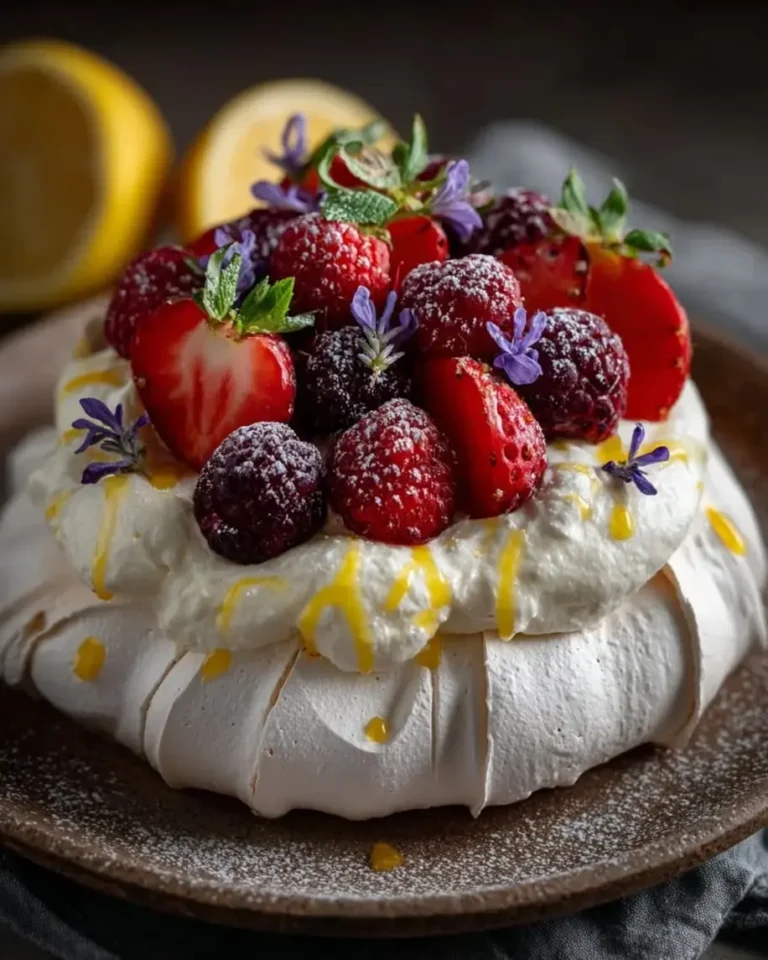
Lavender Lemon Pavlova with Mascarpone Cream & Ruby Berries
A delicate pavlova infused with lavender and lemon, topped with luscious mascarpone cream and a ruby berry medley.
- Yield: 8 1x
Ingredients
- For the Pavlova:
- 4 large egg whites
- 1 cup granulated sugar
- 1 tsp white vinegar
- 1 tsp cornstarch
- 1 tsp vanilla extract
- 1/2 tsp dried culinary lavender, finely ground
- 1 tsp lemon zest
- For the Mascarpone Cream:
- 8 oz mascarpone cheese
- 1 cup heavy cream
- 1/3 cup powdered sugar
- 1 tsp vanilla extract
- 1 tsp lemon juice
- For the Ruby Berries:
- 1 cup strawberries, halved
- 1/2 cup raspberries
- 1/2 cup cherries, pitted and halved
- 1 tbsp honey
- 1 tsp lemon juice
- For Garnish (optional):
- Fresh lavender sprigs
- Lemon zest
- Powdered sugar dusting
Instructions
- Preheat the oven to 250°F (120°C) and line a baking tray with parchment paper.
- Whip egg whites until soft peaks form.
- Gradually add sugar, continuing to whip until stiff, glossy peaks form.
- Fold in vinegar, cornstarch, vanilla, lavender, and lemon zest.
- Shape into a round pavlova base on the baking tray.
- Bake for 1 hour 15 minutes, then turn off oven and let cool completely inside.
- In a bowl, whip mascarpone, cream, powdered sugar, vanilla, and lemon juice until thick and fluffy.
- Toss berries with honey and lemon juice and let sit for 10 minutes.
- Spread mascarpone cream over cooled pavlova.
- Spoon ruby berries over the top.
- Garnish with lavender, lemon zest, and a light dusting of powdered sugar.
- Serve immediately.
Nutrition
- Calories: 290
- Sugar: 29 g
- Fat: 15 g
- Carbohydrates: 34 g
- Protein: 5 g
Tried This Recipe? Leave a Comment!
Did you make this recipe? I’d love to hear how it turned out! Please leave a comment and a rating below. Your feedback helps other home cooks and supports cheerychop.com!
For more delicious inspiration, follow me on Pinterest!