Mango Passionfruit Jewel Rings with Vanilla Silk Filling
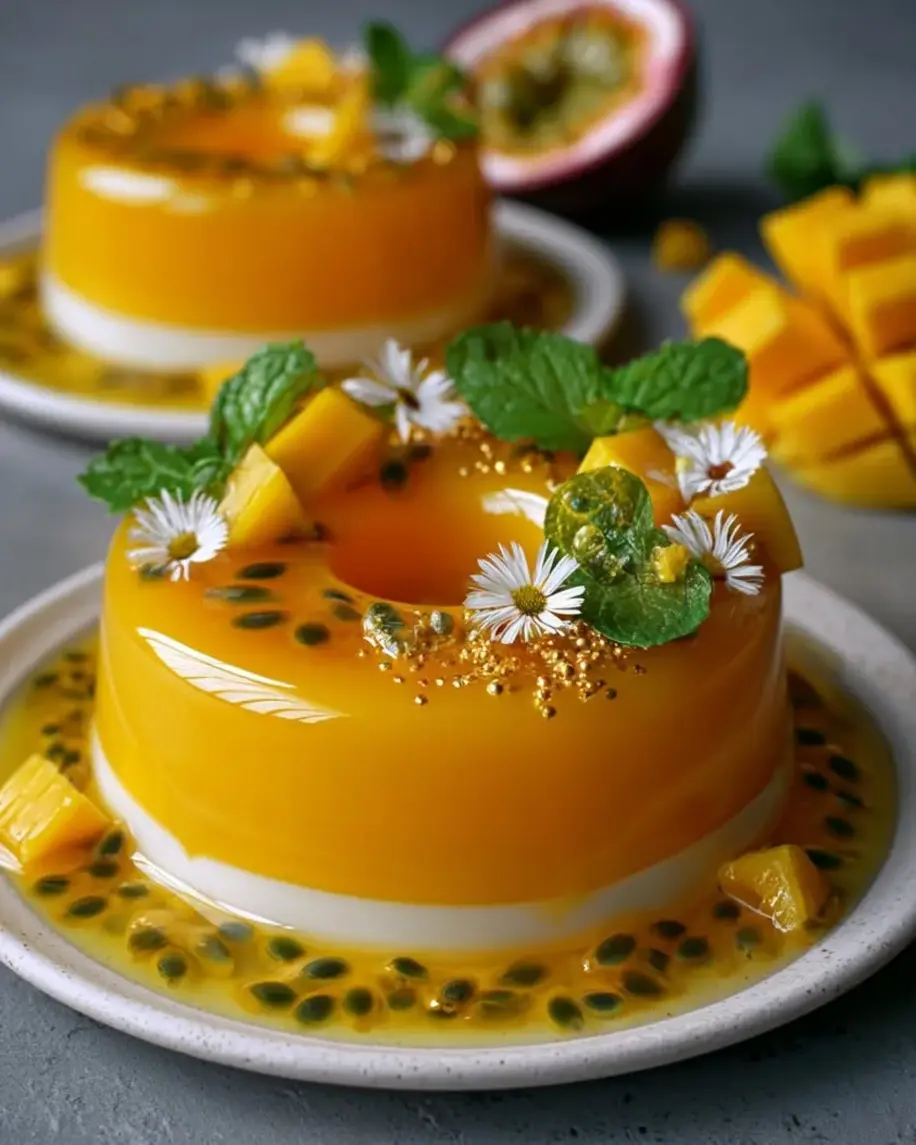
Table of Contents
Mango Passionfruit Jewel Rings with Vanilla Silk Filling – A Dazzling Tropical Dessert
I still remember the first time I bit into a perfectly set agar-agar jewel in a tiny patisserie near the Jardin du Luxembourg in Paris. I was a young culinary student then, fresh from my mother’s kitchen in Morocco where we used agar-agar to set fragrant rose and orange blossom waters into delicate confections. This Mango Passionfruit Jewel Rings with Vanilla Silk Filling recipe is my love letter to those memories — a dazzling tropical dessert where a sparkling mango-passionfruit shell meets the most luxurious vanilla silk center. The jewel rings recipe uses agar-agar to create a crystal-clear, jewel-like exterior that’s firm yet tender, while the filling is pure cloud-like decadence. Every bite is a burst of tropical sunshine.
The combination here is pure alchemy. Ripe mango puree and tart passionfruit juice form a shimmering amber shell that catches the light like a gemstone. Inside, the vanilla silk filling — made with mascarpone, vanilla bean paste, and a whisper of sweetened condensed milk — is impossibly smooth and creamy. A vibrant passionfruit ribbon swirls through the center, adding a bright pop of flavor and color. When you unmold these rings, they glisten like edible jewelry. I finish mine with fresh mango cubes, passionfruit pulp, delicate white chocolate curls, and just a flicker of edible gold flakes and pearl dust. It’s the kind of dessert that makes people gasp when you bring it to the table.
What sets my version apart is the technique I developed during my pastry training in Paris: a thin, even coating of the agar-agar mixture in the mold that creates a flawless, transparent shell, plus a perfectly stable vanilla silk filling that won’t weep or deflate. The trick is in how you layer and set each component. In this post, I’ll share my pro tips for working with agar-agar (a plant-based gelatin alternative that sets at room temperature and holds beautifully), how to keep your tropical agar-agar dessert from turning cloudy, and the one common mistake that can ruin the jewel effect — so you can avoid it. Let’s dive in.
Why This Mango Passionfruit Jewel Rings Recipe Is the Best
The Flavor Secret: Growing up in Morocco, my mother taught me that the best desserts balance sweetness with acidity. In this tropical agar-agar dessert, the mango puree brings lush, honeyed sweetness while the passionfruit juice cuts through with bright, tangy notes. I add a pinch of sea salt and fresh lime juice to elevate and deepen the fruit flavors — a French pastry chef’s trick I learned at Le Cordon Bleu. The vanilla silk filling uses real vanilla bean paste (not extract), giving it those tiny, aromatic specks that signal quality. The passionfruit curd ribbon ties everything together, adding a concentrated punch of tropical flavor in every bite.
Perfected Texture: The magic of these jewel rings lies in the agar-agar shell. Unlike gelatin, agar-agar sets at room temperature and maintains its shape even in warm weather — essential for a dessert that needs to look pristine. I’ve tested the exact ratio of agar-agar to liquid to give you a shell that’s firm enough to unmold cleanly but delicate enough to break with the edge of a spoon. The vanilla silk filling, meanwhile, uses a careful balance of mascarpone, heavy cream, and powdered sugar. Whip it just until fluffy — over-whipping can make it grainy. The result is a center that’s silky, stable, and almost mousse-like.
Foolproof & Fast: This passionfruit curd recipe within the dessert comes together in minutes — just stir honey and lime juice into good-quality passionfruit curd. The entire dessert uses one saucepan and a mixing bowl. While the chilling time is 4–6 hours (mostly hands-off), the active prep is only about 30 minutes. I’ve streamlined the process so home cooks in the US can achieve professional results without special equipment. Ring-shaped silicone molds are inexpensive and reusable, and agar-agar powder is now widely available at Whole Foods, specialty baking shops, and online. If I can make these jewel rings in my tiny NYC apartment kitchen between recipe testing and chasing deadlines, you can absolutely make them at home.
Mango Passionfruit Jewel Rings Recipe Ingredients
I source my mango puree from a specialty Latin grocery near my apartment in Astoria, Queens — they carry the most fragrant Alphonso mango puree in the fall. The passionfruit juice I often find frozen at Whole Foods or in cans at Asian markets. For the vanilla bean paste, I order online from a small-batch producer in Vermont that I discovered at the Union Square Greenmarket. Every ingredient in this tropical agar-agar dessert has been chosen for its ability to create that stunning, gem-like clarity and that cloud-like vanilla silk center.
Ingredients List
- For the Jewel Ring Shell:
- 1 cup mango puree, strained
- 1/2 cup passionfruit juice
- 1/2 cup water
- 3/4 cup granulated sugar
- 2 1/2 tsp agar-agar powder
- 1 tbsp fresh lime juice
- A few drops golden-yellow food coloring (optional)
- Pinch of sea salt
- For the Vanilla Silk Filling:
- 8 oz mascarpone cheese
- 1/2 cup heavy whipping cream
- 1/4 cup powdered sugar
- 1 tsp vanilla bean paste
- 1 tbsp sweetened condensed milk
- For the Passionfruit Ribbon:
- 1/4 cup passionfruit curd
- 1 tbsp honey
- 1 tsp fresh lime juice
- For Garnish (optional):
- Fresh mango cubes
- Passionfruit pulp
- White chocolate curls
- Edible gold flakes
- Edible pearl dust
- Micro mint leaves
Ingredient Spotlight
Mango Puree: The base of the jewel shell. Use a high-quality, strained mango puree for the clearest, most vibrant color. I prefer Alphonso or Ataulfo varieties for their deep sweetness and low fiber. If using fresh mangoes, peel, chop, and blend until smooth, then strain through a fine-mesh sieve to remove any fibers. Substitution: The same amount of papaya puree works well, though the flavor will be milder and the color paler.
Agar-Agar Powder: The key to the jewel-like structure. This plant-based gelling agent derived from seaweed sets firmly at room temperature and is heat-stable up to 140°F. I use Now Foods brand agar-agar powder for consistent results. Do not substitute with gelatin — the textures are completely different, and gelatin won’t give you that crystal-clear, firm-yet-tender shell. Substitution: Agar-agar flakes can be used, but you’ll need to adjust the quantity (use about 1 tbsp flakes for every 1 tsp powder) and soak them first.
Mascarpone Cheese: The heart of the vanilla silk filling. This Italian cream cheese is richer and silkier than American cream cheese, with a high butterfat content that creates a luscious, stable filling. I buy mine from Eataly in the Flatiron district. Substitution: Full-fat cream cheese blended with 2 tbsp heavy cream can mimic mascarpone’s texture, though the flavor will be tangier and less buttery.
Passionfruit Curd: The vibrant ribbon that swirls through the filling. I use store-bought passionfruit curd from Stonewall Kitchen or make my own when passionfruit is in season at the Union Square market. The honey and lime in the ribbon recipe balance the curd’s sweetness and enhance its natural tang. Substitution: Lemon curd mixed with 1 tbsp passionfruit juice works beautifully in a pinch, though the passionfruit flavor will be less pronounced.
| Original Ingredient | Best Substitution | Flavor / Texture Impact |
|---|---|---|
| Mango Puree | Papaya Puree (strained) | Milder flavor, paler color; still sets well |
| Agar-Agar Powder | Agar-Agar Flakes (1 tbsp flakes per 1 tsp powder) | Slightly softer set; needs pre-soaking and longer simmer |
| Mascarpone Cheese | Full-fat cream cheese + 2 tbsp heavy cream | Tangier, less buttery; still creamy but slightly denser |
| Passionfruit Curd | Lemon curd + 1 tbsp passionfruit juice | Less tropical, more citrus-forward; still tangy and glossy |
| Vanilla Bean Paste | 1 vanilla bean (scraped) or 1 1/2 tsp vanilla extract | Slightly less intense vanilla flavor; extract is thinner |
How to Make Mango Passionfruit Jewel Rings — Step-by-Step
This tropical agar-agar dessert comes together in a few straightforward steps. The key is patience with the setting process — don’t rush it! I’ll walk you through each stage, sharing the visual cues and pro tips I’ve learned from years of making these jewel rings.
Step 1: Prepare the Jewel Ring Shell Mixture
Combine 1 cup mango puree, 1/2 cup passionfruit juice, 1/2 cup water, 3/4 cup granulated sugar, 2 1/2 tsp agar-agar powder, 1 tbsp fresh lime juice, a few drops golden-yellow food coloring (if using), and a pinch of sea salt in a saucepan. Whisk thoroughly to dissolve the agar-agar powder — it should feel smooth with no gritty bits. Place the saucepan over medium heat and stir constantly with a silicone spatula. The mixture will start to thicken slightly as it heats. Bring it to a gentle simmer (you’ll see small bubbles forming around the edges), then let it bubble gently for 2 minutes, stirring continuously. The agar-agar needs to reach 185°F to activate fully. Remove from heat.
💡 Stella’s Pro Tip: Whisk the agar-agar powder into the cold liquid before heating. If you add it to a hot liquid, it can clump into gelatinous lumps that never dissolve properly. I learned this the hard way during my first week at culinary school in Paris!
Step 2: Coat the Molds
Place 6 ring-shaped silicone molds on a small baking sheet. Using a small ladle or a measuring cup with a spout, pour a thin layer (about 1/8 inch or 3 mm) of the warm mango-passionfruit mixture into each mold. Gently tilt and rotate each mold so the liquid coats the bottom and about 1 inch up the sides. You want to create a cup-like shell. Place the baking sheet in the refrigerator and chill for 10–15 minutes, until the mixture is partially set — it should feel firm to the touch but still slightly tacky on the surface.
⚠️ Common Mistake to Avoid: Don’t let the shell set completely before adding the filling! If the surface is fully firm and dry, the filling won’t adhere properly and you’ll get gaps between the shell and the vanilla silk center. You want it to be what the French call “prise” — set but still slightly sticky on top.
Step 3: Make the Vanilla Silk Filling
While the shells are chilling, make the vanilla silk filling. In a large mixing bowl, combine 8 oz mascarpone cheese, 1/2 cup heavy whipping cream, 1/4 cup powdered sugar, 1 tsp vanilla bean paste, and 1 tbsp sweetened condensed milk. Using a hand mixer or stand mixer fitted with the whisk attachment, beat on low speed until the ingredients are combined, then increase to medium-high speed and whip until smooth, fluffy, and silky — about 2–3 minutes. The mixture should hold soft peaks when you lift the whisk. Be careful not to over-whip, or the mascarpone can separate and become grainy. Transfer the filling to a piping bag fitted with a 1/2-inch round tip and set aside at room temperature.
💡 Stella’s Pro Tip: Make sure your mascarpone and cream are well-chilled before whipping. If they’re too warm, the filling will be loose and won’t hold its shape. If they’re too cold, the mixture may look curdled — let it sit for 5 minutes and re-whip gently.
Step 4: Make the Passionfruit Ribbon
In a small bowl, stir together 1/4 cup passionfruit curd, 1 tbsp honey, and 1 tsp fresh lime juice until glossy and smooth. The mixture should be thick but pourable — if it’s too thick, add a few drops of water. Transfer to a small piping bag or a zip-top bag with a tiny corner snipped off. Set aside.
⚠️ Common Mistake to Avoid: Don’t use cold passionfruit curd straight from the fridge — it’s too stiff to swirl. Let it come to room temperature for 15–20 minutes before mixing with the honey and lime juice. Cold curd won’t ribbon properly through the vanilla filling.
Step 5: Fill the Molds
Remove the baking sheet with the partially set shells from the refrigerator. Pipe the vanilla silk filling into the center of each ring mold, filling about three-quarters full — leave about 1/4 inch of space at the top. Using the piping bag with the passionfruit mixture, pipe a thin zigzag or spiral line through the filling, then use a toothpick to gently swirl it into a ribbon pattern. Be careful not to touch the sides of the shell. Gently tap the baking sheet on the counter to settle the filling and release any air bubbles.
💡 Stella’s Pro Tip: When swirling the passionfruit ribbon, use a gentle figure-eight motion with the toothpick. Over-swirling will muddy the colors — you want distinct ribbons of orange and cream, not a blended mess. Think of it as painting inside the ring!
Step 6: Set the Jewel Rings
Carefully spoon or ladle the remaining mango-passionfruit mixture over the filling to cover it completely, filling each mold to the brim. The mixture should be warm but not hot — if it’s too hot, it will melt the filling. Use the back of the spoon to gently smooth the tops. Place the baking sheet back in the refrigerator and chill for 4–6 hours, until the jewel rings are completely set and the shell is crystal clear. The tops should feel firm and springy to the touch. Do not move or disturb the molds during setting.
⚠️ Common Mistake to Avoid: Don’t rush the setting time! Agar-agar sets at room temperature, but the full structure takes 4–6 hours in the refrigerator to become firm enough to unmold cleanly. If you unmold too early, the rings will collapse or the shell will tear. Set a timer and practice patience — your jewel rings will reward you.
Step 7: Unmold and Garnish
Once completely set, gently unmold the jewel rings. Carefully flex the silicone molds away from the edges — the rings should release easily. If they stick, run a thin spatula around the edge or dip the bottom of the mold in warm water for 5 seconds. Place the unmolded rings on a chilled serving platter. Garnish with fresh mango cubes, passionfruit pulp, white chocolate curls, edible gold flakes, edible pearl dust, and micro mint leaves. The gold and pearl dust catch the light and make the rings truly sparkle.
💡 Stella’s Pro Tip: For the cleanest unmolding, chill the platter as well — a cold surface helps the rings stay firm. If you’re using edible dust, apply it with a small dry brush just before serving so it doesn’t dissolve. I like to arrange the garnishes in a small pile in the center of each ring for a dramatic, jewelry-box presentation.
| Step | Action | Duration | Key Visual Cue |
|---|---|---|---|
| 1 | Prepare shell mixture | 5–7 min | Gentle simmer, powder fully dissolved |
| 2 | Coat molds | 10–15 min chill | Firm but tacky surface |
| 3 | Make vanilla silk filling | 3–4 min | Soft peaks, fluffy and smooth |
| 4 | Make passionfruit ribbon | 2 min | Glossy, smooth, pourable |
| 5 | Fill molds | 5 min | Clear ribbon swirls, no air bubbles |
| 6 | Set in refrigerator | 4–6 hours | Firm, springy, crystal-clear shell |
| 7 | Unmold and garnish | 5 min | Clean release, jewel-like sparkle |
Serving & Presentation
These Mango Passionfruit Jewel Rings are meant to be the showstopper of any meal. Serve them well chilled on a chilled platter — the contrast between the cool, firm shell and the creamy vanilla silk filling is part of the magic. I like to arrange the garnishes in a small pile in the center of each ring: a few mango cubes, a spoonful of passionfruit pulp, a curl of white chocolate, and a delicate scatter of edible gold flakes and pearl dust. A single micro mint leaf on top adds a fresh green pop that sets off the warm amber and gold tones.
In my NYC kitchen, I often serve these jewel rings after a Moroccan-inspired tagine dinner or a light summer meal of grilled fish and a citrus salad. They pair beautifully with a glass of sparkling wine or a chilled dessert wine like Sauternes or a late-harvest Riesling. For a non-alcoholic option, try a passionfruit iced tea or a sparkling lime and mint spritzer. If you’re making these for a party, you can unmold them up to an hour in advance and keep them covered in the refrigerator — just add the garnishes right before serving so they stay fresh and vibrant.
| Pairing Type | Suggestions | Why It Works |
|---|---|---|
| Side Dish | Grilled fish, citrus salad, Moroccan tagine | The tropical sweetness complements savory-spiced dishes; the acidity cuts richness |
| Sauce / Dip | Extra passionfruit curd, mango coulis, coconut cream | Adds moisture and intensifies the tropical fruit flavor profile |
| Beverage | Sparkling wine, late-harvest Riesling, passionfruit iced tea | The bubbles and acidity of the wine mirror the passionfruit; the tea echoes the tropical notes |
| Garnish | Mango cubes, passionfruit pulp, white chocolate curls, gold flakes, pearl dust, micro mint | Adds visual drama, textural contrast, and a touch of luxury — truly jewel-like |
Make-Ahead, Storage & Reheating
These jewel rings are ideal for entertaining because almost all the work happens in advance. In my busy NYC schedule, I often prepare the full dessert (through step 6) a day ahead and unmold just before serving. Here’s my go-to meal-prep approach: make the shells, filling, and ribbon the night before, assemble in the molds, and let them set overnight in the refrigerator. The next day, unmold, garnish, and serve. The texture actually improves after a full night’s chill — the shell becomes even more crystal-clear and the filling firms up beautifully.
| Method | Container | Duration | Reheating Tip |
|---|---|---|---|
| Refrigerator | Covered in silicone molds or airtight container after unmolding | Up to 3 days | Serve directly from fridge — no reheating needed. Add fresh garnish after chilling. |
| Freezer | Flash-frozen on tray, then transfer to freezer-safe container | Up to 1 month | Thaw in refrigerator overnight. Texture may soften slightly — best enjoyed fresh. |
| Make-Ahead | Assembled in silicone molds, covered with plastic wrap | Up to 24 hours before serving | Unmold just before serving. Add garnishes at the last minute for maximum visual impact. |
A few storage notes from my experience: If you store the unmolded rings in the refrigerator for more than a day, condensation can form on the surface. To prevent this, place them in an airtight container lined with a paper towel — the paper towel will absorb excess moisture. Do not freeze the rings with the garnishes on them; the mango cubes will become mushy and the gold flakes can dissolve. Always garnish fresh. And please don’t try to microwave these — the agar-agar shell will melt and become a sad, watery mess. These are best enjoyed as a chilled dessert, straight from the refrigerator.
Variations & Easy Swaps
One of the best things about this tropical agar-agar dessert is how adaptable it is. Over the years, I’ve experimented with different fruit combinations, fillings, and garnishes — some inspired by my Moroccan roots, others by the seasons at the Union Square Greenmarket. Here are three of my favorite variations that still deliver that stunning jewel-ring effect.
| Variation | Key Change | Best For | Difficulty Impact |
|---|---|---|---|
| Rose & Raspberry Jewel Rings | Substitute mango with raspberry puree; add 1 tsp rose water; use white chocolate filling | Elegant dinner parties, Valentine’s Day, Persian-inspired menus | Same — swap ingredients only |
| Coconut & Lime Jewel Rings | Replace mango puree with coconut cream; add lime zest to shell; use lime curd for ribbon | Summer entertaining, dairy-free option, tropical theme | Slightly easier — coconut cream sets well |
| Spiced Pear & Honey Jewel Rings | Pear puree instead of mango; add 1/2 tsp cinnamon and pinch of cardamom; honey filling | Fall and winter holidays, Thanksgiving, Moroccan-inspired feasts | Same — aromatic spices add complexity |
Rose & Raspberry Jewel Rings
This variation is a nod to my Moroccan heritage. Replace the mango puree with 1 cup strained raspberry puree, omit the passionfruit juice, and add 1 tsp rose water to the shell mixture. The raspberry creates a deep ruby-red jewel, and the rose water adds a floral elegance that the French call “parfumé.” For the filling, use a white chocolate silk (melt 4 oz white chocolate and fold into the mascarpone mixture). The passionfruit ribbon can be replaced with a raspberry coulis ribbon. Garnish with freeze-dried raspberries, rose petals, and gold flakes. The flavor is romantic, sophisticated, and utterly enchanting.
Coconut & Lime Jewel Rings
For a dairy-free version that still feels incredibly luxurious, replace the mango puree with 1 cup full-fat coconut cream (the thick part from a can of coconut milk). Add 1 tsp lime zest to the shell mixture along with the lime juice. The coconut cream creates a beautifully opaque white shell that contrasts stunningly with a lime curd ribbon. For the filling, use a coconut silk — swap the mascarpone for 8 oz coconut cream cheese (or the thick cream from 2 cans of full-fat coconut milk), and use coconut sugar instead of powdered sugar. The flavor is bright, tropical, and refreshing. I love this version with a garnish of toasted coconut flakes, lime zest, and mango cubes.
Spiced Pear & Honey Jewel Rings
When autumn arrives and the farmers markets are full of ripe pears, I make this variation. Replace the mango puree with 1 cup strained pear puree (from ripe Bartlett or Bosc pears), add 1/2 tsp ground cinnamon and a pinch of cardamom to the shell mixture, and use honey in place of some of the sugar. The passionfruit juice can be replaced with 1/4 cup pear cider and 1/4 cup water. For the ribbon, use a honey-lime curd (mix 1/4 cup lemon curd with 1 tbsp honey and 1/2 tsp lime juice). Garnish with thin slices of fresh pear, a drizzle of honey, and a sprinkle of chopped pistachios. This version is warm, spiced, and perfect for holiday tables.
Share Your Version!
I absolutely love hearing how these jewel rings turn out in your kitchen! Did you make the classic Mango Passionfruit version, or did you try one of the variations — Rose & Raspberry, Coconut & Lime, or Spiced Pear & Honey? Maybe you dreamed up a completely new flavor combination? Drop a comment below with your star rating and let me know how it went. What garnish did you choose? Did the agar-agar set perfectly for you? Any questions about the technique? I read every comment and answer as many as I can.
And if you share a photo on Instagram or Pinterest, please tag me @leosfoods — I love scrolling through your beautiful creations and featuring my favorites in my stories. It makes my day to see these jewel rings out in the world, bringing a little sparkle to someone else’s table. Your feedback and photos help me create better recipes for you, so don’t be shy — show me what you made! What’s the one thing you’d love to see next from my kitchen?
From my NYC kitchen to yours — I hope this recipe brings as much warmth to your table as it does to mine. — Stella 🧡
Love This Recipe? Save It to Pinterest!
If you enjoyed this Mango Passionfruit Jewel Rings with Vanilla Silk Filling recipe, don’t let it get lost in your browser tabs! 😄 Pin it now so you can find it again anytime — and explore hundreds more tried-and-tested recipes waiting for you on my Pinterest boards.
👉 Follow Stella on Pinterest @stellarecipeblog
📌 Pin this recipe · 🔁 Re-pin your favorites · 💬 Tag me when you make it — I love seeing your creations!
What is the best way to prepare fresh mango and passionfruit for the jewel rings to keep them from getting soggy?
The key is to use strained purees rather than chunks in the shell mixture. For fresh mango, peel, chop, and blend until smooth, then press through a fine-mesh sieve to remove all fibers. This creates a clear, stable gel. For the garnish, always add fresh mango cubes and passionfruit pulp just before serving — never the day before. The moisture from the fruit will bleed into the agar-agar shell if left too long, creating a cloudy, weepy mess. I recommend prepping your garnishes and keeping them refrigerated in separate containers, then assembling on the platter right before bringing the dessert to the table. Pat the mango cubes dry with a paper towel before arranging them on the rings to remove excess surface moisture.
Can I use a different fruit or jelly substitute for the passionfruit in this dessert?
Absolutely! The passionfruit provides tartness and tropical flavor, but you can substitute it with other citrus or berry components. For the shell, replace the passionfruit juice with an equal amount of lime juice, lemon juice, or a combination of orange and lime juice. The flavor will shift but the structure will remain the same. For the passionfruit curd ribbon, good substitutes include lemon curd, lime curd, or a tangy raspberry coulis. If you want to keep the tropical vibe but avoid passionfruit, try guava juice or pink guava puree — it’s less tart but wonderfully aromatic. Just note that substituting with a very mild juice like pear or apple will result in a less vibrant flavor profile. I’ve also used pomegranate juice successfully for a beautiful ruby-red jewel ring with a tart, fruity kick.
How do you make the vanilla silk filling stable enough to hold the shape of the rings?
The stability comes from three key factors. First, the ratio of mascarpone to heavy cream: 8 oz mascarpone to 1/2 cup cream creates a rich, thick base that holds its shape without being too stiff. Second, the whipped technique — whip on medium-high just until soft peaks form, which takes about 2–3 minutes. Over-whipping can cause the mascarpone to separate and become grainy, which weakens the structure. Third, the chilling time: the filling needs at least 4–6 hours in the refrigerator to firm up completely. The cold temperature solidifies the fats in the mascarpone and cream, creating a stable, sliceable texture. I also add 1 tbsp sweetened condensed milk, which adds both sweetness and a touch of extra viscosity that helps the filling set firmly without becoming heavy. The result is a filling that’s stable enough to unmold cleanly but still luxuriously silky on the palate.
How far in advance can I assemble Mango Passionfruit Jewel Rings before serving?
You can assemble the full jewel rings (through step 6 — completely set in the molds) up to 24 hours before serving. In fact, I often make them the night before a dinner party. The texture improves with a full overnight chill: the shell becomes more crystal-clear and the filling firms up beautifully. However, do not garnish them until just before serving — fresh mango cubes and passionfruit pulp will release moisture and make the shell soggy if left on too long. If you need to prepare further in advance, you can make the shell mixture and the filling separately up to 2 days ahead. Store the shell mixture in the refrigerator and reheat it gently before pouring into the molds. Keep the filling in a piping bag in the fridge and bring it to room temperature for 15 minutes before piping. I do not recommend freezing the fully assembled rings, as the texture of the filling can become watery upon thawing.
Can I use gelatin instead of agar-agar for this tropical dessert?
Technically yes, but I strongly advise against it for this specific recipe. Agar-agar creates a firm, crystal-clear, heat-stable gel that’s ideal for unmolding into jewel-like shapes. Gelatin produces a softer, more wobbly gel that clouds over time and melts at warm room temperature. The two are not direct substitutes — they have completely different setting properties. Agar-agar sets at around 105°F and holds its shape at room temperature, while gelatin sets at around 50°F and needs constant refrigeration. If you absolutely must use gelatin, you’ll need about 2 tbsp (4 packets) of powdered gelatin bloomed in 1/4 cup cold water, then dissolved into the warm shell mixture. However, the rings will be less firm, less clear, and more delicate to unmold. They also won’t hold up as well at a buffet or outdoor party. For the best results with this recipe, I recommend seeking out agar-agar powder — it’s widely available at health food stores, Asian markets, and online.
Why did my agar-agar jewel rings turn out cloudy instead of clear?
Cloudiness in agar-agar desserts is usually caused by one of three things. First, unstrained fruit puree — any fibers, pulp, or solids in the mango puree will scatter light and make the gel look cloudy. Always strain your puree through a fine-mesh sieve before using. Second, boiling the mixture too vigorously or for too long can incorporate air bubbles and cause cloudiness. Bring it to a gentle simmer, not a rolling boil, and stir gently. Third, moving the molds during the setting process can create micro-cracks and air pockets that look cloudy. Once the molds are in the refrigerator, do not disturb them for at least 4 hours. A fourth possible cause is using tap water with high mineral content — I use filtered water for the clearest results. If your rings are already cloudy but still set properly, you can still serve them with the garnishes on top — the visual effect will be less dramatic but the flavor will still be delicious.
Can I make these jewel rings without ring-shaped silicone molds?
Yes, you can adapt the recipe to other mold shapes. Small bundt pans, mini fluted tart pans with removable bottoms, or even clean, empty tuna cans (with the labels removed and both ends opened) can work as ring molds. The key is to use a mold that’s smooth-sided and flexible enough to allow for easy unmolding — silicone is ideal, but well-greased metal pans can work too. If you don’t have ring-shaped molds at all, you can pour the mixture into a small loaf pan or rectangular dish to create a single large jewel block, then cut it into cubes or diamond shapes after setting. The visual effect will be different — more like gemstone cubes than rings — but the flavor will be the same. For the best results, I recommend investing in a set of ring-shaped silicone molds (they’re about $12 on Amazon and reusable indefinitely). They also work beautifully for other molded desserts like panna cotta and frozen mousses.
How do I know when the agar-agar shell mixture is ready to pour into the molds?
The mixture is ready when it reaches a gentle simmer and the agar-agar powder is fully dissolved. You’ll see small bubbles forming around the edges of the saucepan — this is the visual cue. The mixture should be clear and smooth, with no visible grains or particles. I always do a quick test: dip a cold metal spoon into the mixture and check that the liquid clings to the spoon in a thin, even coating. If it’s still watery, let it simmer for another minute. Another reliable test: place a small drop of the mixture on a chilled plate — it should set into a firm, clear gel within 30 seconds. If it’s still liquid, continue heating. Once the mixture is ready, work quickly because agar-agar begins to set at room temperature. If it thickens too much while you’re working, gently reheat it over low heat until fluid again, but do not boil it a second time or the gelling power will weaken.
What can I use instead of mascarpone for the vanilla silk filling to make it dairy-free?
For a dairy-free version that still tastes luxurious, I recommend using full-fat coconut cream (the thick white solid from a can of full-fat coconut milk, not the liquid) as the base. One 13.5 oz can of full-fat coconut milk, refrigerated overnight, will yield about 1 cup of solid coconut cream. Whip it with 1/4 cup powdered sugar, 1 tsp vanilla bean paste, and 1 tbsp coconut cream (from a second can) just until soft peaks form. The texture is lighter than mascarpone but still silky and stable. Another option is cashew cream: soak 1 cup raw cashews overnight, drain, and blend with 1/4 cup maple syrup, 1 tbsp lemon juice, and 1 tsp vanilla until completely smooth. This creates a rich, creamy filling with a subtle nutty undertone. Note that dairy-free versions may be slightly less firm than the original, so I recommend chilling them for at least 6 hours (or overnight) for the best structure.
My jewel rings stuck to the mold — how do I unmold them cleanly?
Don’t panic — stuck rings can be rescued! First, check that the rings are fully set (at least 4–6 hours of chilling). If they still feel soft, return them to the refrigerator for another hour. For silicone molds, gently press on the bottom and flex the sides outward while pulling the ring away from the mold. If it still doesn’t release, dip the bottom of the mold in warm (not hot) water for 5–10 seconds — the warmth helps loosen the agar-agar without melting it. For metal molds, run a thin offset spatula or butter knife around the edge, then place the bottom of the mold in warm water briefly. Never use a sharp knife, as it can scratch the mold and tear the jewel. If the ring cracks during unmolding, don’t worry — you can press the pieces back together gently with your fingers (the agar-agar is forgiving and will stick to itself). For future batches, lightly spray your molds with a neutral oil like grapeseed oil before pouring to ensure effortless release.
💬 I’d love to hear from you!
Did you make these Mango Passionfruit Jewel Rings? ⭐ Leave a star rating and tell me about your experience in the comments below! Which variation are you most excited to try? 📸 Share your photo on Instagram and tag @leosfoods — I might feature your creation in my stories!
From my NYC kitchen to yours — I hope this recipe brings as much warmth to your table as it does to mine. — Stella 🧡
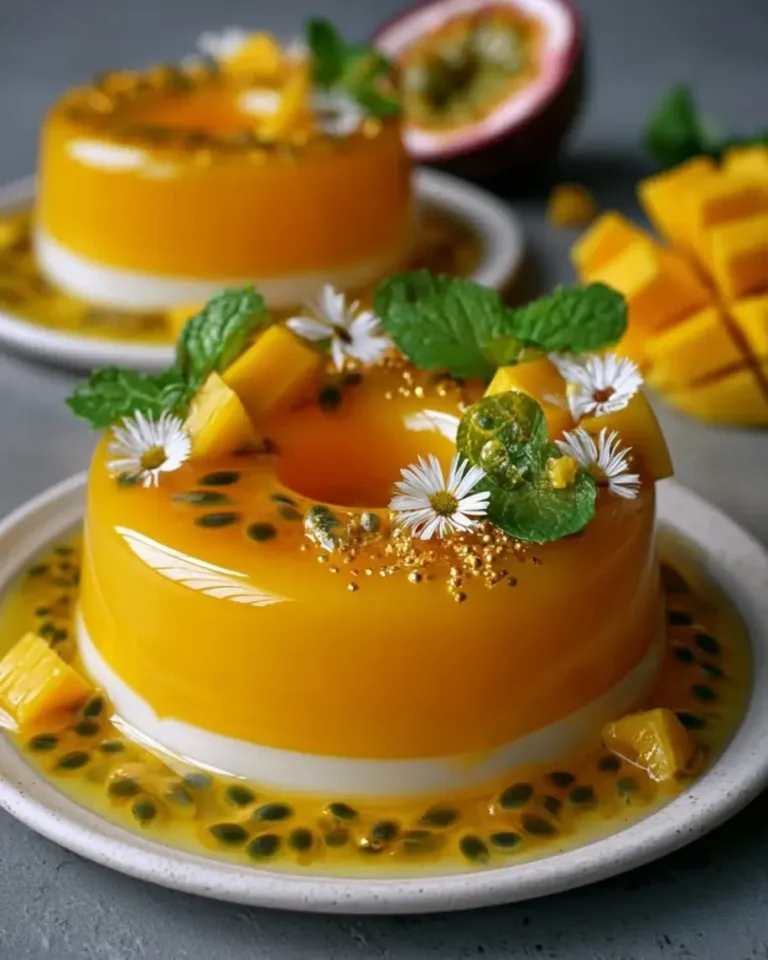
Mango Passionfruit Jewel Rings with Vanilla Silk Filling
A dazzling tropical dessert featuring a sparkling mango-passionfruit shell and a luxurious vanilla silk center, garnished with fresh mango, passionfruit pulp, white chocolate curls, edible gold flakes, pearl dust, and micro mint leaves.
- Yield: 6 1x
Ingredients
- For the Jewel Ring Shell:
- 1 cup mango puree, strained
- 1/2 cup passionfruit juice
- 1/2 cup water
- 3/4 cup granulated sugar
- 2 1/2 tsp agar-agar powder
- 1 tbsp fresh lime juice
- A few drops golden-yellow food coloring (optional)
- Pinch of sea salt
- For the Vanilla Silk Filling:
- 8 oz mascarpone cheese
- 1/2 cup heavy whipping cream
- 1/4 cup powdered sugar
- 1 tsp vanilla bean paste
- 1 tbsp sweetened condensed milk
- For the Passionfruit Ribbon:
- 1/4 cup passionfruit curd
- 1 tbsp honey
- 1 tsp fresh lime juice
- For Garnish (optional):
- Fresh mango cubes
- Passionfruit pulp
- White chocolate curls
- Edible gold flakes
- Edible pearl dust
- Micro mint leaves
Instructions
- Combine mango puree, passionfruit juice, water, sugar, agar-agar powder, lime juice, food coloring, and sea salt in a saucepan. Heat while stirring until completely dissolved and bring to a gentle simmer.
- Pour a thin layer of the mixture into ring-shaped silicone molds, rotating the molds to coat the sides. Refrigerate until partially set.
- In a mixing bowl, whip mascarpone cheese, heavy whipping cream, powdered sugar, vanilla bean paste, and sweetened condensed milk until smooth, fluffy, and silky. Transfer to a piping bag.
- In a small bowl, stir together passionfruit curd, honey, and lime juice until glossy and smooth.
- Pipe the vanilla silk filling into the center of each partially set ring mold. Add a thin swirl of the passionfruit mixture through the filling to create a vibrant ribbon effect.
- Carefully cover with the remaining mango-passionfruit mixture and refrigerate for 4–6 hours until completely set and crystal clear.
- Gently unmold the jewel rings and place them on a chilled serving platter.
- Garnish with fresh mango cubes, passionfruit pulp, white chocolate curls, edible gold flakes, pearl dust, and micro mint leaves.
- Serve well chilled for a dazzling tropical dessert featuring a sparkling mango-passionfruit shell and a luxurious vanilla silk center.
Nutrition
- Calories: 330
- Sugar: 35g
- Fat: 17g
- Carbohydrates: 40g
- Protein: 4g
Tried This Recipe? Leave a Comment!
Did you make this recipe? I’d love to hear how it turned out! Please leave a comment and a rating below. Your feedback helps other home cooks and supports cheerychop.com!
For more delicious inspiration, follow me on Pinterest!