Peach Passionfruit Cheesecake Spheres with Champagne Glaze
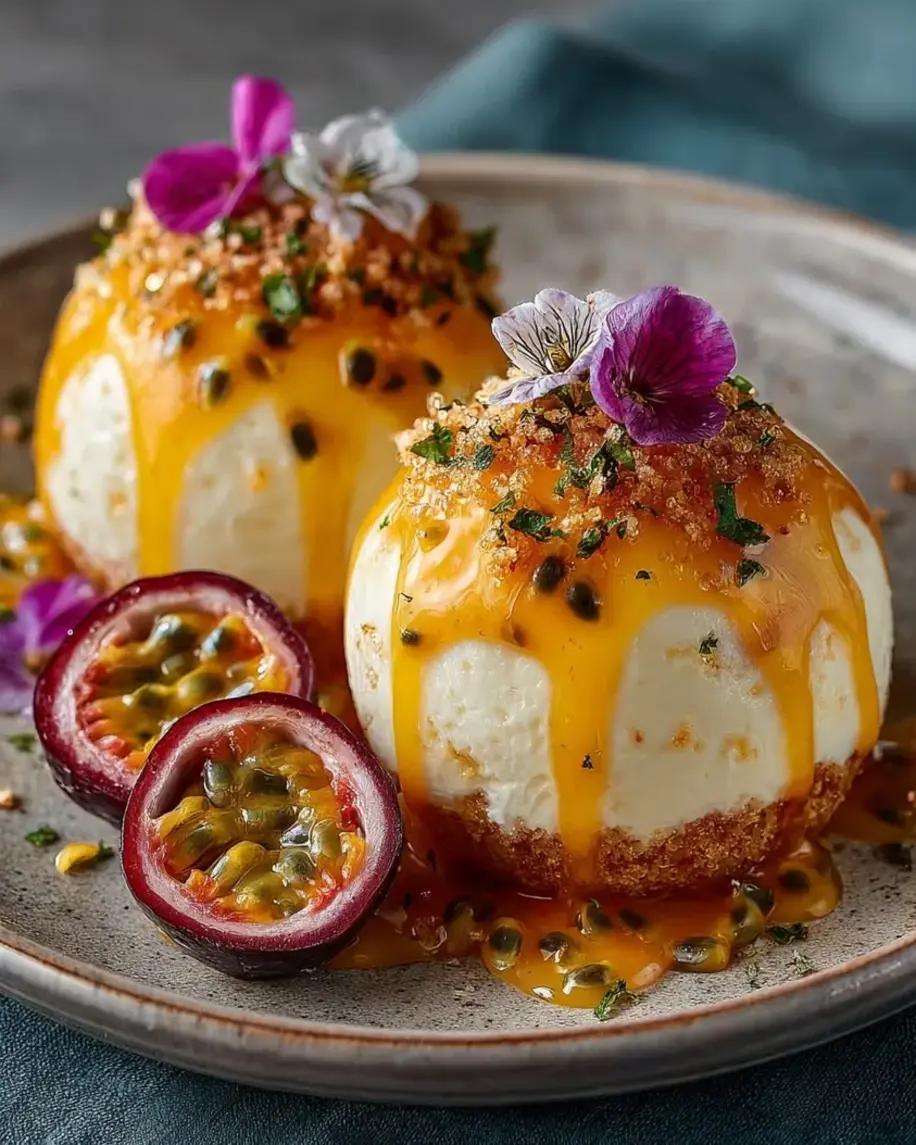
Table of Contents
Peach Passionfruit Cheesecake Spheres with Champagne Glaze – A Showstopper Dessert
I’ll never forget the first time I tasted passionfruit—I was standing in a tiny market in Marrakech with my mother, and she handed me a wrinkled purple fruit. “Squeeze it over some yogurt,” she said in her gentle French-accented Arabic. That sweet-tart burst of tropical sunshine became one of my lifelong flavor obsessions. Years later, after training at Le Cordon Bleu in Paris and settling in New York City, I still chase that moment. This peach passionfruit cheesecake champagne glaze recipe is the culmination of it all: the creamy, no-bake spheres I perfected at a Brooklyn dinner party, the passionfruit jelly core that echoes my mother’s kitchen, and a champagne glaze so elegant it feels like a glass of bubbly turned into dessert. Every bite is a journey—Morocco, Paris, NYC—all wrapped in a single, stunning sphere.
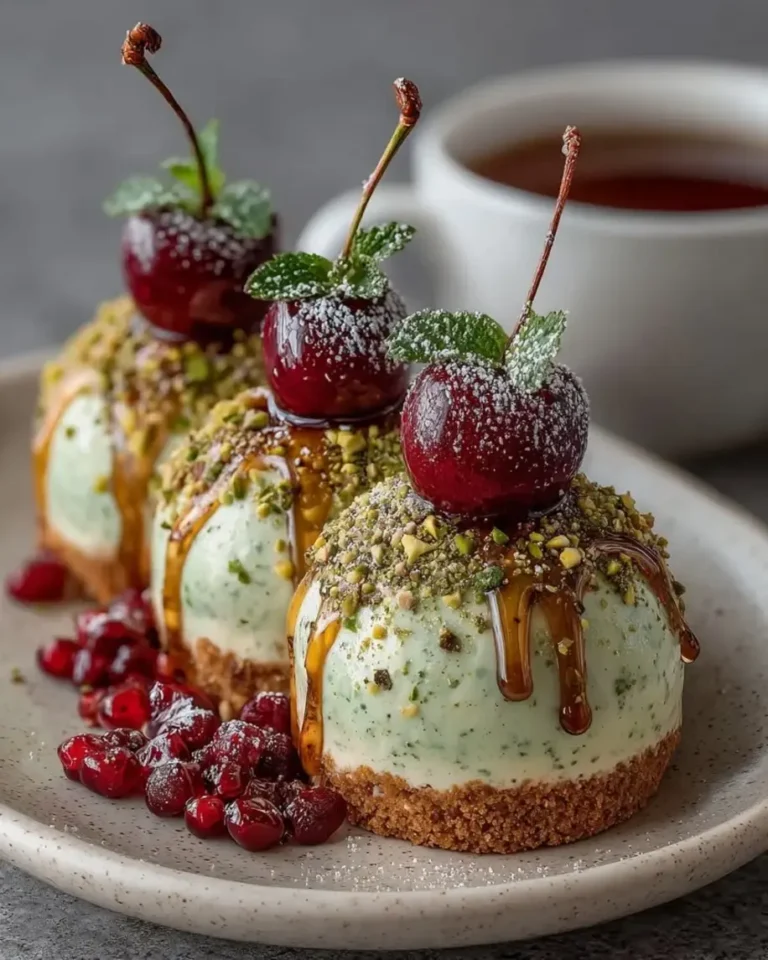
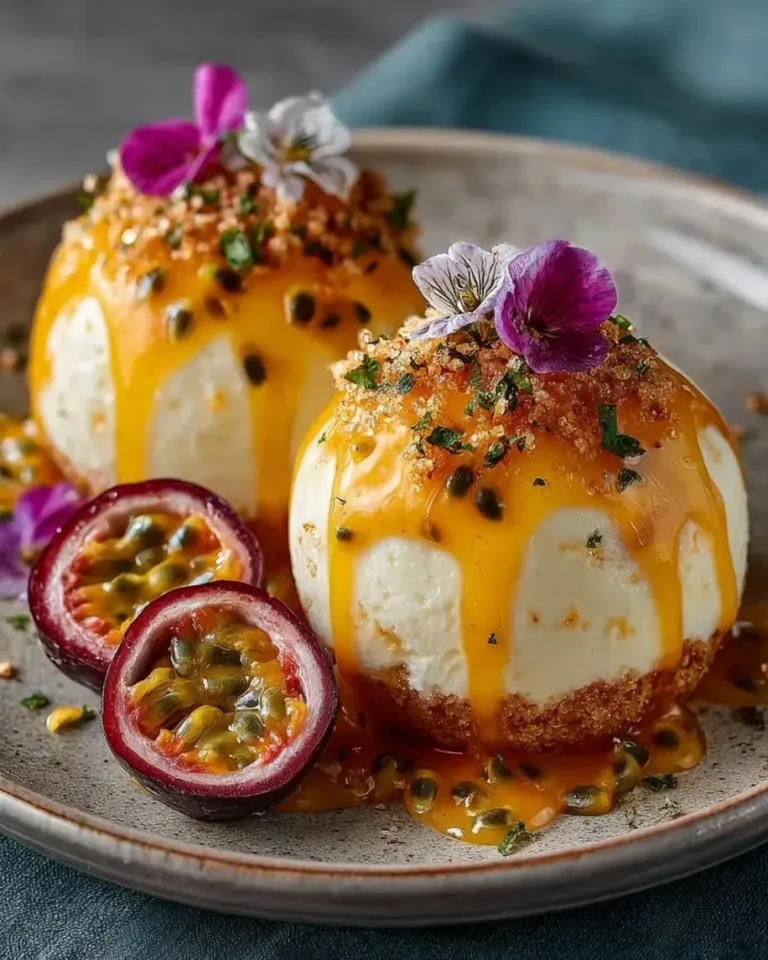
Imagine a smooth, velvety cheesecake filling tinged with the golden sweetness of ripe peaches and the bright, floral zing of passionfruit. Then, right in the center, a hidden jewel of passionfruit jelly that bursts when you bite in. The whole thing is coated in a glossy champagne glaze studded with white chocolate—delicate, just-sweet-enough, and utterly luxurious. I love serving these at holiday parties or anniversaries; they look like they came from a fancy patisserie, but I promise, with a little patience, they’re totally doable at home. And that glaze? It’s become my signature—friends beg me to bottle it!
What makes my version different? I use a biscuit base pressed right into the sphere mold—no fussy crust crumbling. I also add a touch of vanilla to the glaze to round out the champagne’s acidity. And because I know how intimidating gelatin can be, I’ll walk you through every bloom and dissolve. One common mistake I see home cooks make is over-whipping the cream; it leads to a grainy cheesecake. I’ll show you exactly the soft peaks you’re aiming for. So let’s get started—these passionfruit cheesecake spheres are going to be your new go-to elegant dessert.
Why This Peach Passionfruit Cheesecake Spheres Recipe Is the Best
The flavor secret lies in the combination of peach puree and passionfruit pulp. Peach brings a mellow, honeyed sweetness that tames passionfruit’s sharpness, while the passionfruit adds a floral, tangy lift that keeps each bite interesting. I grew up watching my mother balance flavors with a Moroccan touch—a pinch of salt, a squeeze of lemon—and here, the acidity in the passionfruit and champagne does the same job. Plus, using both peach and passionfruit means you get a complex fruit profile that feels both familiar and exotic.
Perfected texture is a non-negotiable for me. The no-bake cheesecake filling is stabilized with just the right amount of gelatin—enough to hold the sphere shape but still be silky on the tongue. And that passionfruit jelly core? It’s a French technique I refined at Le Cordon Bleu: a soft gel that stays intact when frozen but melts luxuriously at room temperature. The champagne glaze is a mirror glaze variation—thin enough to coat evenly but thick enough to stay put, thanks to white chocolate and condensed milk. It sets with a brilliant shine that rivals any bakery window.
Foolproof and fast might sound like a stretch for a dessert that requires freezing, but I’ve streamlined every step. You don’t need a sphere mold—I’ll tell you how to use a muffin tin or silicone half-spheres instead. The glaze comes together in minutes, no candy thermometer required. And because everything is no-bake, there’s no risk of over-baking or cracking. Even if you’re a beginner, you can pull off this showstopper. The only patience needed is the freezing time—and trust me, it’s worth every minute.
Peach Passionfruit Cheesecake Champagne Glaze Ingredients
When I shop for these ingredients in NYC, I head straight to the Union Square Greenmarket for peaches in summer, but frozen peach puree works beautifully year-round. Passionfruit is trickier—I’ve found frozen pulp packets at Whole Foods and even some specialty grocery stores. It’s a lifesaver. For the champagne, I use a dry brut—no need for expensive bottles, just something you’d happily drink. And the white chocolate? Please use a good-quality bar (like Ghirardelli or Lindt), not chips that contain stabilizers. They melt smoothly and give the glaze that gorgeous sheen.
Ingredients List
For the Cheesecake Filling:
- 8 oz cream cheese, softened
- ½ cup granulated sugar
- 1 cup heavy cream
- 1 tsp vanilla extract
- ½ cup peach puree (fresh or thawed from frozen)
- ¼ cup passionfruit pulp (fresh or thawed from frozen)
- 2 tsp powdered gelatin (about one packet)
- 3 tbsp cold water (for blooming gelatin)
For the Biscuit Base:
- 1 cup graham cracker crumbs
- 3 tbsp melted butter
For the Passionfruit Jelly Core:
- ½ cup passionfruit pulp
- 2 tbsp sugar
- 1 tsp powdered gelatin
- 1 tbsp cold water
For the Champagne Glaze:
- ¾ cup champagne (or dry sparkling wine)
- ½ cup water
- 1 cup granulated sugar
- ½ cup sweetened condensed milk
- 1 cup white chocolate, finely chopped
- 1 tbsp powdered gelatin
- 3 tbsp cold water (for blooming)
- 1 tsp vanilla extract
For Garnish (optional):
- Fresh passionfruit seeds
- Thin peach slices
- Edible gold flakes
Ingredient Spotlight
Peach Puree: Fresh, ripe peaches give the best flavor—blanch them to remove skins, then puree. In winter, use frozen peach puree (thawed and drained slightly). Canned peaches can work but tend to be sweeter and less aromatic; if using, reduce sugar in the filling by 1 tablespoon.
Passionfruit Pulp: The star for that tangy, floral kick. Frozen pulp is reliable and consistent. Fresh passionfruit is wonderful if you can find it—just scoop out the pulp and seeds. Don’t skip the seeds in the jelly core? They add a lovely pop. For a seedless option, strain the pulp after warming.
Powdered Gelatin: Essential for structure. Always bloom in cold water for 5 minutes before dissolving into warm liquid. Too hot liquid will kill its gelling power. I use Knox brand; one packet is about 2 ¼ teaspoons. For a vegetarian version, agar-agar can substitute but requires different ratios—not tested here.
| Original Ingredient | Best Substitution | Flavor / Texture Impact |
|---|---|---|
| Peach puree | Apricot or mango puree | Sweeter, less floral; texture similar |
| Passionfruit pulp | Equal parts lime juice + mango puree | More tart, less floral; still good |
| Champagne | Non-alcoholic sparkling wine or white grape juice + 1 tsp lemon juice | Less complex, but still a bubbly glaze |
| White chocolate | High-quality white chocolate chips (eg. Guittard) | Slightly thicker glaze; okay |
How to Make Peach Passionfruit Cheesecake Spheres — Step-by-Step
Don’t be intimidated by the number of steps—I’ve broken it all down so you can follow along easily. The key is to work in stages, and the freezer does most of the heavy lifting. Let’s start!
Step 1: Prepare the Biscuit Base
In a small bowl, mix graham cracker crumbs with melted butter until the texture resembles wet sand. Divide evenly among your sphere molds (or a lined mini muffin tin if you don’t have spheres). Press firmly into the bottom using a small spoon or your fingers. Place in the refrigerator to chill while you make the filling.
⚠️ Common Mistake to Avoid: Pressing the crust too tightly or too loosely. You want it compact but not rock-hard—otherwise it won’t adhere to the cheesecake layer. Also, don’t skip the chilling step; it helps the base stay put when you add the filling.
Step 2: Bloom Gelatin for Cheesecake
Sprinkle 2 teaspoons gelatin over 3 tablespoons cold water in a small bowl. Let it sit for 5 minutes until the gelatin absorbs the liquid and becomes spongy. This is called blooming—it ensures the gelatin dissolves evenly and gives a smooth texture.
💡 Stella’s Pro Tip: If you’re short on time, you can use a high-speed blender to incorporate the gelatin later, but blooming is still essential for proper hydration. Never skip this step!
Step 3: Make Cheesecake Filling
In a large bowl, beat the softened cream cheese, sugar, vanilla, peach puree, and passionfruit pulp with an electric mixer until smooth and fluffy—about 2 minutes. In a small saucepan, warm about 2 tablespoons of the heavy cream (just until hot, not boiling). Remove from heat, add the bloomed gelatin, and stir until fully dissolved. Let it cool slightly, then mix into the cream cheese mixture until combined.
⚠️ Common Mistake to Avoid: Adding hot gelatin directly to cold cream cheese—it will seize and create lumps. Always temper as described.
Step 4: Whip Cream and Fold
In a separate chilled bowl, whip the remaining heavy cream to soft peaks—they should hold their shape but droop slightly. Gently fold the whipped cream into the cream cheese mixture in two additions, using a spatula. Be careful not to deflate the air; you want the filling to be light and airy.
💡 Stella’s Pro Tip: Soft peaks look like a gentle mountain peak that flops over when you lift the whisk. Over-whipping leads to butter—stop as soon as you see the peaks form. If you accidentally over-whip, add a tablespoon of cold cream and fold gently to loosen.
Step 5: Fill Molds and Add Jelly Core
Spoon the cheesecake mixture into the molds until half full. Tap the molds gently on the counter to release air bubbles. For the jelly core, combine passionfruit pulp, sugar, and bloomed gelatin (bloomed in 1 tbsp cold water) in a small saucepan. Warm over low heat just until gelatin dissolves—do not boil. Cool slightly, then spoon a small amount (about 1 teaspoon) into the center of each half-filled sphere. Cover with remaining cheesecake mixture until the mold is full. Smooth the tops with a spatula. Freeze for at least 6 hours until solid.
⚠️ Common Mistake to Avoid: Adding the jelly core too soon—if it’s not cool, it might melt into the cheesecake. Let the jelly cool to room temperature before spooning into the molds.
Step 6: Make Champagne Glaze
About 30 minutes before glazing, start the glaze. Bloom 1 tablespoon gelatin in 3 tablespoons cold water. In a saucepan, combine champagne, water, and sugar. Heat over medium, stirring, until sugar dissolves and mixture is steaming—do not let it boil. Remove from heat. Add sweetened condensed milk and chopped white chocolate, stirring until chocolate melts completely. Add the bloomed gelatin and stir until smooth. Stir in vanilla. Let the glaze cool to about 90°F (32°C)—it should be warm but not hot. If it thickens too much, gently reheat.
💡 Stella’s Pro Tip: Use an instant-read thermometer for accuracy. If you don’t have one, test by dipping a clean finger—the glaze should feel like warm bathwater. Too hot will melt the frozen spheres.
Step 7: Unmold and Glaze
Remove the frozen cheesecake spheres from the molds. Place them on a wire rack set over a baking sheet (to catch excess glaze). Pour the champagne glaze evenly over each sphere, ensuring full coverage. Work quickly because the spheres start to soften. After glazing, transfer to a parchment-lined plate and chill for 30 minutes to set the glaze.
⚠️ Common Mistake to Avoid: Pouring the glaze while the spheres are still rock-hard from the freezer? That’s actually perfect! But if the glaze is too hot, it will melt the sphere and cause cracks. Check the temperature carefully.
Step 8: Garnish and Serve
Once the glaze has set (it will be slightly tacky), decorate with fresh passionfruit seeds, thin peach slices, and a sprinkle of edible gold flakes. Serve immediately, or keep refrigerated up to 4 hours before serving. These look stunning on a pedestal cake stand.
💡 Stella’s Pro Tip: For perfect glazing, dip the entire sphere using a fork or skewer if you prefer a thicker coating. But pouring works well and gives a more natural finish.
| Step | Action | Duration | Key Visual Cue |
|---|---|---|---|
| 1 | Press crust into molds | 5 min | Even, compact layer |
| 2 | Bloom gelatin | 5 min | Spongy, no dry spots |
| 3 | Cheesecake filling | 5 min | Smooth, no lumps |
| 4 | Whip cream & fold | 5 min | Soft peaks, light batter |
| 5 | Fill & add jelly core | 10 min | Jelly centered |
| 6 | Make glaze | 15 min | Smooth, 90°F |
| 7 | Glaze spheres | 10 min | Even coating |
| 8 | Garnish & chill | 30 min | Glaze set, garnishes stick |
Serving & Presentation
These beauties deserve a grand entrance. Place each glazed sphere on a chilled dessert plate—I love using white porcelain to let the gold color pop. Add a small dollop of extra champagne glaze on the plate (if you have leftover) and a few fresh passionfruit seeds scattered around. A thin slice of fresh peach on the side adds a nice color contrast. For a Moroccan-inspired twist, I sometimes sprinkle a pinch of ground cardamom over the plate—it’s a nod to my mother’s tea ritual.
In my NYC kitchen, I’ve served these after a heavy dinner of lamb tagine or even with a light seafood pasta. They’re surprisingly versatile. Pair with a flute of leftover champagne (of course) or a crisp white wine like a Sancerre. For a non-alcoholic option, sparkling water with a splash of peach nectar works beautifully. The spheres should be served cold but not rock-solid—let them sit at room temperature for 5 minutes before serving for the ultimate creamy texture.
| Pairing Type | Suggestions | Why It Works |
|---|---|---|
| Side Dish | Fresh berries, light sorbet | Adds freshness, contrasts richness |
| Sauce / Dip | Extra champagne glaze, raspberry coulis | Enhances flavor, beautiful plate art |
| Beverage | Brut champagne, Prosecco, white wine | Bubbles cut through the creaminess |
| Garnish | Edible flowers, mint leaves, gold leaf | Elevates visual appeal, special occasion |
Make-Ahead, Storage & Reheating
These spheres are perfect for entertaining because almost everything can be done in advance. I often make the cheesecake mixture and jelly core a day ahead, freeze the spheres, then glaze them the day of serving. The glaze itself can be made a day ahead and stored in the fridge—just warm it gently to 90°F before using. For my busy NYC schedule, I prep the crust and filling on Sunday, freeze overnight, and glaze on Monday afternoon for a dinner party. Voilà!
| Method | Container | Duration | Reheating Tip |
|---|---|---|---|
| Refrigerator | Airtight container | Up to 3 days | Serve cold; glaze may soften slightly |
| Freezer (unglazed) | Wrap individually in plastic | Up to 1 month | Thaw in fridge 2 hours before glazing |
| Make-Ahead | Freeze after step 5 | Up to 2 weeks | Glaze directly from frozen |
For best results, glaze the spheres no more than 24 hours before serving. The glaze stays shiny and the texture remains perfect. If you have leftover glazed spheres, store in the fridge—they’ll keep for a day but the shine may fade. I don’t recommend reheating these; they are meant to be enjoyed cold. If you prefer a softer interior, let them sit at room temperature for 10 minutes before serving.
Variations & Easy Swaps
| Variation | Key Change | Best For | Difficulty Impact |
|---|---|---|---|
| Raspberry-Lychee | Swap peach puree for raspberry, passionfruit for lychee | Berry lovers | Same |
| Dairy-Free | Use dairy-free cream cheese & coconut cream | Lactose intolerant | Medium (texture adjustment) |
| Mango-Coconut | Use mango puree, coconut milk in glaze | Tropical twist | Same |
Raspberry-Lychee Variation
If you’re a fan of berries, swap the peach puree for an equal amount of raspberry puree (strained to remove seeds) and the passionfruit for canned lychee juice (drained). The result is a vibrant pink sphere with a floral, sweet-tart interior. I love this version for Valentine’s Day—it’s stunning and surprisingly elegant. You can even use a rose champagne for the glaze for extra romance.
Dairy-Free Version
To make this dairy-free, use a high-quality dairy-free cream cheese (like Miyoko’s) and full-fat coconut cream in place of heavy cream. The texture will be slightly different—a bit denser—but still delicious. For the glaze, use dairy-free white chocolate (many brands are available) and condensed coconut milk. I’ve tested this at a friend’s house who is lactose intolerant, and it was a hit. Note that the jelly core and crust are already dairy-free if you use vegan butter.
Mango-Coconut Twist
For a tropical variation, replace the peach puree with mango puree and add ¼ cup coconut cream to the cheesecake filling. In the glaze, use coconut milk instead of water and add a dash of rum extract (optional). The combination of mango and coconut is a classic that reminds me of the street food in Marrakech. Garnish with toasted coconut flakes and a slice of dried mango—it’s a vacation on a plate.
How do you make peach passionfruit cheesecake spheres without a sphere mold?
You can use a few alternatives. First, try a silicone mini muffin pan—it will create domed top spheres if you overfill slightly and then scrape the base flat. Alternatively, use a standard muffin tin lined with plastic wrap; press the crust into the bottom and freeze the filling in the same way. After freezing, shape the spheres by hand wearing gloves, then refreeze before glazing. Another trick is to use a half-sphere silicone mold (available online) and glue two halves together with a bit of cheesecake mixture before freezing. A sphere mold is best for perfect symmetry, but these methods work well.
What can I use instead of champagne in the glaze for this cheesecake recipe?
For a non-alcoholic version, substitute the champagne with non-alcoholic sparkling wine or white grape juice mixed with a teaspoon of lemon juice to mimic the acidity. You can also use a dry ginger ale—it will add a subtle spice that pairs well with the passionfruit. For a boozy alternative, Prosecco or Cava work great; they are usually cheaper than champagne but give a similar flavor. If you want to skip the bubbles entirely, use a combination of apple juice and sparkling water, but the glaze will lack the characteristic effervescence. I’ve tested all of these, and the grape juice version is my favorite for kids.
How long do you need to freeze the cheesecake spheres before glazing them?
You must freeze the spheres for at least 6 hours, but overnight (10–12 hours) is best. The spheres need to be completely solid so that the warm glaze (at about 90°F) doesn’t melt them. If you freeze for less than 6 hours, the spheres might be too soft and will lose their shape when glazed. I always recommend freezing overnight for the most reliable results. The good news is you can freeze them for up to 2 weeks before glazing—just wrap them tightly in plastic wrap to prevent freezer burn.
Can I use canned peaches and frozen passionfruit pulp for this recipe?
Absolutely! Canned peaches are a fine substitute for fresh peach puree. Just drain them well and puree—you may need to add a teaspoon of lemon juice to brighten the flavor since canned peaches are often sweeter and less acidic. Reduce the sugar in the filling by 1 tablespoon to compensate. Frozen passionfruit pulp is actually my go-to because it’s available year-round and has consistent flavor. I buy it at Whole Foods or online. Just thaw it and use as directed. Avoid canned passionfruit pulp that has added sugar—it throws off the balance.
Why did my champagne glaze turn out lumpy or grainy?
Lumpy glaze usually happens when the white chocolate isn’t finely chopped or when the mixture is too hot when you add the gelatin. Make sure to chop the white chocolate into small, uniform pieces so they melt evenly. If the chocolate seizes from too much heat, add a tablespoon of warm cream and whisk vigorously. Another cause is undissolved gelatin—always bloom gelatin in cold water first, then dissolve it into a small amount of the warm liquid before incorporating. Strain the glaze through a fine-mesh sieve if you see lumps—it saves the batch.
Can I make these cheesecake spheres without gelatin?
Yes, but the texture will be different. You can substitute powdered gelatin with agar-agar (a plant-based gelling agent) using a 1:1 ratio by weight, but agar has a stronger gel strength and sets at room temperature. For the cheesecake filling, you could also use a combination of white chocolate (which contains cocoa butter that firms when chilled) and whipped cream, but the spheres may not be as stable. I recommend using gelatin for the best results—it gives that creamy, melt-in-your-mouth texture. If you must avoid gelatin, try a no-gelatin recipe designed for that purpose.
How do I prevent the chocolate glaze from cracking when I pour it over the frozen spheres?
Cracking usually happens when the glaze is too cold or the spheres are too warm. Make sure your spheres are fully frozen (at least 6 hours, ideally overnight) and the glaze is at the proper temperature—around 90°F. If the glaze is too hot, it will melt the sphere and cause cracks as it cools unevenly. Also, pour the glaze in one confident motion rather than in layers. If you see cracks, don’t worry—you can always pour a second thin layer after the first sets. Use a small offset spatula to spread it gently.
Can I use a different fruit for the jelly core?
Definitely! The passionfruit jelly core is just a guide. You can swap it with any fruit juice or pulp that has a strong flavor and natural acidity. Try mango, raspberry, or even a spiced apple cider gel. Keep in mind that the sugar content needs to be adjusted—more tart fruits may need a bit more sugar. For the gelatin ratio, use the same amount: 1 teaspoon gelatin to 1 tablespoon cold water to ½ cup fruit liquid. The jelly should be firm enough to hold its shape but soft enough to burst.
What if my spheres are too soft after glazing?
If your spheres feel soft after glazing, they likely weren’t frozen long enough or the glaze was too warm. Immediately return them to the freezer for at least 1 hour. If they’re already on the serving plate, you can salvage them by chilling in the refrigerator for 2 hours—they will firm up slightly but won’t be as solid. For future batches, freeze the spheres for the full 6 hours minimum, and ensure the glaze is around 90°F. Also, verify that your gelatin is fresh and properly bloomed—expired gelatin loses strength.
How do I store leftover champagne glaze?
Leftover champagne glaze can be stored in an airtight container in the refrigerator for up to 5 days. When you’re ready to use it again, gently reheat it in a heatproof bowl set over a pot of simmering water (or use a microwave at 50% power in 10-second bursts, stirring in between) until it reaches 90°F. You may need to stir in a teaspoon of warm water if it has thickened. Use it within a few weeks for best quality. It’s also delicious drizzled over ice cream or pound cake!
Share Your Version!
I’d love to see how your peach passionfruit cheesecake spheres turn out! Did you try a fun variation? Did the champagne glaze dazzle your guests? Drop a comment below with your star rating—your feedback helps other home cooks decide to try this recipe. And if you share a photo on Instagram or Pinterest, tag @leosfoods so I can cheer you on. I read every comment and often reply with tips!
One question that always comes up: what’s your favorite way to personalize these spheres? The jelly core is a blank canvas—I’ve had readers use blood orange, lychee, or even a boozy raspberry jam. I’d love to know what you dream up. Remember, the beauty of this recipe is that it’s both elegant and forgiving. So go ahead—make a batch, grab a spoon, and enjoy the fruits of your labor.
From my NYC kitchen to yours — I hope this recipe brings as much warmth to your table as it does to mine. — Stella 🧡
🎉 Did you make this recipe? We’d love to hear from you!
Leave a star rating and comment below, or tag @leosfoods on social media with your creation. Your feedback helps others discover this elegant dessert!
Love This Recipe? Save It to Pinterest!
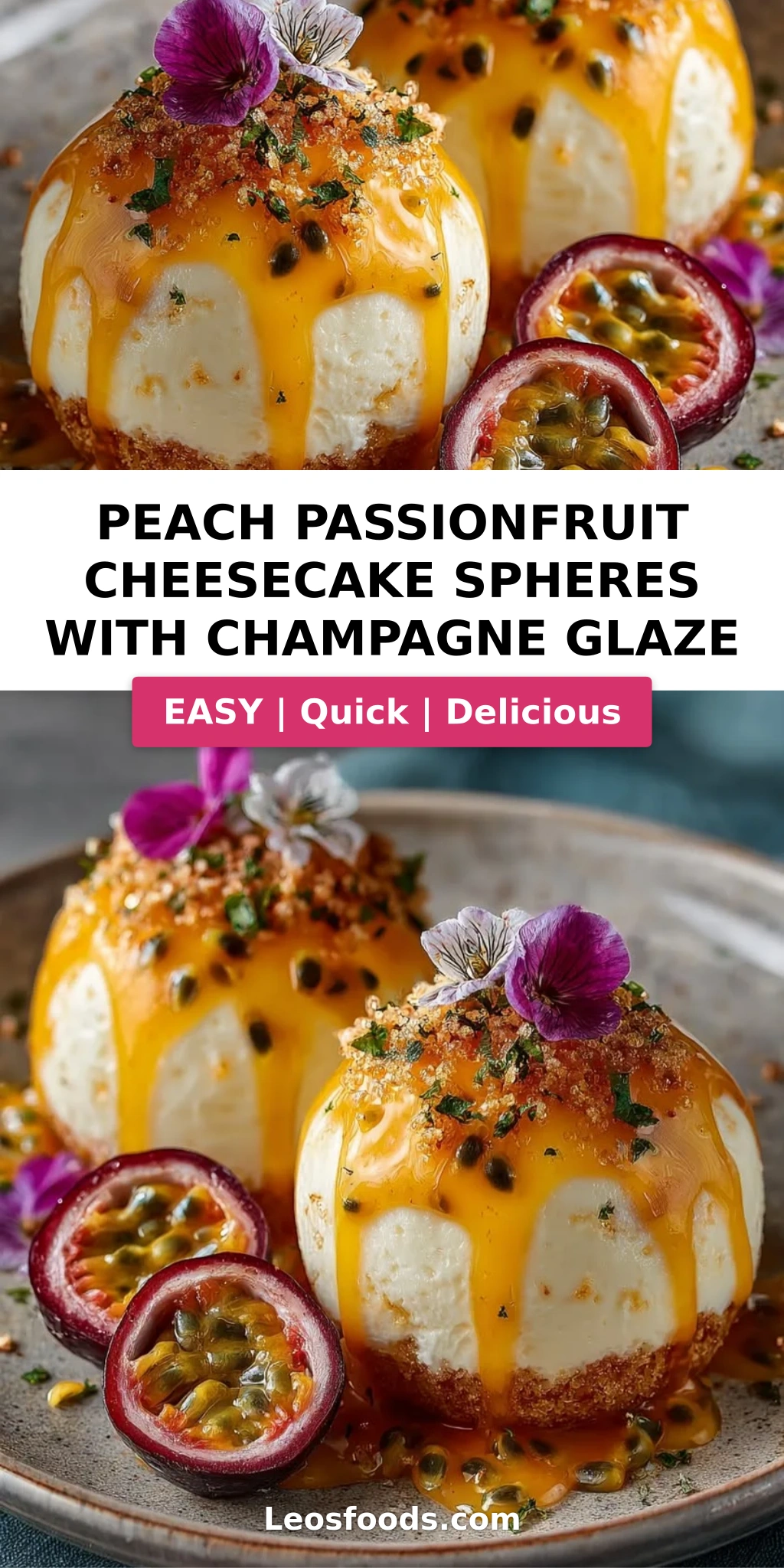
If you enjoyed this Peach Passionfruit Cheesecake Spheres recipe, don’t let it get lost in your browser tabs! 😄 Pin it now so you can find it again anytime — and explore hundreds more tried-and-tested recipes waiting for you on my Pinterest boards.
👉 Follow Stella on Pinterest @stellarecipeblog
📌 Pin this recipe · 🔁 Re-pin your favorites · 💬 Tag me when you make it — I love seeing your creations!
Peach Passionfruit Cheesecake Spheres with Champagne Glaze
A luxurious dessert featuring creamy peach passionfruit cheesecake spheres with a champagne glaze, perfect for special occasions.
- Total Time: 6 hours 30 minutes (includes freezing time)
- Yield: 8 1x
Ingredients
- For the Cheesecake Filling:
- 8 oz cream cheese, softened
- 1/2 cup granulated sugar
- 1 cup heavy cream
- 1 tsp vanilla extract
- 1/2 cup peach puree
- 1/4 cup passionfruit pulp
- 2 tsp powdered gelatin
- 3 tbsp cold water
- For the Biscuit Base:
- 1 cup graham cracker crumbs
- 3 tbsp melted butter
- For the Passionfruit Jelly Core:
- 1/2 cup passionfruit pulp
- 2 tbsp sugar
- 1 tsp powdered gelatin
- 1 tbsp cold water
- For the Champagne Glaze:
- 3/4 cup champagne
- 1/2 cup water
- 1 cup granulated sugar
- 1/2 cup sweetened condensed milk
- 1 cup white chocolate, finely chopped
- 1 tbsp powdered gelatin
- 3 tbsp cold water
- 1 tsp vanilla extract
- For Garnish (optional):
- Fresh passionfruit seeds
- Thin peach slices
- Edible gold flakes
Instructions
- 1. Mix graham cracker crumbs with melted butter and press into sphere molds as the base. Chill for 15 minutes.
- 2. Bloom gelatin for cheesecake filling in cold water for 5 minutes.
- 3. Beat cream cheese, sugar, vanilla, peach puree, and passionfruit pulp until smooth.
- 4. Warm a small portion of cream and dissolve gelatin, then mix into cheesecake base.
- 5. Whip heavy cream to soft peaks and fold into the mixture.
- 6. Fill molds halfway with cheesecake mixture.
- 7. Add a small passionfruit jelly core into each sphere, then cover with remaining cheesecake mixture.
- 8. Freeze for at least 6 hours until fully set.
- 9. Bloom gelatin for glaze in cold water.
- 10. Heat champagne, water, and sugar until steaming (do not boil).
- 11. Remove from heat, add condensed milk, white chocolate, and gelatin, then blend until smooth.
- 12. Stir in vanilla extract and cool glaze to about 90°F (32°C).
- 13. Unmold frozen spheres and place on a rack.
- 14. Pour champagne glaze evenly over spheres until fully coated.
- 15. Chill for 30 minutes before serving.
- 16. Garnish with passionfruit seeds, peach slices, and gold flakes.
Notes
Serves 8. Nutritional info per serving: Calories: 340, Protein: 4 g, Carbohydrates: 38 g, Fat: 18 g, Fiber: 1 g, Sugar: 33 g, Sodium: 70 mg.
Nutrition
- Calories: 340
- Sugar: 33 g
- Fat: 18 g
- Carbohydrates: 38 g
- Protein: 4 g
Tried This Recipe? Leave a Comment!
Did you make this recipe? I’d love to hear how it turned out! Please leave a comment and a rating below. Your feedback helps other home cooks and supports cheerychop.com!
For more delicious inspiration, follow me on Pinterest!