White Chocolate Peach Silk Pyramids Gold Dust Glaze
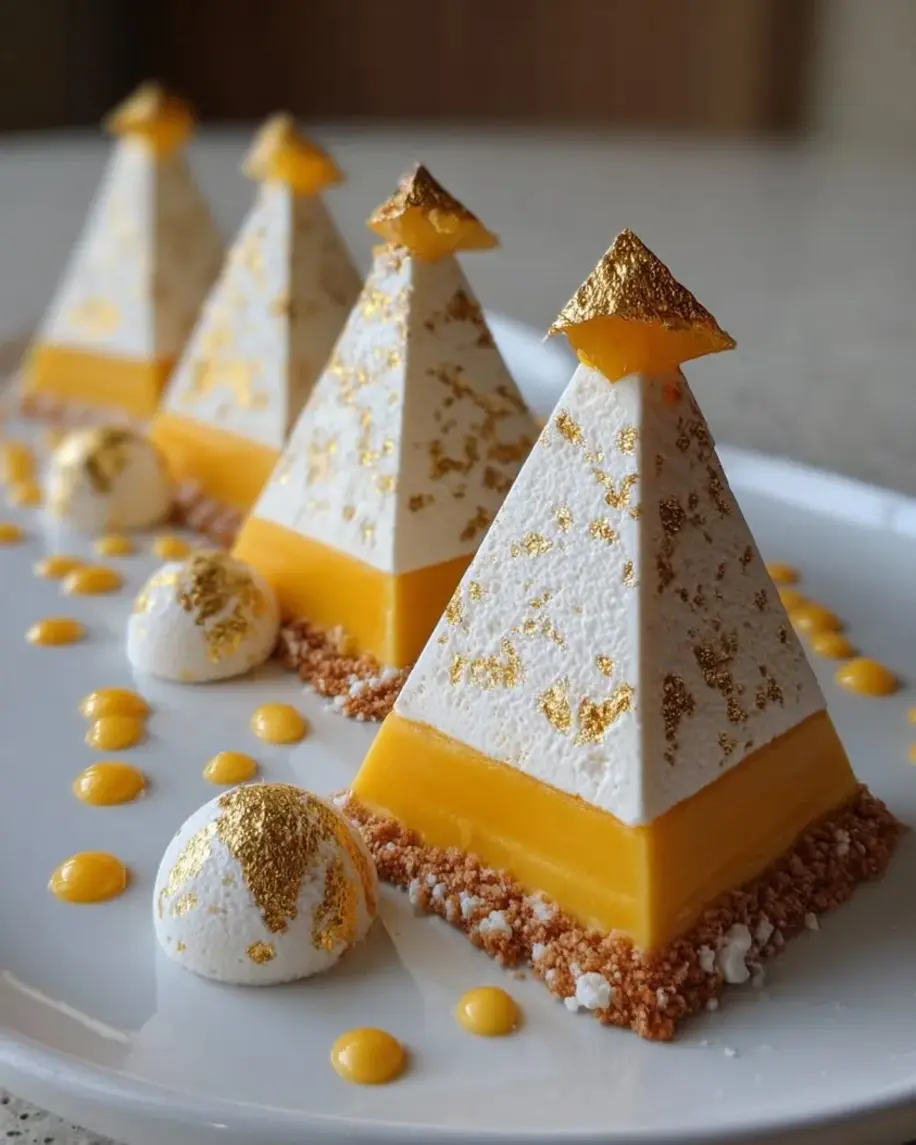
Table of Contents
White Chocolate Peach Silk Pyramids with Gold Dust Glaze – A Luxurious Dessert Fit for Celebration
I still remember the first time I saw a pyramid-shaped dessert in a pâtisserie window in Paris. It was the early 2000s, and I was just a few months into my pastry training at Le Cordon Bleu. That gleaming, geometric little tower of mousse and glaze stopped me mid-stride. I stood there, nose pressed to the glass, thinking: I have to learn how to do that. Fast forward fifteen years, and I’m in my New York City kitchen, blending my French training with the flavors of my Moroccan childhood — and this White Chocolate Peach Silk Pyramid with Gold Dust Glaze is exactly the kind of dessert that makes me feel like that student again, but with way more confidence and a much better understanding of gelatin. This peach pyramid dessert is a showstopper: a crisp biscuit base, a silky white chocolate peach mousse, a hidden jewel of peach center, and a shimmering gold dust glaze that catches every bit of light. It’s the kind of edible gold dessert you bring out when you want to hear actual gasps at the table.
Think of the most luscious white chocolate mousse peach you’ve ever imagined — then add a concentrated burst of peach puree at the very center, like a little golden secret. The white chocolate brings a creamy sweetness that cradles the bright, sunny acidity of the peaches. The texture is exactly what the name promises: silk. It’s smooth, it’s velvety, and it melts on your tongue with almost no effort. And that gold dust glaze recipe? It’s my signature — a glossy, mirror-like finish that flows like liquid metal over the frozen pyramids. I add just a whisper of edible gold luster dust to the glaze, plus a few gold flakes on top, and suddenly these little pyramids look like they belong in a museum. The peaches remind me of the orchards outside Marrakech, where my mother would buy baskets of them in late summer. Here in NYC, I source mine from the Union Square Greenmarket, and I swear the flavor is just as intense.
What I love most about this recipe is that it looks impossibly fancy, but the techniques are all approachable if you take them one step at a time. You don’t need to be a pastry chef to pull this off — you just need good ingredients, a little patience, and my guiding hand through the process. I’ve tested this white chocolate mousse peach recipe more times than I can count, tweaking the gelatin ratio, the sweetness level, and the glaze temperature until everything worked perfectly for a home kitchen. 💡 Stella’s Pro Tip: The key to that silk-like texture is in how you handle the gelatin — bloom it properly, dissolve it gently, and fold it in at just the right temperature. I’ll walk you through every detail so you can create a gold dust glaze dessert that looks like it came from a three-Michelin-star kitchen. From my NYC kitchen to yours — I hope this recipe brings as much warmth to your table as it does to mine. — Stella 🧡
Why This White Chocolate Peach Silk Pyramids Recipe Is the Best
The Flavor Secret: This isn’t just another white chocolate mousse peach dessert. The flavor secret lies in the double peach treatment — a luscious peach puree folded into the mousse itself, plus a concentrated frozen peach center that bursts open when you cut into the pyramid. That two-layer approach means you get peach flavor in every single bite, not just a hint. I learned this layering technique during my pastry training in Paris, where we called it le cœur fruité — the fruity heart. It’s the same principle used in high-end French entremets, and it makes all the difference between a dessert that tastes vaguely peachy and one that sings with peach.
Perfected Texture: The “silk” in the name is a promise I take seriously. To achieve that cloud-like, velvety texture, I use a precise ratio of cream cheese to heavy cream to white chocolate, plus just enough gelatin to give the mousse structure without making it rubbery. The cream cheese adds a subtle tang that balances the sweetness of the white chocolate, while the whipped cream gives it that airy lift. I’ve tested this with different gelatin amounts and even tried a gelatin-free version, and I can tell you — the sweet spot is exactly what you’ll find in the recipe below. The result is a mousse that holds its pyramid shape beautifully yet melts like silk on your tongue.
Foolproof & Fast: I know that working with gelatin and glaze can feel intimidating, which is why I’ve broken this gold dust glaze recipe into clear, manageable steps. The glaze itself is incredibly forgiving — as long as you cool it to the right temperature (about 90°F / 32°C), it will flow smoothly over the frozen mousse and set to a flawless, mirror-like finish. And here’s a secret: you can make the entire dessert (minus the glaze) up to two weeks in advance and keep it in the freezer. That means you can tackle the project on a lazy Sunday and simply glaze it on the day of your dinner party. Even if you’re a complete beginner to entremets, this recipe is designed to make you look like a pro.
Peach Pyramid Dessert Ingredients
Every time I head to the Union Square farmers market in early fall, I load up on the last of the season’s peaches — the ones that are so ripe they practically drip juice when you bite into them. Those are the peaches I use for the puree in this peach pyramid dessert. But don’t worry if you can’t find perfect fresh peaches; I’ll show you exactly how to use frozen or canned ones, too. For the rest of the ingredients, I rely on pantry staples you can find at any well-stocked grocery store. Let’s gather everything you’ll need.
Ingredients List
- For the White Chocolate Peach Silk Mousse:
- 1 cup peach puree (from about 2-3 ripe peaches)
- 6 oz white chocolate, melted and cooled
- 8 oz cream cheese, softened
- 1 cup heavy cream
- 1/2 cup granulated sugar
- 1 tsp vanilla extract
- 2 tsp powdered gelatin
- 3 tbsp cold water (for blooming gelatin)
- For the Peach Center:
- 3/4 cup peach puree
- 2 tbsp granulated sugar
- 1 tsp lemon juice
- 1 tsp powdered gelatin
- 1 tbsp cold water
- For the Biscuit Base:
- 1 cup digestive biscuits, finely crushed
- 3 tbsp melted butter
- For the Gold Dust Glaze:
- 1 cup granulated sugar
- 1/2 cup water
- 1/2 cup sweetened condensed milk
- 1 cup white chocolate, finely chopped
- 1 tbsp powdered gelatin
- 3 tbsp cold water
- 1 tsp clear vanilla extract
- 1 tsp edible gold luster dust
- For Garnish (optional):
- Fresh peach slices
- White chocolate curls
- Edible gold flakes
Ingredient Spotlight
Peach Puree: This is the soul of the dessert. For the best flavor, use ripe, in-season peaches — yellow or white both work beautifully. Peel them, pit them, and blend until smooth. If peaches aren’t in season, high-quality frozen peaches (thawed and drained) are a fantastic substitute. Avoid canned peaches in heavy syrup, as they’re too sweet and lack acidity. If that’s all you have, reduce the sugar in the recipe by 1 tablespoon per cup of puree.
White Chocolate: Use a good-quality white chocolate with cocoa butter (not just vegetable oils). Callebaut or Ghirardelli are my go-to brands. The white chocolate needs to be melted gently — I do it in a double-boiler or in short bursts in the microwave (20-second intervals, stirring in between). If the chocolate gets too hot, it can seize, so be patient. For a dairy-free version, use a high-quality dairy-free white chocolate.
Powdered Gelatin: This is what gives the mousse and glaze their structure. I use powdered gelatin because it’s widely available and easy to work with. Always bloom it in cold water for exactly 5 minutes before using — this ensures it dissolves smoothly without lumps. If you want to use sheet gelatin, use the same weight: 2 tsp powdered gelatin = about 8 grams = 4 standard sheets. Never skip the blooming step; it’s non-negotiable for a silk-like texture.
Edible Gold Luster Dust: This is what makes your gold dust glaze recipe truly shine. You can find it at baking supply stores or online — make sure it’s labeled “edible” and “food-grade.” The luster dust dissolves into the glaze and gives it that metallic shimmer without any gritty texture. A little goes a long way; 1 teaspoon is plenty for the whole batch. If you can’t find gold luster dust, you can omit it and the glaze will still be beautiful and glossy — just not as sparkly.
| Original Ingredient | Best Substitution | Flavor / Texture Impact |
|---|---|---|
| Fresh peach puree | Frozen peach puree (thawed, drained) | Nearly identical; slightly less bright acidity |
| White chocolate (cocoa butter based) | Dairy-free white chocolate | Slightly less creamy; works well for dairy-free |
| Digestive biscuits | Graham crackers or shortbread cookies | Slightly sweeter or more buttery base |
| Powdered gelatin | Sheet gelatin (same weight) | Identical if measured correctly |
| Edible gold luster dust | Omit or use edible gold leaf | Less shimmer; still glossy without it |
How to Make Peach Pyramid Dessert — Step-by-Step
I know this looks like a long list of steps, but trust me — each one is simple, and I’m going to guide you through every detail. Take it one step at a time, and you’ll have a stunning gold dust glaze dessert that will make you feel like a pastry chef.
Step 1: Prepare the Biscuit Base
Finely crush the digestive biscuits into crumbs — I use a food processor, but a rolling pin and a zip-top bag work beautifully too. Mix the crumbs with melted butter until the texture resembles wet sand. Press about 1 tablespoon of the mixture into the bottom of each pyramid mold, using a small flat object (like a shot glass or your thumb) to tamp it down firmly. You want a thin, even layer — about 1/8 inch thick. Place the molds in the refrigerator to chill for at least 15 minutes while you prepare the filling.
⚠️ Common Mistake to Avoid: Don’t press the biscuit base too thick or too loosely. A thick base will throw off the proportions of the dessert, and a loose base will crumble when you unmold. Press firmly and evenly for a clean, sturdy foundation.
Step 2: Make the Peach Center
In a small bowl, bloom 1 teaspoon of powdered gelatin in 1 tablespoon of cold water. Let it sit for 5 minutes. Meanwhile, combine 3/4 cup peach puree, 2 tablespoons sugar, and 1 teaspoon lemon juice in a small saucepan. Heat over medium, stirring occasionally, until the mixture is warm but not boiling. Remove from heat and whisk in the bloomed gelatin until completely dissolved. Pour the mixture into small silicone inserts (or an ice cube tray, if you don’t have pyramid inserts) and freeze until completely firm — about 2 hours. These will become the hidden jewel in the center of each pyramid.
💡 Stella’s Pro Tip: For the smoothest peach center, strain the peach puree through a fine-mesh sieve before heating. This removes any fibrous bits and ensures a silky, uniform texture. My mother taught me this trick when making fruit preserves in Morocco.
Step 3: Create the White Chocolate Peach Mousse
Bloom 2 teaspoons of powdered gelatin in 3 tablespoons of cold water for 5 minutes. In a large bowl, beat the softened cream cheese with an electric mixer until smooth and fluffy. Add 1 cup peach puree, 1/2 cup sugar, 1 teaspoon vanilla extract, and the melted (and cooled) white chocolate. Beat until everything is well combined and silky. Take about 2 tablespoons of the heavy cream and warm it gently in a small saucepan or in the microwave (about 10-15 seconds). Whisk the bloomed gelatin into the warm cream until fully dissolved, then immediately mix this into the peach-cream cheese mixture. In a separate bowl, whip the remaining heavy cream to soft peaks — it should hold a gentle shape but not be stiff. Gently fold the whipped cream into the peach mixture in three additions, using a rubber spatula and a light hand. You want to keep as much air in the mousse as possible.
⚠️ Common Mistake to Avoid: Over-whipping the cream or folding too aggressively can deflate the mousse and make it dense. Fold just until no white streaks remain. Stop as soon as it looks uniform.
Step 4: Assemble the Pyramids
Remove the chilled molds with the biscuit base from the refrigerator. Fill each mold about halfway with the white chocolate peach mousse. Gently tap the mold on the counter to release any air bubbles. Take a frozen peach center insert and place it in the middle of each mold, pressing it down slightly into the mousse. Cover with the remaining mousse, smoothing the tops with an offset spatula or the back of a spoon. Make sure the mousse reaches all the way to the edges of the mold.
💡 Stella’s Pro Tip: If you’re using silicone pyramid molds, place them on a baking sheet before filling. This makes it much easier to transfer them to the freezer without spilling. Also, leave about 1/8 inch of space at the top of each mold to account for any slight expansion during freezing.
Step 5: Freeze and Unmold
Place the filled molds in the freezer and freeze for at least 6 hours, or preferably overnight. The mousse needs to be completely solid to hold its shape when unmolded and to take the glaze properly. When you’re ready to unmold, gently flex the silicone molds and the pyramids should pop right out. If they stick, let them sit at room temperature for 1-2 minutes and try again. Place the unmolded pyramids on a wire rack set over a baking sheet — this will catch the excess glaze.
⚠️ Common Mistake to Avoid: Don’t rush the freezing. If the mousse isn’t fully frozen, it will be difficult to unmold cleanly and the glaze won’t adhere properly. Six hours is the absolute minimum; overnight is better.
Step 6: Prepare the Gold Dust Glaze
Bloom 1 tablespoon of powdered gelatin in 3 tablespoons of cold water for 5 minutes. In a medium saucepan, combine 1 cup sugar and 1/2 cup water. Heat over medium heat, stirring occasionally, until the sugar dissolves. Add 1/2 cup sweetened condensed milk and continue heating until the mixture is steaming — about 175°F (80°C) — but don’t let it boil. Remove from heat. Add the bloomed gelatin and 1 cup finely chopped white chocolate. Whisk until both are completely melted and smooth. Add 1 teaspoon clear vanilla extract and 1 teaspoon edible gold luster dust, then blend with an immersion blender (or whisk vigorously) until the glaze is glossy and uniform. Let the glaze cool to about 90°F (32°C) — it should feel warm to the touch but not hot. This is the perfect pouring temperature.
💡 Stella’s Pro Tip: The immersion blender is the secret to a flawless gold dust glaze recipe — it removes any tiny air bubbles and gives the glaze that mirror-like finish. If you don’t have one, pour the glaze through a fine-mesh sieve instead. And don’t skip the gold luster dust! It gives the glaze a subtle metallic shimmer that regular food coloring can’t replicate.
Step 7: Glaze and Garnish
Working quickly, hold each frozen pyramid by the base and pour the gold dust glaze evenly over the top, letting it flow down all four sides. Let the excess drip off for a few seconds before transferring the glazed pyramid to a serving plate or a parchment-lined baking sheet. Repeat with all 8 pyramids. Once all are glazed, place them in the refrigerator for at least 30 minutes to allow the glaze to set. Just before serving, garnish each pyramid with a fresh peach slice, a curl of white chocolate, and a few edible gold flakes.
⚠️ Common Mistake to Avoid: If the glaze is too hot, it will melt the mousse and slide off. If it’s too cool, it will be thick and won’t flow evenly. Use a thermometer to get the temperature right — 90°F (32°C) is the sweet spot.
| Step | Action | Duration | Key Visual Cue |
|---|---|---|---|
| 1 | Biscuit base | 15 mins chill | Firm, compacted crumbs |
| 2 | Peach center | 2 hrs freeze | Solid, easy to pop out |
| 3 | White chocolate mousse | 10 mins prep | Smooth, no lumps, soft peaks |
| 4 | Assembly | 10 mins | Mousse evenly filled, center inserted |
| 5 | Freeze | 6+ hrs | Completely solid to touch |
| 6 | Gold dust glaze | 15 mins prep + cooling | Glossy, 90°F, flows like syrup |
| 7 | Glaze & garnish | 30 mins set | Smooth, shiny, evenly coated |
Serving & Presentation
When I serve these White Chocolate Peach Silk Pyramids, I like to create a little drama on the plate. Place one pyramid in the center of a white or dark plate (the contrast makes the gold pop). Add a small quenelle of whipped cream or a scoop of vanilla bean ice cream on the side — the cold creaminess balances the richness of the dessert. I also love to drizzle a little extra peach puree or a raspberry coulis around the base of the pyramid for a pop of color that echoes the fruity filling. A few fresh peach slices, a curl of white chocolate, and a sprinkle of edible gold flakes finish the presentation.
For a dinner party, I arrange the pyramids on a large wooden board or a marble slab with small bowls of garnishes so guests can customize their own plates. If you’re feeling extra festive, serve these as an edible gold dessert for New Year’s Eve, a milestone birthday, or a wedding shower. I once served them at a charity gala in NYC and the executive chef from a three-Michelin-star restaurant asked me for the gold dust glaze recipe — that was a proud moment.
| Pairing Type | Suggestions | Why It Works |
|---|---|---|
| Side Dish | Vanilla ice cream, whipped cream, fresh berries | Creamy and cool; balances sweetness |
| Sauce / Dip | Raspberry coulis, caramel sauce, peach puree | Adds acidity or caramel depth |
| Beverage | Champagne, prosecco, peach iced tea, espresso | Bubbles cut richness; tea adds fruity harmony |
| Garnish | Edible gold flakes, white chocolate curls, fresh peach slices | Texture contrast + visual opulence |
Make-Ahead, Storage & Reheating
As a busy NYC food blogger and mom, I rely on make-ahead desserts to keep my sanity during the holiday season. The beauty of this peach pyramid dessert is that almost all of it can be prepared in advance. The assembled (un-glazed) pyramids can be frozen for up to 2 weeks. I often make a double batch and keep them in the freezer, ready to glaze on a moment’s notice. The glaze itself can be made a day ahead and reheated gently to 90°F before pouring. Just store it in an airtight container in the refrigerator and give it a good whisk or a quick blitz with the immersion blender when you reheat it.
| Method | Container | Duration | Reheating Tip |
|---|---|---|---|
| Refrigerator | Airtight container | 3-4 days | Serve chilled; no reheating needed |
| Freezer | Freezer-safe container, layers separated by parchment | Up to 2 weeks | Thaw in refrigerator 2 hrs before glazing |
| Make-Ahead | Molds in freezer | Up to 2 weeks in advance | Glaze on serving day for best shine |
One important note: once glazed, these pyramids should be served within 24 hours for the best appearance. The glaze stays glossy and shiny for about a day in the refrigerator. After that, it may start to dull slightly or develop condensation if stored in a humid environment. If you need to store glazed pyramids overnight, place them in an airtight container in the refrigerator and bring them out about 10 minutes before serving to let any condensation evaporate. Trust me on this — I learned it the hard way when I brought a tray of glazed pyramids to a friend’s dinner party and they arrived looking a little foggy. Now I always glaze them the same day I plan to serve.
Variations & Easy Swaps
One of the things I love most about this white chocolate mousse peach recipe is how adaptable it is. Over the years, I’ve experimented with different fruits, base flavors, and even dietary restrictions for friends. Here are some of my favorite variations — each one tested in my NYC kitchen and approved by my family and taste-testing neighbors.
| Variation | Key Change | Best For | Difficulty Impact |
|---|---|---|---|
| Mango & Passionfruit Pyramids | Replace peach puree with mango + passionfruit | Tropical lovers, summer parties | Same difficulty |
| Gluten-Free Version | Use gluten-free graham crackers for base | Celiac guests | Easier (simple swap) |
| Rose & Pistachio Pyramids | Add rose water to mousse, pistachios to base | Middle Eastern flavor profile | Same difficulty |
Mango & Passionfruit Pyramids
This tropical twist is my go-to for summer gatherings. Simply substitute the peach puree with an equal amount of mango puree (from fresh or frozen mangoes) for the mousse, and use a passionfruit center instead of the peach center. For the passionfruit center, use 3/4 cup passionfruit pulp (about 6-8 passionfruits, strained to remove seeds if desired) and increase the sugar to 3 tablespoons since passionfruit is quite tart. The result is a bright, tangy-sweet dessert that feels like a vacation in every bite. I like to garnish these with a tiny edible orchid or a sprinkle of toasted coconut flakes.
Gluten-Free Version
Making this peach pyramid dessert gluten-free couldn’t be simpler. The mousse, peach center, and glaze are naturally gluten-free — the only component that contains gluten is the biscuit base. Simply swap the digestive biscuits with gluten-free graham crackers or a gluten-free shortbread cookie. Crush them the same way and mix with melted butter. The texture will be slightly different (gluten-free cookies tend to be a bit more crumbly), but they hold together just fine once pressed into the molds. I’ve tested this with both Schär and Simple Mills brands and both worked beautifully. Just make sure to chill the base thoroughly before adding the mousse.
Rose & Pistachio Pyramids
This variation is inspired by the flavors of my Moroccan childhood — my mother would make a rose-scented milk pudding that I’ve always loved. Add 1 tablespoon of rose water to the white chocolate peach mousse (along with the vanilla) and replace the biscuit base with a pistachio crust: use 1/2 cup finely ground pistachios mixed with 1/2 cup crushed graham crackers and 3 tablespoons melted butter. The pistachio adds a gorgeous green hue and a nutty crunch that pairs beautifully with the floral rose. For the center, you can keep it peach or swap for a raspberry center for added color. Garnish with chopped pistachios and dried rose petals. This version is always a hit at my spring brunches.
What is the best way to achieve a smooth, silk-like texture for the white chocolate peach filling?
The secret to that silky texture lies in three things: properly blooming your gelatin, gentle heating, and careful folding. First, always bloom powdered gelatin in cold water for exactly 5 minutes — if you skip this or use warm water, the gelatin won’t dissolve evenly and you’ll get lumps. Second, when dissolving the bloomed gelatin into the mousse base, warm just a small portion of the cream (about 2 tablespoons) and whisk the gelatin into that warm cream until completely smooth before mixing it into the peach-cream cheese mixture. This prevents the gelatin from seizing or forming strings. Third, fold in the whipped cream by hand with a rubber spatula using gentle, sweeping motions — over-mixing or using an electric mixer will deflate the mousse and make it dense instead of airy and light. Stella’s Pro Tip: If you see any small lumps in your mousse before freezing, pass it through a fine-mesh sieve to guarantee a perfectly smooth texture.
Can I substitute fresh peaches with canned or frozen peaches for the pyramid filling?
Absolutely — and I’ve tested all three options so you don’t have to wonder. Frozen peaches are actually my top choice when fresh peaches are out of season, because they’re picked at peak ripeness and flash-frozen, so they retain excellent flavor. Just thaw them completely, drain off any excess liquid, and puree them — you may need to reduce the sugar slightly since some frozen peaches are packed in syrup. Canned peaches can also work, but you’ll want to use ones packed in juice (not heavy syrup) and drain them well, then reduce the added sugar in the recipe by at least 1-2 tablespoons. The texture will be slightly softer and the peach flavor a bit less bright, so I recommend adding a splash of lemon juice (about 1/2 teaspoon extra) to bring back some acidity. In all cases, strain the puree through a fine-mesh sieve for the smoothest result.
How long do White Chocolate Peach Silk Pyramids need to chill before they hold their shape?
You need a minimum of 6 hours in the freezer for the mousse to set firmly enough to unmold cleanly and hold its shape during glazing. I strongly recommend freezing overnight (at least 8 hours) for the best results. The mousse needs to be completely solid — if it’s still soft in the center, it will be difficult to unmold without damaging the pyramid shape, and the warm glaze (which is poured at about 90°F) will partially melt the surface and create a messy finish. If you’re in a hurry, you can use a flash-freeze method: place the molds on a metal baking sheet in the coldest part of your freezer (usually the back, away from the door) and make sure your freezer temperature is at 0°F (-18°C) or lower. Even then, don’t attempt to unmold before 5 hours. For the best texture and easiest handling, give them the full 6-8 hours.
What is the easiest method to apply gold dust glaze without ruining the pyramid shape?
The easiest and most reliable method is to freeze the pyramids completely solid (at least 6 hours), then unmold them and place each one on a wire rack set over a baking sheet. Holding each frozen pyramid gently by the base with your fingers or a pair of tweezers, pour the glaze (cooled to exactly 90°F) over the top in a slow, steady stream, letting it flow naturally down all four sides. The glaze should be fluid enough to coat evenly but not so runny that it slides off. Don’t touch the pyramid while glazing — the heat from your hands can create fingerprints or melt the surface. Allow the excess to drip off for about 5-10 seconds, then transfer the glazed pyramid to a parchment-lined tray. Work quickly and keep the remaining pyramids in the freezer until it’s their turn. Stella’s Pro Tip: If you’re nervous about holding them, use a wide offset spatula to support the base while you pour — just make sure the spatula is cold.
Can I make this peach pyramid dessert without gelatin?
Gelatin is essential for achieving the firm, stable structure that allows these pyramids to hold their shape and take a flawless glaze. Without it, the mousse would be too soft to unmold and the glaze wouldn’t adhere properly. That said, if you need a vegetarian alternative, you can try using agar-agar (a plant-based gelatin derived from seaweed). Use the same weight as the powdered gelatin (about 2 tsp for the mousse and 1 tsp for the center), but note that agar-agar sets much firmer and at a higher temperature — you’ll need to dissolve it by boiling the liquid for 2-3 minutes rather than just heating. The texture will be slightly different: less creamy and more jelly-like, with a firmer bite. I’ve tested this with agar-agar and while it works structurally, the silky mouthfeel is compromised. For the best result, I recommend using gelatin if you can.
How do I store leftover gold dust glaze and can I reuse it?
Yes, you can absolutely store and reuse leftover gold dust glaze! Pour any remaining glaze into an airtight container and refrigerate for up to 1 week. When you’re ready to use it again, the glaze will have solidified into a firm gel. To reheat, gently warm it in a heatproof bowl set over a pot of simmering water (double-boiler method), whisking occasionally until it reaches 90°F (32°C). You can also microwave it in 10-second bursts at 50% power, stirring between each burst. If the glaze looks a little thick, add 1-2 teaspoons of water or milk to thin it back to the right consistency. The gold luster dust will settle over time, so a quick blitz with an immersion blender or a vigorous whisk will bring back the shimmer. Stella’s Pro Tip: I often make a double batch of the glaze and keep half in the fridge for another project — it’s wonderful on donuts, cheesecakes, or even as a dip for fresh fruit.
Why did my gold dust glaze turn out cloudy instead of shiny?
A cloudy or dull glaze is usually caused by one of three things: the temperature was off, the glaze wasn’t blended thoroughly, or there was excess moisture. First, make sure your glaze was at exactly 90°F (32°C) when you poured it — if it’s too cool, it will be thick and set before it can flow into a smooth mirror; if it’s too hot, it will melt the surface of the frozen mousse and turn cloudy. Use an instant-read thermometer for accuracy. Second, the immersion blender step is crucial — it emulsifies the fats and liquids into a glossy, uniform mixture. If you don’t blend enough, the glaze will separate and look streaky or dull. Finally, make sure your frozen pyramids are completely dry before glazing — any frost or condensation on the surface will create a cloudy spot. Pat them gently with a paper towel if needed, then glaze immediately.
Can I use a different shape mold instead of pyramids?
Absolutely — this recipe is incredibly versatile and works beautifully in other shapes. You can use dome molds (like hemisphere silicone molds for entremets) for a classic half-sphere look, cylinder molds for a modern tower effect, or even small bundtlette molds for a more intricate design. The key is to use silicone molds for easy unmolding, and to adjust the baking time if you’re using a different size. For the biscuit base in a dome or cylinder, I recommend creating a small disc of the crumb mixture that fits the bottom of the mold — same technique, just a different shape. The glaze application works the same way regardless of shape: freeze solid, unmold, and pour. If you’re using a very detailed mold (like a flower or geometric shape), make sure the mousse is extra firm (freeze overnight) to preserve the fine details during glazing.
What can I use instead of edible gold luster dust for the glaze?
If you can’t find edible gold luster dust or prefer not to use it, you have several alternatives that still produce a beautiful, party-worthy glaze. You can use edible gold leaf or gold flakes applied directly to the surface of the glazed pyramids as a garnish — just press them gently onto the glaze while it’s still slightly tacky. For color, you can add a few drops of yellow and a tiny drop of orange gel food coloring to the glaze for a warm golden hue (though it won’t shimmer). Another option is to use edible pearl dust or edible silver luster dust for a different metallic effect. If you want to skip the metallic look entirely, you can simply omit the luster dust and the glaze will still be clear, glossy, and beautiful — it will look like a mirror-glazed dessert with a subtle white-chocolate sheen. I’ve served it both ways and it’s always a hit.
How do I prevent the biscuit base from getting soggy inside the pyramid?
This is a common concern, but the biscuit base stays perfectly crisp thanks to a few key techniques. First, the base is pressed into the mold and chilled while the mousse is being prepared, which allows the butter to re-solidify and create a barrier. Second, the mousse is frozen immediately after assembly, so there’s almost no time for moisture to migrate from the mousse into the crumb base. Third — and this is my most important tip — make sure the biscuit base is pressed firmly enough that it forms a compact, cohesive layer. If the crumbs are too loose, they’ll act like a sponge and absorb moisture from the mousse. I also recommend using digestive biscuits or graham crackers, which are drier and lower in sugar than cookies like Oreos or shortbread, so they stay crisp longer. If you’re making the dessert more than a week in advance, consider adding an extra half-tablespoon of melted butter to the crumb mixture to reinforce the barrier.
Share Your Version!
I absolutely love hearing from you — there’s nothing that makes my day quite like a photo or a comment from someone who tried one of my recipes. If you make these White Chocolate Peach Silk Pyramids with Gold Dust Glaze, please leave a star rating and a comment below to let me know how it went. Did you try one of the variations? Did you come up with your own twist? I want to hear all about it! Snap a photo of your beautiful creation and share it on Instagram or Pinterest — tag me @leosfoods so I can see your gorgeous gold-dusted pyramids. I read every single comment and I try to respond to as many as I can, especially when you share a clever substitution or a plating idea I haven’t thought of.
And here’s a question for you: what occasion are you planning to serve these for? I’m always looking for new inspiration, and your celebrations help me dream up my next recipe. Whether it’s a birthday, an anniversary, a holiday dinner, or just a “because I deserve something beautiful” Tuesday night, I want to know. From my NYC kitchen to yours — I hope this recipe brings as much warmth to your table as it does to mine. — Stella 🧡
Love This Recipe? Save It to Pinterest!
If you enjoyed this White Chocolate Peach Silk Pyramids with Gold Dust Glaze recipe, don’t let it get lost in your browser tabs! 😄 Pin it now so you can find it again anytime — and explore hundreds more tried-and-tested recipes waiting for you on my Pinterest boards.
👉 Follow Stella on Pinterest @stellarecipeblog
📌 Pin this recipe · 🔁 Re-pin your favorites · 💬 Tag me when you make it — I love seeing your creations!
White Chocolate Peach Silk Pyramids with Gold Dust Glaze
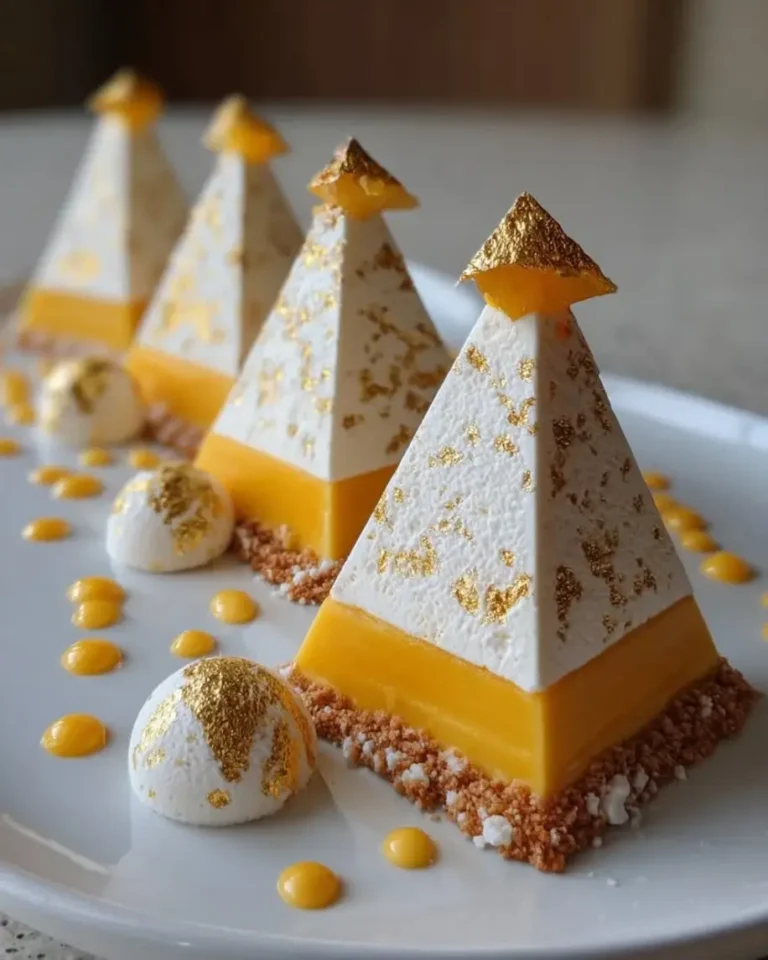
Elegant pyramid-shaped desserts with white chocolate peach mousse, a peach center, biscuit base, and a shimmering gold dust glaze.
- Yield: 8 1x
Ingredients
- For the White Chocolate Peach Silk Mousse:
- 1 cup peach puree
- 6 oz white chocolate, melted and cooled
- 8 oz cream cheese, softened
- 1 cup heavy cream
- 1/2 cup granulated sugar
- 1 tsp vanilla extract
- 2 tsp powdered gelatin
- 3 tbsp cold water
- For the Peach Center:
- 3/4 cup peach puree
- 2 tbsp granulated sugar
- 1 tsp lemon juice
- 1 tsp powdered gelatin
- 1 tbsp cold water
- For the Biscuit Base:
- 1 cup digestive biscuits, finely crushed
- 3 tbsp melted butter
- For the Gold Dust Glaze:
- 1 cup granulated sugar
- 1/2 cup water
- 1/2 cup sweetened condensed milk
- 1 cup white chocolate, finely chopped
- 1 tbsp powdered gelatin
- 3 tbsp cold water
- 1 tsp clear vanilla extract
- 1 tsp edible gold luster dust
- For Garnish (optional):
- Fresh peach slices
- White chocolate curls
- Edible gold flakes
Instructions
- 1. Mix crushed biscuits with melted butter and press into pyramid molds as a thin base layer. Chill for 15 minutes.
- 2. Bloom gelatin for the peach center in cold water for 5 minutes.
- 3. Heat peach puree, sugar, and lemon juice until warm.
- 4. Stir in gelatin until dissolved and pour into small silicone inserts. Freeze until firm.
- 5. Bloom gelatin for the mousse in cold water for 5 minutes.
- 6. Beat cream cheese, peach puree, sugar, vanilla extract, and melted white chocolate until smooth.
- 7. Warm a small portion of the cream and dissolve the gelatin, then mix into the peach mixture.
- 8. Whip the remaining cream to soft peaks and fold into the mixture.
- 9. Fill pyramid molds halfway with mousse.
- 10. Place a frozen peach center into the middle of each mold.
- 11. Cover with remaining mousse and smooth the tops.
- 12. Freeze for at least 6 hours or until completely firm.
- 13. Bloom gelatin for the glaze in cold water.
- 14. Heat sugar, water, and condensed milk until steaming.
- 15. Remove from heat and stir in gelatin and white chocolate until smooth.
- 16. Add vanilla extract and gold luster dust, then blend until glossy.
- 17. Cool glaze to about 90°F (32°C).
- 18. Unmold frozen pyramids and place on a wire rack.
- 19. Pour the gold dust glaze evenly over each pyramid until fully coated.
- 20. Refrigerate for 30 minutes before serving.
- 21. Garnish with peach slices, white chocolate curls, and gold flakes.
Nutrition
- Calories: 365
- Sugar: 36g
- Fat: 21g
- Carbohydrates: 41g
- Protein: 4g
Tried This Recipe? Leave a Comment!
Did you make this recipe? I’d love to hear how it turned out! Please leave a comment and a rating below. Your feedback helps other home cooks and supports cheerychop.com!
For more delicious inspiration, follow me on Pinterest!