Shimmering White Pearl Coconut Cream Pavlova Spheres
“`html
Table of Contents
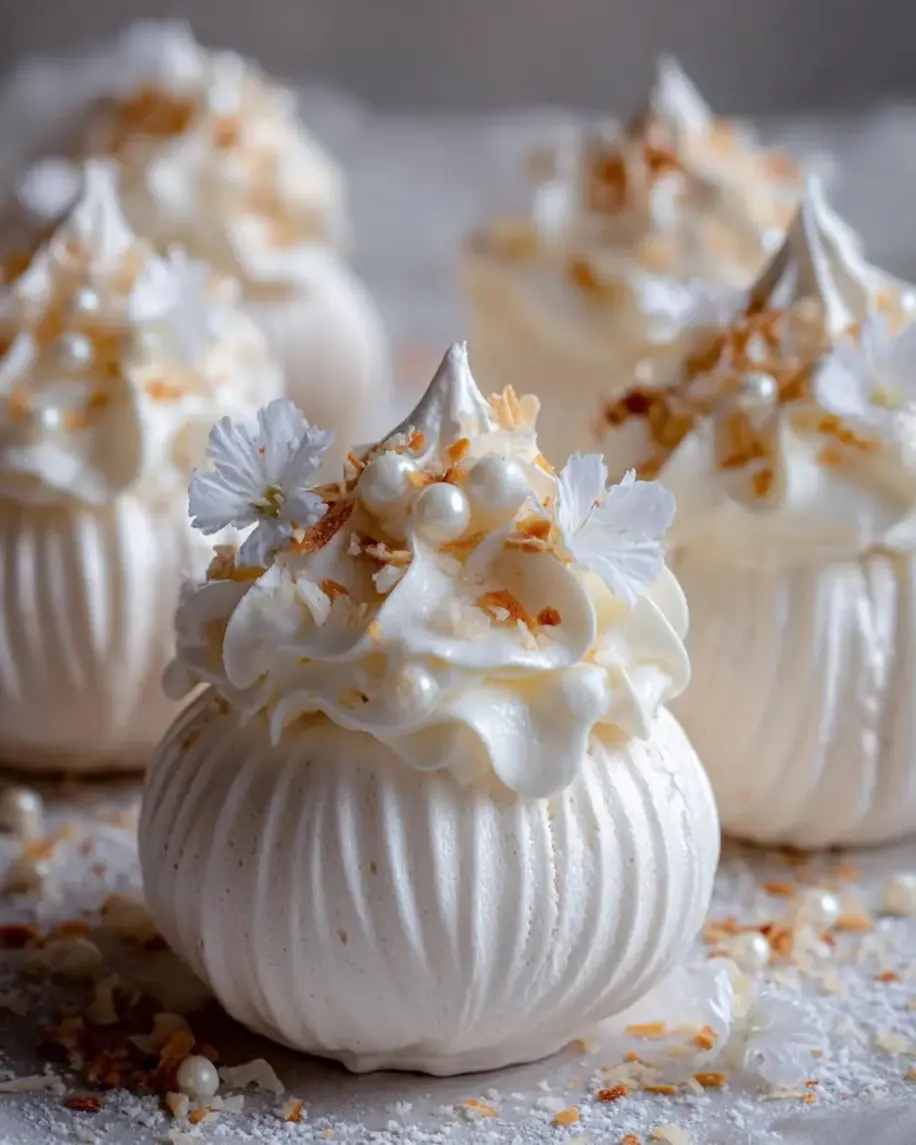
White Pearl Coconut Cream Pavlova Spheres – A Shimmering Showstopper
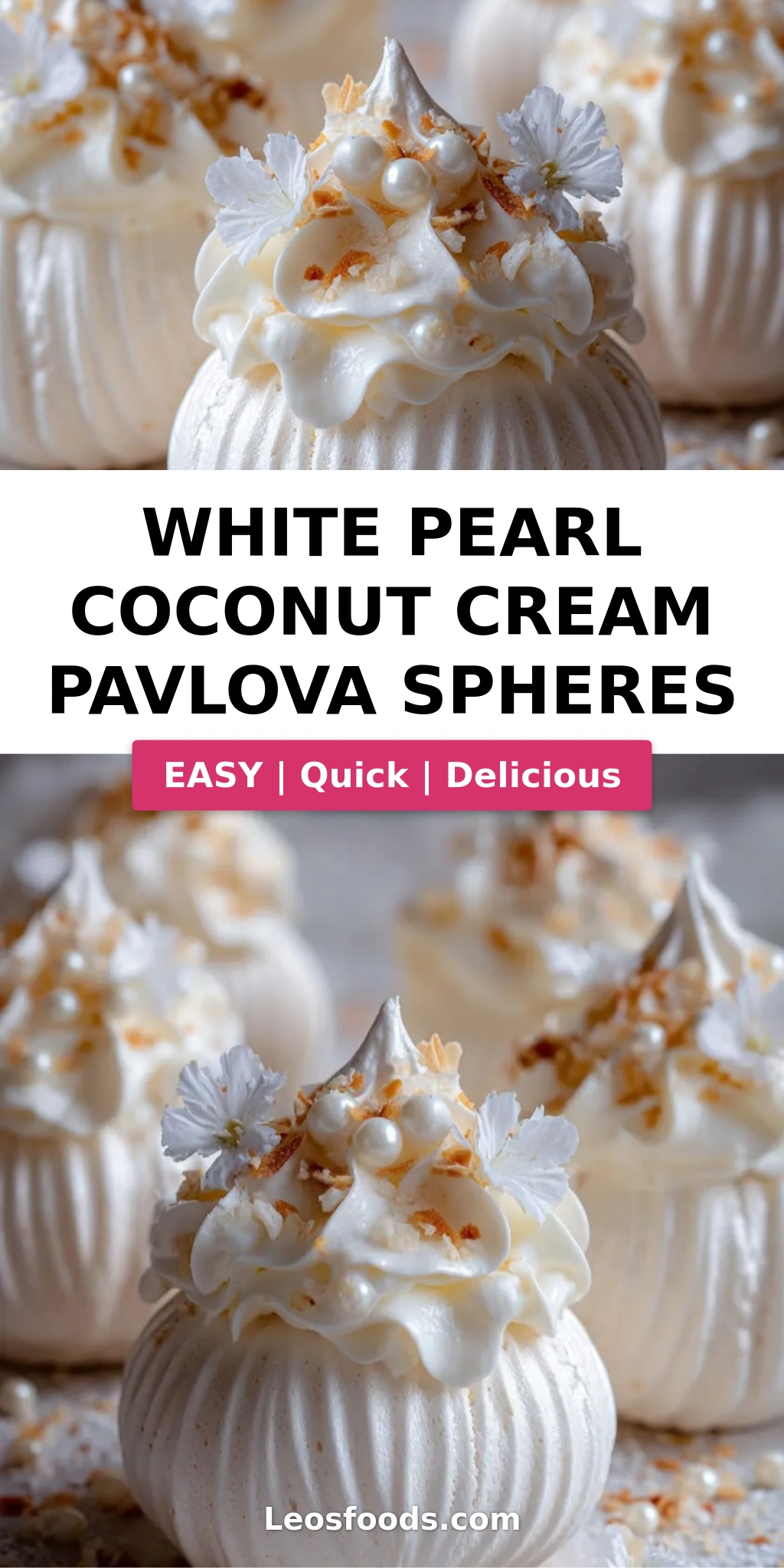
The first time I made these White Pearl Coconut Cream Pavlova Spheres, I was standing in my tiny Paris apartment kitchen. I had just returned from the patisserie down the street where a gorgeous display of pearl-dusted desserts caught my eye, and I knew I had to recreate that magic at home. This white pearl coconut pavlova recipe is the result — a gorgeous, shimmering dessert that blends the crisp, airy meringue of a classic pavlova with a luscious coconut cream filling and a white chocolate glaze that gleams like a pearl. It is an elegant dessert that feels fancy enough for a celebration, yet is surprisingly doable for a home baker.
Imagine biting into a delicate meringue shell that shatters with the slightest pressure, giving way to a silky coconut cream filling that is both rich and refreshing. The white chocolate glaze adds a smooth, sweet finish, while the pearl luster dust gives each sphere a subtle, iridescent sheen. The toasted coconut adds a gentle crunch and a nutty warmth that ties everything together. It is a dessert that looks like it came from a high-end patisserie, but it is made with simple ingredients and a little patience. My mother in Morocco would always say that the best sweets are the ones that bring people together — and these pavlova spheres truly do.
I have tested this easy pavlova dessert recipe more times than I can count, and I have streamlined every step to make it foolproof. The key is in the meringue — getting that stiff, glossy peak that holds its shape — and the low-and-slow baking that keeps the shells from cracking. In this post, I will share my go-to technique for achieving the perfect meringue every time, plus my best tip for preventing cracks and soggy shells. Whether you are new to pavlova or a seasoned baker, I think you will love this white chocolate pearl glaze pavlova as much as I do. Let us get started!
Why This White Pearl Coconut Pavlova Recipe Is the Best
The Flavor Secret: This elegant coconut meringue dessert is built on layers of delicate flavor. The meringue itself is lightly sweetened with a touch of vanilla, while the coconut cream filling is made with both heavy cream and coconut cream for a richness that is not too heavy. The white chocolate glaze adds a buttery sweetness that pairs perfectly with the toasted coconut. A pinch of salt in the meringue balances the sweetness and enhances the coconut. Growing up in Morocco, I learned that the best desserts have a balance of sweet and savory, and this one absolutely delivers.
Perfected Texture: I have spent years perfecting the art of the meringue. The secret is in the technique: beating the egg whites to stiff, glossy peaks and then folding in cornstarch and vinegar, which help stabilize the meringue and prevent cracking. Baking at a low temperature for a long time ensures a dry, crisp shell that holds its shape. The result is a pavlova that shatters beautifully under your fork, with a soft, marshmallow-like center. My Paris training taught me that patience is the real secret to a perfect meringue — and it is so worth it.
Foolproof & Fast — For Beginners Too: While pavlova can seem intimidating, this recipe is designed to be approachable. I break every step down clearly, with visual cues and pro tips to help you succeed. The silicone dome molds make shaping the half-spheres incredibly easy — no piping skills required. If you can beat egg whites and fold in a few ingredients, you can make these beautiful pavlova spheres. I have made this recipe with friends in my NYC kitchen who had never attempted meringue before, and they were amazed at the results. You can do this!
White Pearl Coconut Pavlova Recipe Ingredients
When I make this white pearl coconut pavlova recipe, I source my ingredients from a mix of local NYC markets and specialty stores. The egg whites come from pasture-raised eggs from the Union Square farmers market — they whip up fluffier and more stable. The coconut cream I love is from a brand that uses only organic coconut, and I always keep a few cans in my pantry. Shopping for ingredients is one of my favorite parts of recipe development, and I love sharing what I have learned.
Ingredients List
- For the Pavlova Shells: 4 large egg whites
- 1 cup granulated sugar
- 1 tsp cornstarch
- 1 tsp white vinegar
- 1 tsp vanilla extract
- Pinch of salt
- For the Coconut Cream Filling: 1 cup heavy cream, chilled
- 1/2 cup coconut cream
- 2 tbsp powdered sugar
- 1 tsp vanilla extract
- 1/4 cup toasted shredded coconut
- For the White Chocolate Pearl Glaze: 8 oz (225 g) white chocolate, finely chopped
- 1/4 cup heavy cream
- 1 tsp coconut oil
- White pearl luster dust
- For Garnish (optional): White chocolate pearls, toasted coconut flakes, edible white flowers
Ingredient Spotlight
Egg Whites: The foundation of the pavlova. Fresh egg whites from pastured eggs whip up more stable and create a stronger meringue. For best results, bring them to room temperature before beating. Substitute: Pasteurized liquid egg whites work in a pinch, but fresh will give you the best volume and stability.
Coconut Cream: This is different from coconut milk — it is thicker and richer, with a higher fat content. Look for it in the Asian foods aisle or online. It gives the filling a lush, tropical flavor. Substitute: If you cannot find coconut cream, chill a can of full-fat coconut milk and scoop off the thick top layer. The flavor will be slightly less intense, but it works.
White Chocolate: Choose a good-quality white chocolate for the glaze — something you would enjoy eating on its own. Cheaper white chocolate can be waxy and separate. I prefer a brand like Valrhona or Callebaut for its smoothness and buttery flavor. Substitute: Vegan white chocolate works also, but you may need to adjust the coconut oil for smoothness.
| Original Ingredient | Best Substitution | Flavor / Texture Impact |
|---|---|---|
| Egg whites | Pasteurized liquid egg whites | Slightly less volume; still works |
| Coconut cream | Chilled full-fat coconut milk (top layer) | Less rich, thinner filling |
| White chocolate | Vegan white chocolate | Slightly different melt; add extra coconut oil if needed |
| Heavy cream | Full-fat coconut cream (for filling) | Dairy-free; lighter texture |
How to Make White Pearl Coconut Cream Pavlova Spheres — Step-by-Step
I promise you, this easy pavlova dessert recipe is much simpler than it looks. Follow these steps, and you will have stunning pavlova spheres that will wow everyone at your table.
Step 1: Prepare and Preheat
Preheat your oven to 250°F (120°C). Line two baking trays with parchment paper. If you are using silicone dome molds, they are the easiest way to get perfect spheres — just set them on the trays. Otherwise, you can spoon the meringue into mounds and shape them into half-spheres with the back of a spoon.
💡 Stella’s Pro Tip: For perfectly even shells, trace 3-inch circles on the parchment paper as a guide. Flip the paper over so the ink does not touch the meringue.
Step 2: Whip the Meringue
In a clean, dry bowl, beat the egg whites and a pinch of salt on medium speed until soft peaks form — about 2 minutes. The peaks should droop slightly when you lift the whisk. Then, gradually add the sugar, one tablespoon at a time, while continuing to beat on medium-high. Once all the sugar is in, beat for 4–5 more minutes until stiff, glossy peaks form. The meringue should be thick, smooth, and hold its shape firmly.
⚠️ Common Mistake to Avoid: If the meringue looks grainy, the sugar has not dissolved fully. Rub a tiny bit between your fingers — if it feels gritty, keep beating. Undissolved sugar will cause the meringue to weep later.
Step 3: Fold and Shape
Gently fold in the cornstarch, white vinegar, and vanilla extract with a spatula. Use a light hand — you want to maintain as much air as possible. The vinegar and cornstarch help stabilize the meringue, giving it that crisp shell and soft interior. Spoon or pipe the meringue into the silicone dome molds or onto the parchment circles, shaping them into neat half-spheres. Smooth the tops gently with a spatula.
💡 Stella’s Pro Tip: For extra height, use a piping bag with a large round tip. Pipe the meringue in a spiral from the center outward, building up the sides slightly.
Step 4: Bake Low and Slow
Bake the meringues for 60–70 minutes, or until they are firm to the touch and can be lifted easily off the parchment. They should be pale ivory, not browned. Turn off the oven and leave the door slightly ajar — I use a wooden spoon to prop it open. Let the shells cool completely inside the oven for at least 1 hour. This gradual cooling prevents cracking.
⚠️ Common Mistake to Avoid: Opening the oven door during baking can cause the meringues to crack. Resist the temptation to peek until at least the 50-minute mark.
Step 5: Make the Coconut Cream Filling
While the shells cool, make the filling. In a chilled bowl, combine the heavy cream, coconut cream, powdered sugar, and vanilla extract. Whip on medium-high speed until soft peaks form — about 2–3 minutes. Be careful not to overwhip, or the filling will become grainy. Gently fold in the toasted shredded coconut with a spatula. Set the bowl in the refrigerator while you prepare the glaze.
💡 Stella’s Pro Tip: Chill your mixing bowl and beaters for 10 minutes before whipping the cream. This helps the cream whip up faster and stay fluffy.
Step 6: Assemble the Spheres
Once the pavlova shells are completely cool, carefully remove them from the molds or parchment. Select the 8 best-looking half-spheres for the tops. Fill the remaining 8 halves with the coconut cream filling, mounding it slightly in the center. Gently place a top half over each filled base, pressing very lightly to sandwich them together. Set the assembled spheres on a wire rack placed over a baking sheet.
⚠️ Common Mistake to Avoid: Do not press too hard when sandwiching, or the shell will crack. A gentle touch is all you need.
Step 7: Glaze and Decorate
In a small saucepan, heat the heavy cream until steaming — just before a simmer. Pour it over the finely chopped white chocolate in a heatproof bowl. Let it sit for 2 minutes, then stir slowly in one direction until the chocolate is fully melted and the glaze is smooth. Stir in the coconut oil for extra shine. Let the glaze cool for 5–8 minutes until it thickens slightly but is still pourable. Spoon the glaze over each pavlova sphere, letting it drip down the sides in an even layer. Immediately dust lightly with white pearl luster dust while the glaze is still tacky. Garnish with white chocolate pearls, toasted coconut flakes, and edible white flowers. Chill for 20 minutes before serving to let the glaze set.
💡 Stella’s Pro Tip: If the glaze becomes too thick to pour, warm it gently over a double boiler for 10 seconds. Do not microwave white chocolate, as it can seize easily.
| Step | Action | Duration | Key Visual Cue |
|---|---|---|---|
| 1 | Preheat oven & line trays | 5 mins | Oven at 250°F, parchment ready |
| 2 | Whip meringue | 6–8 mins | Stiff, glossy peaks |
| 3 | Fold & shape | 5 mins | Smooth half-spheres |
| 4 | Bake & cool shells | 60–70 mins + 1 hr cooling | Firm, pale, lifts easily |
| 5 | Make filling | 5 mins | Soft peaks, fluffy |
| 6 | Assemble spheres | 5 mins | Sandwiched, filled |
| 7 | Glaze & garnish | 15 mins | Even glaze, pearl shimmer |
Serving & Presentation
These white pearl coconut cream pavlova spheres are a showstopper on any dessert table. I love serving them on a large white platter, arranged in a circle with a few edible white flowers scattered between them. The contrast of the glossy white glaze against the vibrant green of a fresh mint leaf or two is stunning. For a touch of elegance, drizzle a little extra white chocolate glaze on the plate and place the sphere right on top — it makes for an incredible presentation.
When I make these for a dinner party, I usually serve them as the finale after a lighter main course. The crisp meringue and creamy coconut filling are refreshing without being too heavy. A small glass of chilled dessert wine, like a late-harvest Riesling or a Moscato d’Asti, pairs beautifully with the coconut and white chocolate. For a non-alcoholic option, a sparkling water with a splash of elderflower syrup is a lovely match.
In my NYC kitchen, I have served these at bridal showers and birthday parties, and they always get the most compliments. People cannot believe they are homemade. The edible white flowers and white chocolate pearls make them look so refined. If you are serving them for a special occasion, you can even personalize the garnish — add a few gold leaf flakes for a truly luxurious touch.
| Pairing Type | Suggestions | Why It Works |
|---|---|---|
| Side Dish | Fresh berries, citrus salad, mango slices | Acidity cuts the sweetness |
| Sauce / Dip | Raspberry coulis, passion fruit sauce, caramel drizzle | Fruit sauces add brightness |
| Beverage | Late-harvest Riesling, Moscato d’Asti, sparkling water with elderflower | Light, sweet wines complement the coconut |
| Garnish | Edible white flowers, white chocolate pearls, gold leaf, mint | Adds elegance and visual contrast |
Make-Ahead, Storage & Reheating
One of the best things about this elegant coconut meringue dessert is that you can prepare almost everything in advance. In my busy NYC schedule, I rely on make-ahead steps to reduce stress on the day of a dinner party. The meringue shells can be baked days ahead, and the filling can be whipped up in minutes. Here is how I store and assemble everything for the best results.
| Method | Container | Duration | Reheating Tip |
|---|---|---|---|
| Refrigerator | Airtight container, separate layers with parchment | Up to 2 days (assembled) | Serve cold; do not reheat |
| Freezer | Freezer-safe bag or container with parchment between shells | Up to 1 month (shells only) | Thaw at room temp 20 mins; do not refreeze after assembly |
| Make-Ahead | Bake shells up to 5 days ahead; store in airtight container at room temp | Shells: 5 days; Filling: 1 day ahead | Assemble and glaze on serving day for best texture |
The most important rule for storing pavlova is to keep it away from moisture. Humidity is the enemy of crisp meringue. That is why I always store the shells in an airtight container with a layer of silica gel or a piece of bread (the bread absorbs excess moisture). If you are making the shells ahead, let them cool completely before storing, and do not refrigerate them — the fridge will make them soft. The filling and glaze, on the other hand, are best made fresh on the day you plan to serve. If you do have leftovers, you can refrigerate the assembled spheres for up to two days, but the shells will soften slightly. They are still delicious — just not as crisp.
I have tested freezing the assembled spheres, and I do not recommend it. The coconut cream filling becomes icy, and the glaze can discolor. Instead, freeze only the plain meringue shells and make the filling and glaze fresh. That way, you get the best texture every time. On the day of your event, just whip the cream, assemble, glaze, and serve. It takes only 30 minutes of active time, and your guests will think you spent hours in the kitchen.
Variations & Easy Swaps
| Variation | Key Change | Best For | Difficulty Impact |
|---|---|---|---|
| Tropical Mango-Passion Fruit | Add mango puree to filling, passion fruit seeds on top | Summer parties, tropical themed events | Easy |
| Vegan / Dairy-Free | Use coconut cream + aquafaba meringue | Dairy-free/vegan guests | Medium (aquafaba requires patience) |
| Berry Rose | Fold freeze-dried raspberry powder into meringue; rose water in filling | Romantic occasions, Valentine’s Day | Easy |
Tropical Mango-Passion Fruit
For a bright, tropical twist, swirl 1/4 cup of mango puree into the coconut cream filling before folding in the toasted coconut. The mango adds a luscious sweetness and a beautiful golden hue. Top each glazed sphere with a sprinkle of fresh passion fruit seeds — the tartness cuts through the sweetness of the white chocolate beautifully. This variation is inspired by the tropical flavors I grew up with in Morocco, where fresh fruit is always at the center of dessert. It is perfect for summer gatherings or a taste of sunshine in the middle of winter.
Vegan / Dairy-Free
To make this elegant coconut meringue dessert completely dairy-free and vegan, substitute the egg whites in the meringue with aquafaba — the liquid from a can of chickpeas. Whip the aquafaba on high speed with cream of tartar until stiff peaks form, then add sugar following the same method. For the filling, use only coconut cream (no heavy cream) and whip it the same way. The glaze can be made with vegan white chocolate and coconut oil. The texture is slightly different — the meringue is a bit more delicate — but the flavor is lovely. I have tested this version multiple times in my NYC kitchen for friends with dietary restrictions, and it never disappoints.
Berry Rose
This variation is pure romance. Fold 1 tablespoon of freeze-dried raspberry powder into the meringue before shaping — it will tint the shells a soft pink and add a gentle berry flavor. For the filling, replace the vanilla with 1 teaspoon of rose water. The combination of rose and raspberry is a classic French pairing that always feels elegant. Top with fresh raspberries and a few edible rose petals. I love serving this version for Valentine’s Day or anniversary dinners. The pink meringue against the white glaze is absolutely dreamy.
What is the best way to achieve the perfect glossy texture for the meringue in white pearl pavlova spheres?
The secret to a glossy meringue lies in two things: room-temperature egg whites and gradual sugar addition. Start with fresh egg whites at room temperature — they whip up to a much greater volume and create a finer, more stable foam. Beat them with a pinch of salt on medium speed until soft peaks form, then add the sugar one tablespoon at a time while beating on medium-high. This slow addition allows each grain of sugar to dissolve fully, which is what gives the meringue that beautiful sheen. Rub a little meringue between your fingers — if it feels smooth, the sugar is dissolved. If it feels gritty, keep beating. I also add a teaspoon of white vinegar and a teaspoon of cornstarch at the end, which help stabilize the meringue and keep it glossy even after baking.
Can I substitute fresh coconut cream with canned coconut cream for the filling of these pavlova spheres?
Absolutely, and I actually recommend using canned coconut cream for this recipe. Fresh coconut cream is wonderful but can be inconsistent in fat content, which affects how well it whips. Canned coconut cream, on the other hand, is standardized and reliable. Look for a brand that contains only coconut and water — no guar gum or stabilizers, as those can make the filling gummy. Chill the can overnight before using, then scoop out the thick cream that rises to the top, leaving the watery liquid behind. For the best texture, whip the coconut cream with the heavy cream and powdered sugar until soft peaks form. If you want a fully dairy-free version, you can use all coconut cream — just whip it well and do not overbeat.
How far in advance can I assemble the white pearl coconut cream pavlova spheres without them getting soggy?
I recommend assembling the pavlova spheres no more than 2 to 3 hours before serving for the best texture. The meringue shells are very sensitive to moisture, and the coconut cream filling will gradually soften them once they are sandwiched together. If you need to prepare ahead, bake the shells up to 5 days in advance and store them in an airtight container at room temperature. Make the filling and glaze on the day of serving, then assemble, glaze, and garnish just before serving. The assembled spheres can sit in the refrigerator for up to 2 hours, but after that the shells will start to lose their crispness. For a dinner party, I usually assemble them during the main course and pop them in the fridge — 20 minutes of chilling is all the glaze needs to set.
What is the ideal baking temperature and time to prevent the pavlova spheres from cracking?
The ideal baking temperature is 250°F (120°C), which is low enough to dry out the meringue slowly without browning or cracking. Bake the shells for 60 to 70 minutes, depending on their size. The key is to not rush the process. After baking, turn off the oven and leave the door slightly ajar with a wooden spoon — let the shells cool completely inside for at least 1 hour. This gradual cooling is the most important step for preventing cracks. A sudden change in temperature will cause the shells to crack. Also, make sure your meringue is whipped to stiff, glossy peaks and the sugar is fully dissolved before baking. Any undissolved sugar can cause weeping and cracking later. I have been making pavlova for years, and this method has never failed me.
Can I use a different type of chocolate for the glaze instead of white chocolate?
Yes, you can certainly use other chocolates, but keep in mind that the flavor and color will change the character of the dessert. Milk chocolate will give you a warmer, sweeter glaze and a tan color, while dark chocolate will create a rich, bitter contrast to the sweet meringue and coconut — I personally love a 60% dark chocolate for a more adult version. If you use a different chocolate, you may need to adjust the amount of heavy cream slightly. For white chocolate, the ratio of 8 oz chocolate to 1/4 cup cream works perfectly. For dark chocolate, use a little more cream (about 1/3 cup) to keep the glaze pourable. The coconut oil can stay as is — it helps the glaze set with a beautiful shine.
Why did my meringue shells turn out sticky or chewy instead of crisp?
Sticky or chewy meringue is usually a sign of humidity or underbaking. Meringue loves a dry environment — if you are making these on a rainy or very humid day, the shells can absorb moisture from the air and become tacky. To combat this, bake the shells a little longer, until they are completely dry to the touch. Another common culprit is underbaking. The shells should be firm and lift easily off the parchment paper. If they feel soft or stick, return them to the oven at 250°F for another 10 minutes. Finally, make sure you store the baked shells in an airtight container immediately after they cool — exposure to air will soften them. If you live in a humid climate, add an extra tablespoon of cornstarch to the meringue to help absorb excess moisture.
Can I make the pavlova shells without silicone dome molds?
Absolutely! Silicone dome molds make the job easier and give you perfectly uniform half-spheres, but you can definitely shape the meringue by hand. Simply spoon the meringue into mounds on a parchment-lined baking sheet, then use the back of a spoon to shape each mound into a neat half-sphere with a slight indentation in the center. You can also pipe the meringue using a piping bag with a large round tip — pipe in a spiral from the center outward, building up the sides slightly. If you are shaping by hand, try to make all the mounds the same size so the spheres match when you sandwich them. I often do it by hand when I am baking at my mother’s house in Morocco, where I do not have all my fancy tools — and they turn out beautifully every time.
How do I prevent the white chocolate glaze from seizing or becoming grainy?
White chocolate is delicate and can seize easily if it gets too hot or comes into contact with water. The best method is to heat the heavy cream until steaming — just below a simmer — and pour it over the finely chopped white chocolate in a heatproof bowl. Let it sit undisturbed for 2 minutes, then stir slowly in one direction with a spatula until the chocolate is fully melted and the glaze is smooth. If the glaze does seize (turns thick and grainy), you can rescue it by adding a teaspoon of coconut oil or warm cream and stirring vigorously. Avoid using a microwave for white chocolate, as it can scorch easily. Also, make sure your bowl and utensils are completely dry — even a drop of water can cause white chocolate to seize. This technique has worked for me in countless baking projects.
Can I freeze the assembled pavlova spheres for later?
I do not recommend freezing the fully assembled pavlova spheres. The coconut cream filling does not freeze well — it becomes icy and loses its silky texture, and the white chocolate glaze can discolor or develop a white bloom when thawed. The meringue shells themselves can be frozen on their own, though. Bake and cool the shells completely, then place them in a single layer in an airtight container with parchment between the layers. Freeze for up to one month. When you are ready to serve, thaw the shells at room temperature for 20 minutes, then make the filling and glaze fresh and assemble. This way, you get the best texture and flavor. I often freeze a batch of shells during the holiday season so I can whip up a stunning dessert at a moment’s notice.
What can I use instead of white pearl luster dust for the glaze?
If you do not have white pearl luster dust, you can still achieve a beautiful shimmer with a few alternatives. Edible gold or silver dust will give a similarly glamorous effect, though the color will be different. You can also skip the luster dust entirely and use white sprinkles, sanding sugar, or even a dusting of confectioners’ sugar for a simpler, matte look. The pavlova spheres will still be stunning — the white chocolate glaze itself has a natural shine. If you want a subtle shimmer without buying specialty dust, try brushing the glaze with a tiny amount of clear vanilla extract on a pastry brush — it will add a light sheen. I love the pearl dust for its subtle, pearl-like glow, but the dessert is beautiful with or without it.
Share Your Version!
I absolutely love hearing from you — there is nothing that makes me happier than knowing one of my recipes has found a place at your table. If you make these White Pearl Coconut Cream Pavlova Spheres, please leave a star rating and a comment below. Let me know how they turned out, what you served them with, and any creative twists you added. Your feedback helps me create better recipes for you and inspires the whole community.
And if you are on Instagram or Pinterest, tag me when you share your creation! Use @leosfoods and #WhitePearlPavlova — I love seeing your photos and sharing them with my followers. I am always curious: what occasion are you making these for? A birthday, a bridal shower, or just a special weekend treat? Let me know in the comments — I read every single one.
From my NYC kitchen to yours — I hope this recipe brings as much warmth to your table as it does to mine. — Stella 🧡
Love This Recipe? Save It to Pinterest!
If you enjoyed this White Pearl Coconut Cream Pavlova Spheres recipe, don’t let it get lost in your browser tabs! 😄 Pin it now so you can find it again anytime — and explore hundreds more tried-and-tested recipes waiting for you on my Pinterest boards.
👉 Follow Stella on Pinterest @stellarecipeblog
📌 Pin this recipe · 🔁 Re-pin your favorites · 💬 Tag me when you make it — I love seeing your creations!
“`
Print
White Pearl Coconut Cream Pavlova Spheres
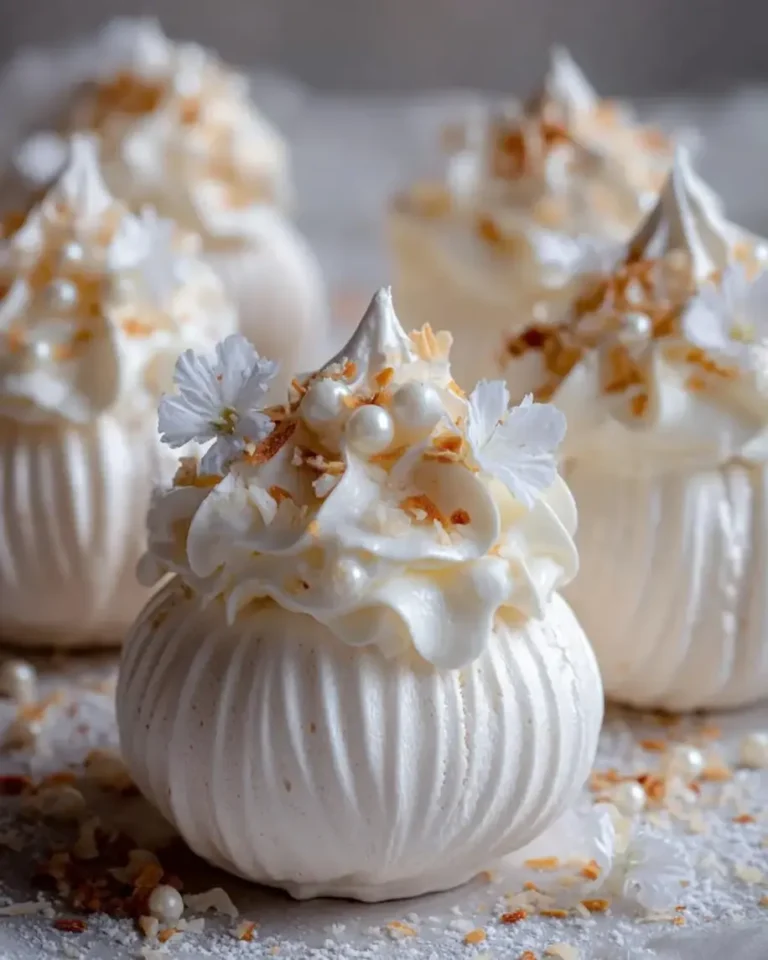
Elegant pavlova spheres with a crispy meringue shell, coconut cream filling, and a shimmering white chocolate pearl glaze.
- Yield: 8 1x
Ingredients
- For the Pavlova Shells:
- 4 large egg whites
- 1 cup granulated sugar
- 1 tsp cornstarch
- 1 tsp white vinegar
- 1 tsp vanilla extract
- Pinch of salt
- For the Coconut Cream Filling:
- 1 cup heavy cream, chilled
- 1/2 cup coconut cream
- 2 tbsp powdered sugar
- 1 tsp vanilla extract
- 1/4 cup toasted shredded coconut
- For the White Chocolate Pearl Glaze:
- 8 oz (225 g) white chocolate, finely chopped
- 1/4 cup heavy cream
- 1 tsp coconut oil
- White pearl luster dust
- For Garnish (optional):
- White chocolate pearls
- Toasted coconut flakes
- Edible white flowers
Instructions
- 1. Preheat the oven to 250°F (120°C) and line two baking trays with parchment paper.
- 2. Beat the egg whites and salt until soft peaks form.
- 3. Gradually add the sugar, beating until stiff, glossy peaks develop.
- 4. Fold in the cornstarch, vinegar, and vanilla.
- 5. Pipe or shape the meringue into 16 half-spheres using silicone dome molds or by hand.
- 6. Bake for 60–70 minutes, then turn off the oven and let the shells cool completely inside.
- 7. Whip the heavy cream, coconut cream, powdered sugar, and vanilla until fluffy. Fold in the toasted coconut.
- 8. Fill half of the pavlova shells with the coconut cream and gently sandwich them together.
- 9. Heat the heavy cream until steaming, then pour it over the white chocolate. Let sit for 2 minutes before stirring smooth. Mix in the coconut oil.
- 10. Cool the glaze slightly and coat each pavlova sphere with a thin, even layer.
- 11. Dust lightly with white pearl luster dust.
- 12. Garnish with white chocolate pearls, toasted coconut flakes, and edible white flowers. Chill for 20 minutes before serving.
Nutrition
- Calories: 345
- Sugar: 31 g
- Fat: 22 g
- Carbohydrates: 34 g
- Protein: 3 g
Tried This Recipe? Leave a Comment!
Did you make this recipe? I’d love to hear how it turned out! Please leave a comment and a rating below. Your feedback helps other home cooks and supports cheerychop.com!
For more delicious inspiration, follow me on Pinterest!