Strawberry Vanilla Cream Pyramids with Mirror Glaze
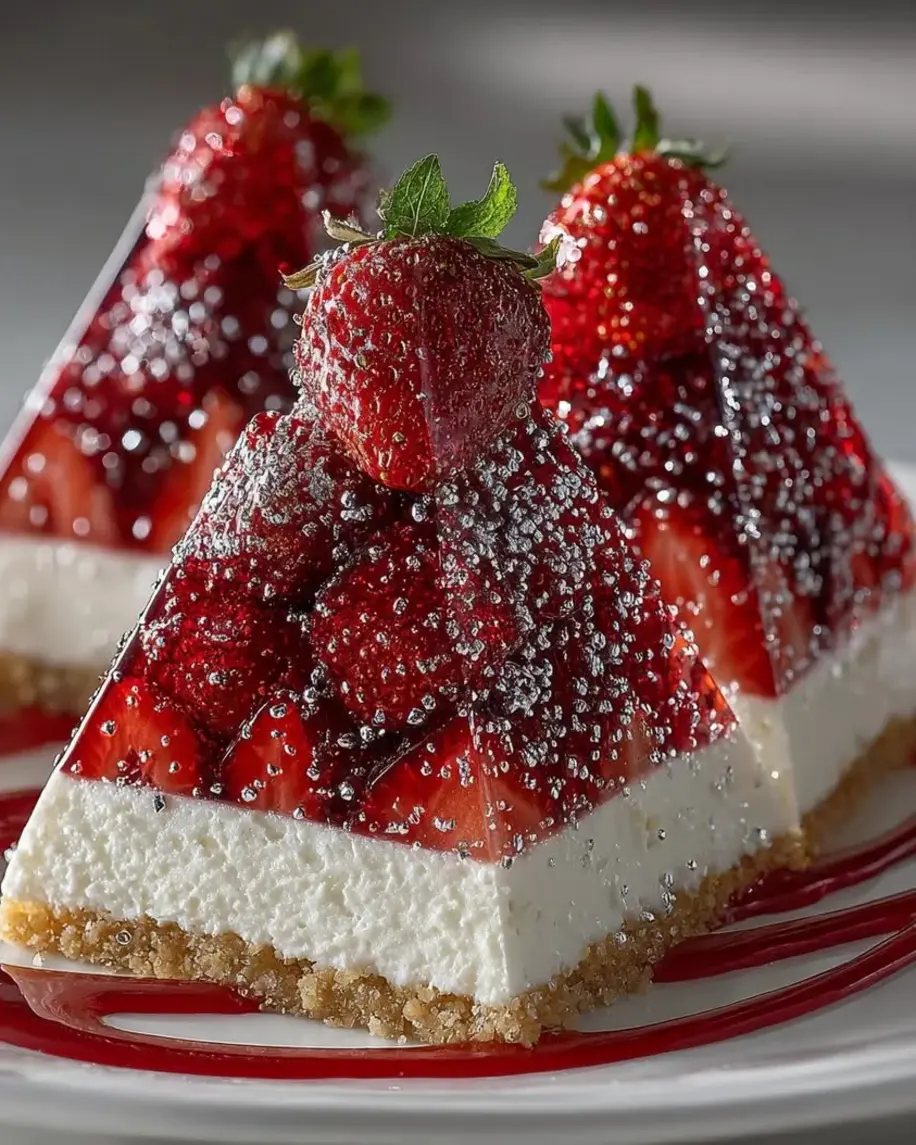
Table of Contents
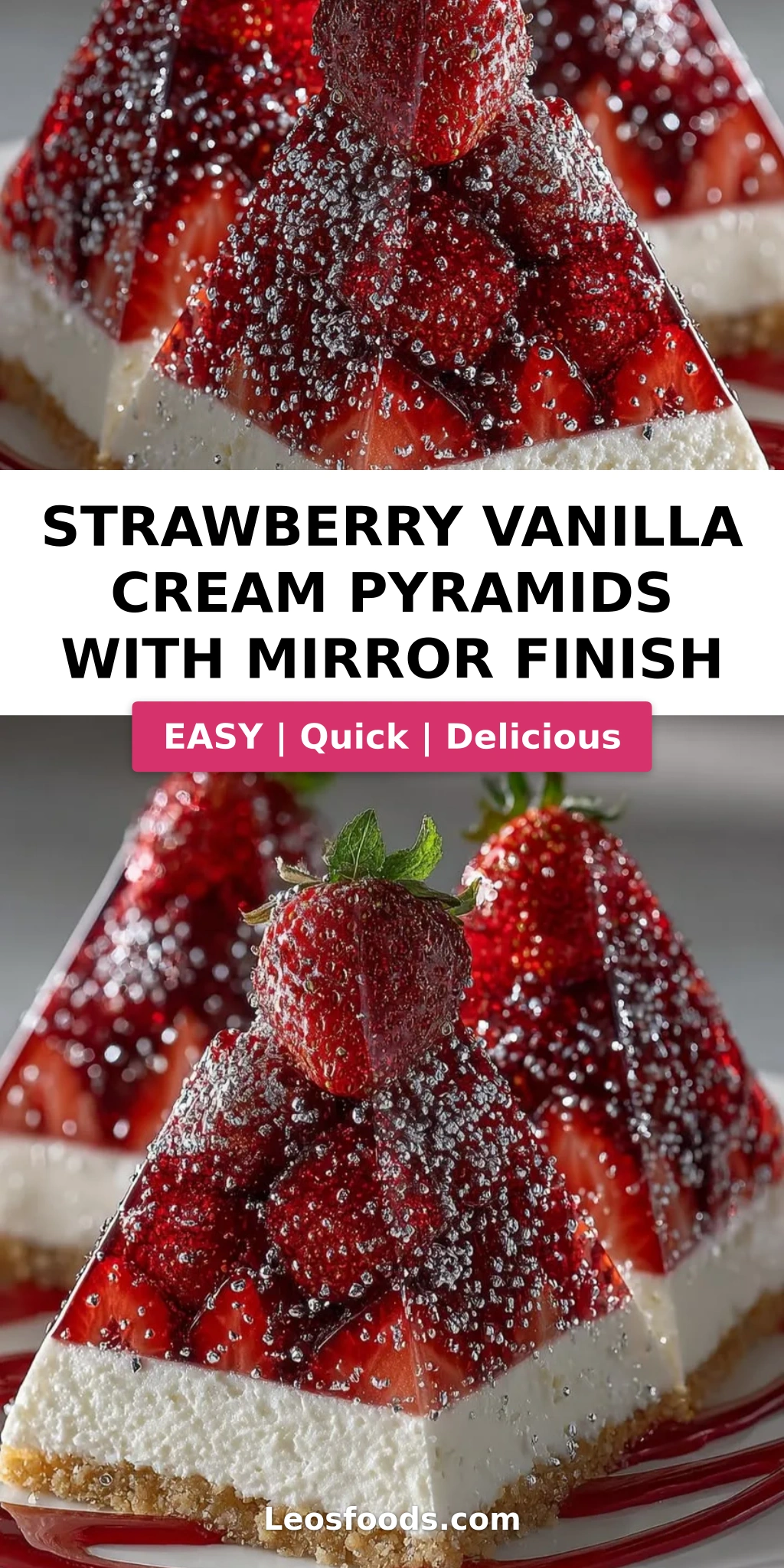
Strawberry Vanilla Cream Pyramids with Mirror Finish – A Stunning Mirror Glaze Dessert
I still remember the first time I saw a mirror glaze cake in a Parisian pâtisserie window. I was twenty-two, fresh out of culinary school, and utterly mesmerized by the way light danced across that flawless ruby surface. It looked like a jewel—untouchable, almost too beautiful to eat. That moment planted a seed in my mind, and years later, after returning to New York and setting up my own kitchen, I knew I had to create a version that felt approachable for home bakers. These strawberry vanilla cream pyramids are the result: a pyramid mousse cake with a hidden strawberry heart, draped in a glossy mirror finish cake glaze that any confident cook can master. The combination of creamy vanilla and bright strawberry is pure nostalgia—like the best berry shortcake you’ve ever had, elevated into something magical.
Let me paint the picture for you. Imagine slicing into a perfectly chilled pyramid: the knife meets the glassy ruby shell with a gentle crack, then glides through a cloud of vanilla cream mousse until it hits a concentrated core of cooked-down strawberries—intensely fruity, a little tart, and beautifully jewel-toned. The mirror glaze itself is silky, sweet, and just firm enough to hold its shape, with a subtle white chocolate richness that balances the tang of the berries. In every bite, you get a textural conversation—smooth, creamy, tender, and bright. It’s the kind of dessert that stops conversation at the table. People lean in. They ask, “How did you do that?” And honestly, with a little patience and a few smart techniques, you can absolutely do it too.
What sets my version apart is the way I build flavor from the inside out. Instead of relying on artificial colors or extracts, I use a real strawberry reduction for the core, vanilla bean paste for those beautiful black specks and deep aroma, and a mirror finish that’s tempered to exactly 90°F for that flawless pour. I’ve tested this recipe a dozen times in my own NYC kitchen—on humid summer days, chilly winter afternoons, and everything in between—so I know exactly where things can go wrong. That’s why I’m sharing every pro tip I’ve learned along the way. 💡 Stella’s Pro Tip: The single most important factor for a perfect mirror glaze is temperature—get it to 90°F and your pour will be glass-smooth every time.
Why This Strawberry Vanilla Cream Pyramids Recipe Is the Best
The Flavor Secret. Growing up in Morocco, my mother always cooked with fruit that was perfectly in season—strawberries in spring meant something special. That memory stayed with me. For the strawberry core, I gently simmer fresh berries with a touch of sugar and lemon juice until they collapse into a concentrated, tangy-sweet compote. This technique intensifies the berry flavor without adding any artificial stuff. Paired with the vanilla bean paste in the cream cheese mousse, the contrast is absolutely sublime. The vanilla isn’t shy—it’s warm, floral, and unmistakably present.
Perfected Texture. I trained in Paris under chefs who drilled precision into every step. That training is why this mousse sets up perfectly every time—not too heavy, not too airy. The key is folding the gelatin into the cream cheese mixture before gently incorporating the whipped cream. You want medium peaks on that cream, not stiff, so the final texture stays light as a cloud. The mirror finish, meanwhile, is a lesson in emulsion. Poured at the right temperature, it clings to the frozen pyramid in a thin, even layer that doesn’t drip or pool. It’s the kind of technique that sounds intimidating but becomes second nature after one successful batch.
Foolproof & Fast. I know what you’re thinking—this looks like a project. But here’s the thing: the hands-on time is only about 45 minutes. The rest is freezer time, which means you can make these a day ahead and pull them out when you’re ready to impress. The steps are logical, the ingredients are straightforward (no weird stabilizers or specialty gums), and I’ve written every instruction with the home cook in mind. If you can make Jell-O and whip cream, you can make these strawberry vanilla cream pyramids. I promise.
Strawberry Vanilla Cream Pyramids Ingredients
Every time I walk through Union Square Greenmarket in spring and see those first flats of locally grown strawberries, I know it’s time to make these pyramids again. There’s something about using fruit that’s at its peak—scented, juicy, and deeply red—that makes the final dessert taste alive. Here’s exactly what you’ll need, broken down by component. Most of these ingredients are pantry staples or easy to find at any well-stocked grocery store.
Ingredients List
For the Vanilla Cream Mousse:
- 1.5 cups heavy cream, chilled
- 8 oz cream cheese, room temperature
- 1/2 cup powdered sugar
- 1 tbsp vanilla bean paste
- 1.5 tsp powdered gelatin
- 2 tbsp cold water (for blooming gelatin)
For the Strawberry Core:
- 1.5 cups fresh strawberries, hulled and chopped
- 2 tbsp granulated sugar
- 1 tsp fresh lemon juice
- 1 tsp powdered gelatin
- 1.5 tbsp cold water (for blooming gelatin)
For the Ruby Red Mirror Finish:
- 1 cup granulated sugar
- 1/2 cup sweetened condensed milk
- 1/2 cup water
- 1 cup white chocolate chips
- 1 tbsp powdered gelatin whisked into 1/4 cup cold water
- 3 drops red gel food coloring
For Garnish:
- 1 tbsp freeze-dried strawberry powder
Ingredient Spotlight
Vanilla Bean Paste. This is my secret weapon for any no-bake dessert. Unlike extract, which can taste sharp and one-dimensional, vanilla bean paste gives you those beautiful specks and a round, floral sweetness that lingers. Look for it near the baking extracts at your grocery store. One tablespoon is all you need. If you must substitute, use 2 teaspoons of pure vanilla extract plus the seeds from half a vanilla pod.
Gelatin. Gelatin is the backbone of both the mousse and the mirror finish. Use powdered gelatin (not sheets, for consistency) and always bloom it in cold water for exactly 5 minutes before dissolving. This ensures it activates evenly and gives you a smooth, lump-free texture. I use Knox brand—it’s reliable and widely available. If you need a vegetarian option, see the FAQ section for agar agar substitutions.
White Chocolate Chips. The mirror glaze gets its silky body from white chocolate. Use high-quality chips or chopped white chocolate bars—avoid “white baking chips” that are often artificially flavored. Ghirardelli or Guittard work beautifully. The chocolate provides sweetness and structure to the glaze, so don’t skimp here.
Freeze-Dried Strawberry Powder. This is my favorite finishing touch. It adds a pop of color, a hit of concentrated strawberry flavor, and a lovely rustic contrast to the glossy glaze. You can find freeze-dried strawberries at Trader Joe’s, Whole Foods, or online. Grind them in a spice grinder or crush them in a bag with a rolling pin.
| Original Ingredient | Best Substitution | Flavor / Texture Impact |
|---|---|---|
| Vanilla bean paste | 2 tsp pure vanilla extract + seeds from 1/2 vanilla pod | Slightly less visual speckle, similar flavor depth |
| Powdered gelatin (standard) | Agar agar powder (see FAQ for ratio) | Firmer set, vegetarian; requires different blooming method |
| White chocolate chips | High-quality chopped white chocolate bar | Smoother melt, richer flavor; avoid “baking chips” |
| Fresh strawberries | Frozen strawberries (thawed and drained) | Slightly softer texture, still good flavor; drain excess liquid |
| Red gel food coloring | Natural red beet powder or pomegranate juice concentrate | Less vibrant color, more earthy flavor; adjust sweetness |
How to Make Strawberry Vanilla Cream Pyramids — Step-by-Step
Take a deep breath and trust the process. I’ve broken everything down into six clear steps, and I’m sharing every visual cue and pro tip I’ve learned from making these dozens of times. You’ve got this.
Step 1: Prepare the Strawberry Core
Sprinkle 1 teaspoon of powdered gelatin over 1.5 tablespoons of cold water in a small bowl. Let it sit undisturbed for 5 minutes to bloom. Meanwhile, combine the chopped strawberries, granulated sugar, and lemon juice in a small saucepan. Bring to a gentle simmer over medium heat and cook for 6 to 8 minutes, stirring occasionally, until the berries have completely broken down into a thick, jammy sauce. Remove from heat and puree with an immersion blender until smooth. Strain through a fine-mesh sieve to remove the seeds—this step is non-negotiable for a silky core. Stir the bloomed gelatin into the warm puree until fully dissolved. Pour into mini silicone molds (half-sphere or small pyramid shapes work beautifully) and freeze for 2 hours, or until rock-solid.
💡 Stella’s Pro Tip: Use a silicone mold with individual cavities for the strawberry cores. Mini muffin molds or ice cube trays work perfectly. Spray them lightly with nonstick spray before filling to make unmolding effortless.
Step 2: Make the Vanilla Mousse
Sprinkle 1.5 teaspoons of powdered gelatin over 2 tablespoons of cold water and let bloom for 5 minutes. Microwave for 10 seconds until the gelatin is completely liquid—don’t overheat. In a large mixing bowl, beat the room-temperature cream cheese, powdered sugar, and vanilla bean paste together until smooth, creamy, and free of lumps. In a separate bowl, whip the chilled heavy cream to medium peaks—the cream should hold its shape but still be soft and pillowy. Working quickly but gently, fold the liquid gelatin into the cream cheese mixture until fully incorporated. Then, in three additions, fold the whipped cream into the cream cheese base. Use a rubber spatula and a gentle hand—you want to keep as much air as possible.
⚠️ Common Mistake to Avoid: Over-whipping the cream. If you whip it to stiff peaks, the mousse will be dense and almost buttery instead of light and airy. Stop at medium peaks—when the cream holds a soft, droopy peak that flops over slightly.
Step 3: Assemble the Pyramids
Spoon the vanilla mousse into six silicone pyramid molds, filling each one about three-quarters full. Take a frozen strawberry core and press it gently into the center of each mold, pushing it down until it’s fully surrounded by mousse. Smooth the remaining mousse over the top to completely encase the core. Tap the molds gently on the counter to release any air bubbles. Freeze the molds flat for at least 6 hours, or overnight, until the pyramids are completely solid. This is crucial—the mousse must be rock-hard before glazing.
💡 Stella’s Pro Tip: Place the filled pyramid molds on a small baking sheet or cutting board before putting them in the freezer. This keeps them perfectly level and makes it easy to move them without disturbing the surface.
Step 4: Prepare the Mirror Finish
Combine the sugar, water, and sweetened condensed milk in a small saucepan over medium heat. Stir gently and bring to a gentle simmer—do not boil vigorously. Remove from heat immediately. Stir the pre-bloomed gelatin (1 tbsp gelatin whisked into 1/4 cup cold water, bloomed for 5 minutes) into the hot liquid until fully dissolved. Pour the hot liquid directly over the white chocolate chips in a heatproof bowl. Let it sit undisturbed for 1 minute, then add 3 drops of red gel food coloring. Using an immersion blender, blend the mixture in a circular motion—keep the blender submerged to avoid incorporating air bubbles. Blend until completely smooth and uniform in color. Strain through a fine-mesh sieve into a clean bowl and let cool until it reaches exactly 90°F (32°C).
⚠️ Common Mistake to Avoid: Air bubbles in the glaze are the enemy of a perfect mirror finish. When using the immersion blender, always keep the blade fully submerged and tilt the bowl slightly to avoid sucking in air. If bubbles do form, let the glaze rest for a minute and gently tap the bowl on the counter to bring them to the surface.
Step 5: Unmold the Pyramids
Remove the frozen pyramids from the freezer. If you’re using silicone molds, gently flex the sides and bottom of each cavity to release the pyramid. If it sticks, let it sit at room temperature for 30 seconds and try again. Place each unmolded pyramid onto a wire rack set over a parchment-lined baking sheet. The wire rack allows the excess glaze to drip off cleanly. Space the pyramids at least 2 inches apart so the glaze can flow freely around each one.
💡 Stella’s Pro Tip: Work quickly when unmolding. The pyramids need to be completely frozen when the glaze hits them—if they start to soften, the glaze won’t adhere properly and will slide right off.
Step 6: Glaze and Serve
Check that your mirror finish is at exactly 90°F. Pour the glaze steadily over the apex of each frozen pyramid, starting from the top and letting it flow naturally down all four sides. The glaze should cover the pyramid in one smooth, continuous pour. Let the glaze set for 5 minutes on the wire rack. Use a small offset spatula or your finger to carefully trim any drips from the bottom edges. Transfer each glazed pyramid to a serving plate. Lightly dust the bottom edges with freeze-dried strawberry powder using a small fine-mesh sieve. Refrigerate for 30 minutes to allow the pyramids to thaw completely before serving.
⚠️ Common Mistake to Avoid: Pouring the glaze too slowly or stopping mid-pour. You need one confident, continuous stream from the apex. If you hesitate, you’ll get uneven coverage and visible lines. Practice your pouring motion over the sink first if you’re nervous.
| Step | Action | Duration | Key Visual Cue |
|---|---|---|---|
| 1 | Prepare strawberry core | 15 mins active + 2 hrs freeze | Puree is thick, jammy, seedless; cores are solid |
| 2 | Make vanilla mousse | 15 mins | Cream is at medium peaks, mousse is light and fluffy |
| 3 | Assemble pyramids | 10 mins + 6 hrs freeze | Pyramids are rock-solid, no soft spots |
| 4 | Prepare mirror finish | 15 mins + cooling to 90°F | Glaze is smooth, glossy, no air bubbles |
| 5 | Unmold pyramids | 5 mins | Pyramids release cleanly from molds |
| 6 | Glaze and serve | 10 mins + 30 mins thaw | Glaze covers evenly, surface is mirror-like |
Serving & Presentation
These strawberry vanilla cream pyramids are showstoppers on any table, but a few thoughtful touches elevate them even further. I like to serve each pyramid on a chilled white plate with a small quenelle of lightly sweetened whipped cream or a scoop of vanilla bean ice cream on the side. The cool creaminess echoes the mousse inside and gives guests something to dip into. For a Moroccan-inspired twist, sprinkle a tiny pinch of ground cardamom over the whipped cream—it pairs beautifully with both strawberry and vanilla.
When it comes to garnishing, less is more. The mirror glaze is already dramatic, so let it shine. A light dusting of freeze-dried strawberry powder at the base adds color and a concentrated berry note without overwhelming the visual. A few fresh mint leaves or tiny edible flowers (pansies or violets) placed at the base of each pyramid add a touch of elegance. If you’re serving these for a special occasion like Valentine’s Day or a birthday brunch, arrange them on a stand with fresh strawberries scattered around the base.
In my New York kitchen, I’ve served these at dinner parties where guests literally gasped when I brought them out. The combination of the ruby red gloss against the creamy white plate, the geometric pyramid shape, and the promise of that hidden strawberry core—it’s pure theater. And the best part? You can prepare everything a day ahead, so when it’s time to serve, all you have to do is glaze, garnish, and bask in the compliments.
| Pairing Type | Suggestions | Why It Works |
|---|---|---|
| Side | Lightly sweetened whipped cream, vanilla ice cream | Adds cool creaminess that echoes the mousse, no flavor competition |
| Sauce / Dip | Warm berry coulis, chocolate fudge sauce | Introduces a temperature contrast and extra fruit or chocolate layer |
| Beverage | Champagne, rosé, espresso, mint tea | Bubbles cut richness; coffee adds bitter contrast; mint tea nods to Moroccan roots |
| Garnish | Freeze-dried strawberry dust, fresh mint, edible flowers, gold leaf | Adds color, texture, and a touch of elegance without overpowering |
Make-Ahead, Storage & Reheating
One of the best things about this recipe is how well it fits into a busy schedule. In my NYC life, I’m all about smart preparation—making components ahead so the final assembly is a breeze. Here’s exactly how to store each element, along with my tested timelines for make-ahead success.
| Method | Container | Duration | Reheating / Thawing Tip |
|---|---|---|---|
| Refrigerator (glazed, thawed) | Airtight container, single layer | Up to 2 days | Serve chilled; do not reheat |
| Freezer (unglazed, frozen) | Sealed freezer bag or container | Up to 1 month | Glaze directly from frozen, then thaw 30 mins in fridge |
| Make-Ahead (cores) | Freezer bag or container | Up to 2 weeks | Use directly from frozen when assembling mousse |
My favorite make-ahead strategy is to prepare the strawberry cores and freeze them solid up to two weeks in advance. Then, the day before I plan to serve, I make the mousse, assemble the pyramids, and freeze them overnight. The next day, I prepare the mirror finish, glaze, and serve. This breaks the work into manageable chunks and means I’m never scrambling on the day of a party. If you have leftover glazed pyramids, store them in the refrigerator for up to two days—the glaze will stay glossy and the mousse will remain creamy. Do not refreeze once glazed, as the texture of the glaze may become cloudy.
Variations & Easy Swaps
One of the things I love most about this recipe is how versatile it is. Over the years, I’ve experimented with different fruit cores, flavor infusions, and even a dairy-free version for friends with restrictions. Here are three of my favorite variations, each tested in my kitchen and ready for yours.
| Variation | Key Change | Best For | Difficulty Impact |
|---|---|---|---|
| Raspberry-Rose Core | Replace strawberries with raspberries + 1 tsp rose water | Romantic occasions, Valentine’s Day | Same difficulty level |
| Dairy-Free / Vegan | Use coconut cream + vegan cream cheese + agar agar | Dairy-free and vegan diets | Slightly more advanced |
| Mango-Passion Fruit | Replace strawberry core with mango + passion fruit puree | Summer entertaining, tropical flavor lovers | Same difficulty level |
Variation 1: Raspberry-Rose Core
For a romantic twist, swap the strawberries for an equal amount of fresh or frozen raspberries. Cook them down with sugar and lemon juice just as you would the strawberries, then stir in 1 teaspoon of rose water after straining. The floral notes pair beautifully with the vanilla mousse and create a gorgeous deep pink core. This version is especially lovely for Valentine’s Day or a bridal shower. I like to garnish with a tiny dried rose petal on top of each pyramid for an extra touch of elegance.
Variation 2: Dairy-Free / Vegan
I developed this version for a friend’s dairy-free birthday, and it turned out surprisingly well. Replace the heavy cream with full-fat coconut cream (chilled overnight and whipped to medium peaks), and use a high-quality vegan cream cheese. For the gelatin, substitute with agar agar powder: use 1 teaspoon agar agar powder bloomed in 2 tablespoons water for the mousse, and 2 teaspoons agar agar in 1/4 cup water for the mirror finish. The texture will be slightly firmer than the original, and the coconut adds a subtle tropical note that pairs nicely with strawberry. The mirror finish will be a bit more delicate, so work quickly.
Variation 3: Mango-Passion Fruit
When summer hits and the farmers market is overflowing with mangoes, this is my go-to swap. Use 1.5 cups of chopped ripe mango in place of the strawberries, and add 2 tablespoons of passion fruit pulp (fresh or frozen) along with the sugar and lemon juice. The tropical tartness cuts through the creamy vanilla mousse beautifully. For the glaze, switch to a yellow or orange gel food coloring and garnish with a light dusting of freeze-dried mango powder. It’s bright, sunny, and absolutely delicious.
What is the best way to achieve a smooth mirror glaze for strawberry vanilla cream pyramids?
The key to a perfectly smooth mirror glaze is temperature control and proper blending. First, make sure your gelatin is fully bloomed and dissolved—no undissolved granules allowed. When you use the immersion blender, keep the blade fully submerged and move it in a circular motion to avoid incorporating air bubbles. Strain the glaze through a fine-mesh sieve before cooling. Most importantly, let the glaze cool to exactly 90°F (32°C) before pouring. A digital thermometer is your best friend here. If the glaze is too warm, it will run off the frozen pyramid and leave thin spots; if it’s too cool, it will thicken and won’t self-level into that glassy finish. I always test the temperature at multiple points in the bowl to make sure it’s even.
Can I use frozen strawberries for the vanilla cream filling in this dessert?
Yes, you can absolutely use frozen strawberries for the strawberry core, and I’ve done it many times when fresh berries aren’t in season. The key is to thaw them completely first, then drain off any excess liquid before cooking. Frozen berries release more water than fresh, so you may need to simmer the mixture a few minutes longer to achieve the same thick, jammy consistency. I recommend reducing the added water in the recipe by half if using frozen strawberries. The flavor will still be bright and delicious—just make sure to strain the puree thoroughly to remove any seeds. One advantage of frozen berries is that they’re often picked at peak ripeness, so the flavor can actually be more intense than off-season fresh berries.
How long do strawberry vanilla cream pyramids need to set in the refrigerator before serving?
After glazing, the pyramids need just 30 minutes in the refrigerator to thaw from their frozen state to a perfectly creamy, sliceable texture. This is one of the most common questions I get, and the answer is surprisingly short! The pyramids are frozen solid when you pour the glaze over them, so they need time to soften. Thirty minutes at 35-40°F yields a mousse that’s cold, creamy, and holds its shape beautifully when sliced. If you leave them in the fridge longer—up to 2 days—they’ll stay perfectly delicious, but the texture will continue to soften. I don’t recommend serving them fully frozen, as the mousse will be icy and the glaze may crack when you cut into it.
What can I use as a substitute for gelatin in the mirror finish for a vegetarian version?
For a vegetarian mirror finish, agar agar powder is your best substitute. Use 2 teaspoons of agar agar powder bloomed in 1/4 cup of cold water for the mirror finish (instead of 1 tbsp gelatin). The method is slightly different: after blooming, bring the agar agar mixture to a full boil for 2 minutes while stirring constantly—this activates it properly. Then proceed with the recipe as written. Keep in mind that agar agar sets more firmly and at a higher temperature than gelatin, so you’ll need to work a bit faster when pouring the glaze. The finish will be slightly less glossy than the gelatin version, but still beautiful. I recommend practicing with a small test batch first if you’re new to working with agar agar.
Can I make strawberry vanilla cream pyramids without a thermometer?
I strongly recommend using a digital thermometer for the mirror glaze—it’s the most reliable way to know when the glaze has reached that perfect 90°F pouring temperature. However, if you don’t have one, you can use the “touch test”: dip a clean finger into the glaze and touch it to your inner wrist. It should feel cool but not cold—like lukewarm bath water. Another visual cue: the glaze should be fluid enough that it runs smoothly off a spatula but thick enough that it coats the spatula in a thin, even layer. That said, a good instant-read thermometer is a worthwhile investment for this recipe and will save you from guessing. They’re widely available for under $15.
How do I prevent air bubbles in my mirror glaze?
Air bubbles are the most common frustration with mirror glazes, but they’re easy to avoid with a few simple techniques. First, when using an immersion blender, always keep the blade fully submerged and tilt the bowl slightly to avoid sucking air into the mixture. Blend in a slow, circular motion rather than up and down. After blending, let the glaze rest for 2-3 minutes—any bubbles that formed will rise to the surface. You can gently tap the bowl on the counter to encourage them to pop. Finally, always strain the cooled glaze through a fine-mesh sieve into your pouring vessel. This catches any remaining bubbles and ensures a perfectly smooth pour. If you see small bubbles on the surface of your glazed pyramids, you can gently pass a kitchen torch over them or use a toothpick to pop them.
Can I use a different shape mold for this strawberry vanilla mousse dessert?
Absolutely! While the pyramid shape is dramatic and beautiful, this recipe works wonderfully with other mold shapes. You can use dome molds (like hemisphere or half-sphere molds) for a classic entremets look, rectangular loaf pans for a sliceable cake, or even individual silicone muffin cups for a simpler presentation. Just keep in mind that the mirror glaze is designed to flow over a curved or angled surface, so shapes with sharp edges (like cubes) may require a slightly thicker glaze. If using a different shape, adjust the freezing time based on the volume of the mold—thicker shapes need more time to freeze solid. The baking time and instructions remain the same.
How do I store leftover mirror glaze and can I reuse it?
You can store leftover mirror glaze in an airtight container in the refrigerator for up to one week. When you’re ready to reuse it, gently reheat it in a double boiler or in short bursts in the microwave (10-15 seconds at a time, stirring between each) until it reaches 90°F again. You may need to add a teaspoon of warm water to thin it out if it has thickened during storage. Re-blend with the immersion blender to re-emulsify and strain again before using. I find that the glaze can be reheated once or twice successfully, but after that, the texture starts to degrade. It’s best to make exactly the amount you need for the number of pyramids you’re glazing—this recipe yields just enough for 6 pyramids with minimal waste.
Why did my mirror glaze crack or peel off the pyramid?
Cracking or peeling is usually caused by one of three issues. The first is temperature shock: if the glaze is too warm (above 95°F) and the pyramid is too cold, the rapid temperature change can cause the glaze to crack as it contracts. Always cool your glaze to exactly 90°F. The second issue is an uneven or rough surface on the frozen mousse—if the mousse isn’t smooth, the glaze won’t adhere evenly. Make sure your molds are smooth and that you tap out any air bubbles before freezing. The third issue is applying the glaze to a pyramid that’s not fully frozen. If the mousse has started to thaw, it will create a layer of condensation that prevents the glaze from sticking. Make sure your pyramids are rock-solid before glazing.
Can I add alcohol to the strawberry core or the mousse?
Yes, a small amount of alcohol can add a lovely adult twist to these pyramids. For the strawberry core, try adding 1 tablespoon of strawberry liqueur, framboise, or even a dry rosé wine to the strawberry mixture after pureeing—just stir it in before freezing. For the vanilla mousse, 1 to 2 tablespoons of a good-quality vanilla vodka or a light rum can be folded in along with the vanilla bean paste. Keep in mind that alcohol lowers the freezing point, so if you add more than 2 tablespoons, the mousse may take longer to freeze solid and may be slightly softer in texture. I’ve tested this with up to 1.5 tablespoons of framboise in the core and it worked beautifully—the flavor was subtle but noticeable, and the texture was unaffected.
Share Your Version!
I absolutely love hearing from you—there’s nothing that makes my day quite like seeing photos of these strawberry vanilla cream pyramids in your own kitchen. Every time someone tags me in their creation, I remember why I started this blog: to share the joy of cooking that my mother gave me, the precision I learned in Paris, and the bold, creative energy of New York that keeps me experimenting. So please, leave a star rating and comment below—tell me how your glaze poured, what variation you tried, or even what you’d add next time. Your questions and stories inspire the recipes I develop next.
Snap a photo of your finished pyramids and share it on Instagram or Pinterest with the hashtag #StellasKitchen and tag @leosfoods. I personally read every comment and love to feature my readers’ creations on my stories. If you’re stuck on a step, just ask—I’m always here to help. And if you’re looking for more mirror glaze inspiration, check out my Chocolate Raspberry Mirror Dome or our Lemon Passion Fruit Entremets. From my NYC kitchen to yours — I hope this recipe brings as much warmth to your table as it does to mine. — Stella 🧡
Love This Recipe? Save It to Pinterest!
If you enjoyed this Strawberry Vanilla Cream Pyramids recipe, don’t let it get lost in your browser tabs! 😄 Pin it now so you can find it again anytime — and explore hundreds more tried-and-tested recipes waiting for you on my Pinterest boards.
👉 Follow Stella on Pinterest @stellarecipeblog
📌 Pin this recipe · 🔁 Re-pin your favorites · 💬 Tag me when you make it — I love seeing your creations!
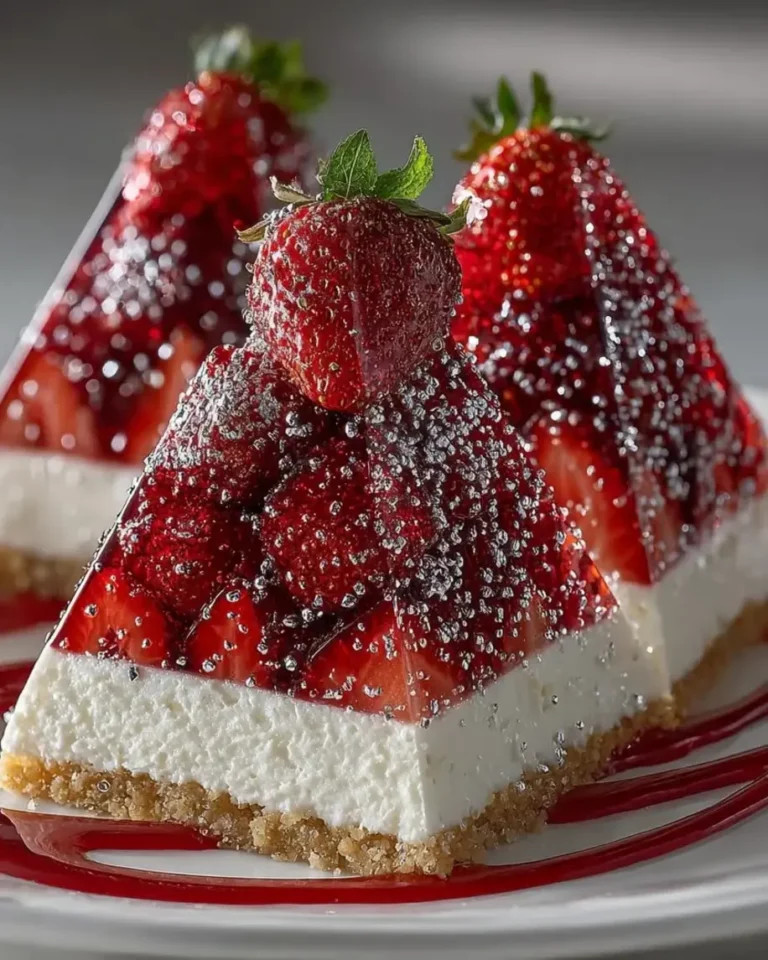
Strawberry Vanilla Cream Pyramids with Mirror Finish
A stunning dessert featuring a vanilla cream mousse pyramid with a strawberry core, covered in a ruby red mirror glaze and dusted with freeze-dried strawberry powder.
- Yield: 6 1x
Ingredients
- For the Vanilla Cream Mousse:
- 1.5 cups heavy cream, chilled
- 8 oz cream cheese, room temperature
- 1/2 cup powdered sugar
- 1 tbsp vanilla bean paste
- 1.5 tsp powdered gelatin
- 2 tbsp cold water
- For the Strawberry Core:
- 1.5 cups fresh strawberries, hulled and chopped
- 2 tbsp granulated sugar
- 1 tsp fresh lemon juice
- 1 tsp powdered gelatin
- 1.5 tbsp cold water
- For the Ruby Red Mirror Finish:
- 1 cup granulated sugar
- 1/2 cup sweetened condensed milk
- 1/2 cup water
- 1 cup white chocolate chips
- 1 tbsp powdered gelatin whisked into 1/4 cup cold water
- 3 drops red gel food coloring
- For Garnish:
- 1 tbsp freeze-dried strawberry powder
Instructions
- 1. Prepare the strawberry core. Sprinkle 1 teaspoon of gelatin over 1.5 tablespoons of cold water and let bloom for 5 minutes. In a small saucepan, simmer the chopped strawberries, granulated sugar, and lemon juice over medium heat for 6 to 8 minutes until the berries break down completely. Puree the mixture with an immersion blender, then strain through a fine-mesh sieve to remove seeds. Stir the bloomed gelatin into the warm strawberry puree until completely dissolved. Pour into mini silicone molds and freeze for 2 hours until solid.
- 2. Make the vanilla mousse. Sprinkle 1.5 teaspoons of gelatin over 2 tablespoons of cold water and let bloom for 5 minutes, then microwave for 10 seconds until liquid. In a large bowl, beat the cream cheese, powdered sugar, and vanilla bean paste until smooth and creamy. In a separate bowl, whip the heavy cream to medium peaks. Fold the liquid gelatin into the cream cheese mixture, then gently fold in the whipped cream.
- 3. Assemble the pyramids by spooning the vanilla mousse into six silicone pyramid molds, filling them three-quarters full. Press a frozen strawberry core insert into the center of each mold, smoothing the remaining mousse over the base. Freeze the molds flat for at least 6 hours, or overnight, until rock-solid.
- 4. Prepare the mirror finish. Combine the sugar, water, and condensed milk in a small saucepan over medium heat and bring to a gentle simmer. Remove from the heat, stir in the bloomed gelatin until fully dissolved, then pour the hot liquid directly over the white chocolate chips. Let sit for 1 minute, add the red gel coloring, and blend with an immersion blender until perfectly smooth. Strain through a fine-mesh sieve and let cool until it reaches 90°F (32°C).
- 5. Unmold the frozen pyramid cakes and place them onto a wire rack set over a parchment-lined baking sheet.
- 6. Pour the warm red mirror finish steadily over the apex of each frozen pyramid, allowing it to flow down and cover all sides evenly. Let the glaze set for 5 minutes, carefully trim any drips from the bottom edges, and transfer to serving plates. Dust the bottom edges lightly with freeze-dried strawberry powder and refrigerate for 30 minutes to thaw completely before serving.
Nutrition
- Calories: 460
- Sugar: 40g
- Fat: 29g
- Carbohydrates: 43g
- Protein: 6g
Tried This Recipe? Leave a Comment!
Did you make this recipe? I’d love to hear how it turned out! Please leave a comment and a rating below. Your feedback helps other home cooks and supports cheerychop.com!
For more delicious inspiration, follow me on Pinterest!